• Fri frakt över 249 kr
  • •
  • Snabba leveranser
  • •
  • Billiga böcker
Kundservice

Du är på sajten för privatpersoner.

Företag, bibliotek eller offentlig verksamhet?

Du handlar på classic.bokus.com, där alla dina funktioner finns intakta.
Till classic.bokus.com
Bokus logotyp. Gå till startsidan.
  • Erbjudanden
  • Nyheter
  • Student
  • Topplistor
  • Barn & ungdom
  • Bokus Play
  • E-böcker
  • Pocketböcker
  • Spel & pussel

10% studentrabatt med kod TERM26

Sidfot

Mina sidor

    Hjälp

    • Kundservice
    • Vanliga frågor och svar
    • Frakt och leverans
    • Retur vid ångerrätt
    • Reklamera vara
    • Betalning
    • Köpvillkor
    • Allmänna villkor
    • Information om webbplatsens tillgänglighet

    Om Bokus

    • Om oss
    • Pressrum
    • För studenter
    • För företag
    • För bibliotek och offentlig verksamhet
    • För leverantörer
    • Hållbarhet

    Populärt

    • Aktuella erbjudanden
    • Presentkort
    • Studentlitteratur
    • Nya böcker
    • Topplistor
    • Signerade böcker
    • Engelska böcker

    Inspiration

    • Boktips
    • BookTok
    • Populära bokserier
    • Barnbokskaraktärer
    • Populära författare
    Logotyp för Bokus
    Följ oss på Facebook (extern länk)Följ oss på Instagram (extern länk)Följ oss på YouTube (extern länk)Följ oss på TikTok (extern länk)
    bokus @ CookiesAnpassa cookiesIntegritetspolicyKöpvillkor
    Till Citymail hemsida (extern länk)Till Budbee hemsida (extern länk)Till Postnord hemsida (extern länk)Till Schenker hemsida (extern länk)Till Early Bird hemsida (extern länk)Till Walleys hemsida (extern länk)
    1. Djur och Natur
    2. Naturböcker
    3. Växtböcker

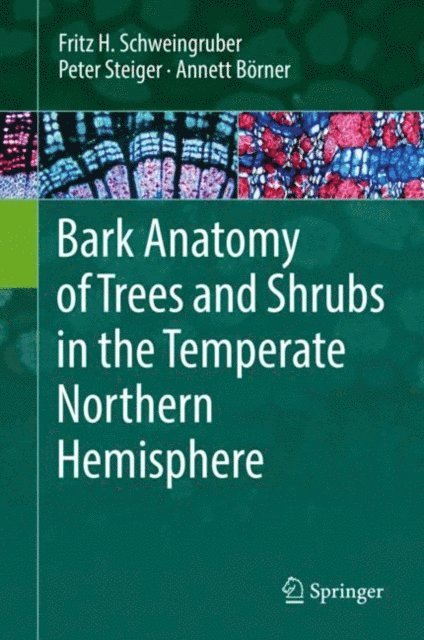
    Bark Anatomy of Trees and Shrubs in the Temperate Northern Hemisphere

    AvFritz H. Schweingruber,Peter Steiger

    Inbunden, Engelska, 2019

    1 960 kr

    Beställningsvara. Skickas inom 10-15 vardagar. Fri frakt över 249 kr.

    Beskrivning

    This book presents the microscopic and macroscopic bark structure of more than 180 different tree and shrub species from Europe, Asia and North America. It is the first compendium to demonstrate the anatomical variability in bark since almost 70 years (Holdheide 1951). The introductory chapter explains with high-quality microphotographs the anatomical traits most important for identification and ecological interpretation of barks, and the monographic part demonstrates in text and pictures the species-specific patterns. The species treatments are grouped by their main biomes. Each species description first characterizes the macroscopic aspects with its main form, features and habitat with text and pictures of the whole plant and the barks in a young and old stage. This is followed by the microscopical description of each species. The microscopic photographs are based on double-stained slides, revealing the quality and distribution of unlignified and lignified tissues in low and highmagnification.The book fills a scientific gap: Archeologists and soil scientists want to identify prehistoric and historical remnants. Ecophysiologists are interested in the distribution of conducting and non-conducting tissues in the phloem and xylem along the stem axis and the internal longevity of cells. Ecologists get information about internal defense mechanisms and technologists are enabled to recognize indicators relevant in biophysics and technology.

    Produktinformation

    • Utgivningsdatum:2019-07-15
    • Mått:155 x 235 x 26 mm
    • Vikt:836 g
    • Format:Inbunden
    • Språk:Engelska
    • Antal sidor:394
    • Förlag:Springer Nature Switzerland AG
    • ISBN:9783030140557

    Utforska kategorier

    • Växtböcker inom Djur och Natur
    • Botanik inom Naturvetenskap och teknik
    • Miljövetenskap och miljöpolitik inom Naturvetenskap och teknik

    Mer om författaren

    Fritz Hans SchweingruberAfter studying at the University of Bern, Switzerland, and pursuing postdoctoral research under Hal Fritts in Tucson, Arizona, he taught wood anatomy and dendrochronology at the University of Basel for 26 years. At the same time he was leader of the research group Tree Rings and Environment at the Swiss Federal Institute of Forest, Snow and Landscape in Birmensdorf, where he set up the Northern Hemispheric Dendroclimatological Densitometric Network and published wood anatomical books for Europe, Russia and the Sahara. In 1986 he founded the International Dendroecological Field Week and in 2001 the International Dendroanatomical Weeks. Since retirement, he has focused on the anatomy of herbs and dwarf shrubs. Peter SteigerHas a master’s degree in landscape architecture from the Technische Hochschule Hannover. As an independent landscape architect with a strong interest in plant-ecology, he creates private and public gardens, mainly using native plants. He is the author of the book Wälder der Schweiz (4th edition 2010), on the Swiss forest communities. He is also a co-author of the Swiss National Forest-reserve Concept, the red list of Swiss forest communities and forest experts for the research-group Phytosuisse describing all the plant communities of Switzerland. His second book, Esche, Espe oder Erle? - Pflanzenportraits aller wildwachsenden Gehölze Mitteleuropas (2nd edition 2016) is a comprehensive encyclopedia of all native Central European trees and shrubs. Working also as a naturalist guide for British Greentours, he visits and illustrates plant biomes all over the world.  Annett BörnerAnnett Börner studied geo-ecology at the University of Bayreuth, Germany, and has a special interest in plant ecology. She has been working in the field of scientific publishing and science communication for more than 15 years, and her clients include a number of major research institutes in Europe and Australia. Annett lives in Adelaide, Australia.

    Recensioner i media

    “The intended audience includes a very wide range of readers. Scientists and professionals of various disciplines from archaeology to ecophysiology, soils science to plant ecology will benefit from the book. ... The reader will appreciate the plant descriptions and photographs, which help to link the microscopic views to the scale at which we may have known the plants in our hikes and, in some cases, in our gardens.” (Alan Crivellaro, Plant Science Bulletin, Vol. 66 (2), 2020)

    Innehållsförteckning

    • Introduction.- The Boreal Taiga.- Subalpine and Subarctic Dwarf Shrubs.- Mountain Ranges in Eurasia.- Deciduous Forest of Temperate Europe.- Deciduous Forest of Submediterranean Europe.- Deciduous Forest of Eastern Asia.- Deciduous Forest of Eastern North America.- Coniferous Forest of Pacific North America.- Mediterranean Hard-Leaved Forest.