• Fri frakt över 249 kr
  • •
  • Snabba leveranser
  • •
  • Billiga böcker
Kundservice

Du är på sajten för privatpersoner.

Företag, bibliotek eller offentlig verksamhet?

Du handlar på classic.bokus.com, där alla dina funktioner finns intakta.
Till classic.bokus.com
Bokus logotyp. Gå till startsidan.
  • Erbjudanden
  • Nyheter
  • Student
  • Topplistor
  • Barn & ungdom
  • Bokus Play
  • E-böcker
  • Pocketböcker
  • Spel & pussel

10% rabatt på allt med kod: NYSTART10 →

Sidfot

Mina sidor

    Hjälp

    • Kundservice
    • Vanliga frågor och svar
    • Frakt och leverans
    • Retur vid ångerrätt
    • Reklamera vara
    • Betalning
    • Köpvillkor
    • Allmänna villkor
    • Information om webbplatsens tillgänglighet

    Om Bokus

    • Om oss
    • Pressrum
    • För studenter
    • För företag
    • För bibliotek och offentlig verksamhet
    • För leverantörer
    • Hållbarhet

    Populärt

    • Aktuella erbjudanden
    • Presentkort
    • Studentlitteratur
    • Nya böcker
    • Topplistor
    • Signerade böcker
    • Engelska böcker

    Inspiration

    • Boktips
    • BookTok
    • Populära bokserier
    • Barnbokskaraktärer
    • Populära författare
    Logotyp för Bokus
    Följ oss på Facebook (extern länk)Följ oss på Instagram (extern länk)Följ oss på YouTube (extern länk)Följ oss på TikTok (extern länk)
    bokus @ CookiesAnpassa cookiesIntegritetspolicyKöpvillkor
    Till Citymail hemsida (extern länk)Till Budbee hemsida (extern länk)Till Postnord hemsida (extern länk)Till Schenker hemsida (extern länk)Till Early Bird hemsida (extern länk)Till Walleys hemsida (extern länk)
    1. Naturvetenskap och teknik
    2. Geovetenskap
    3. Geovetenskap

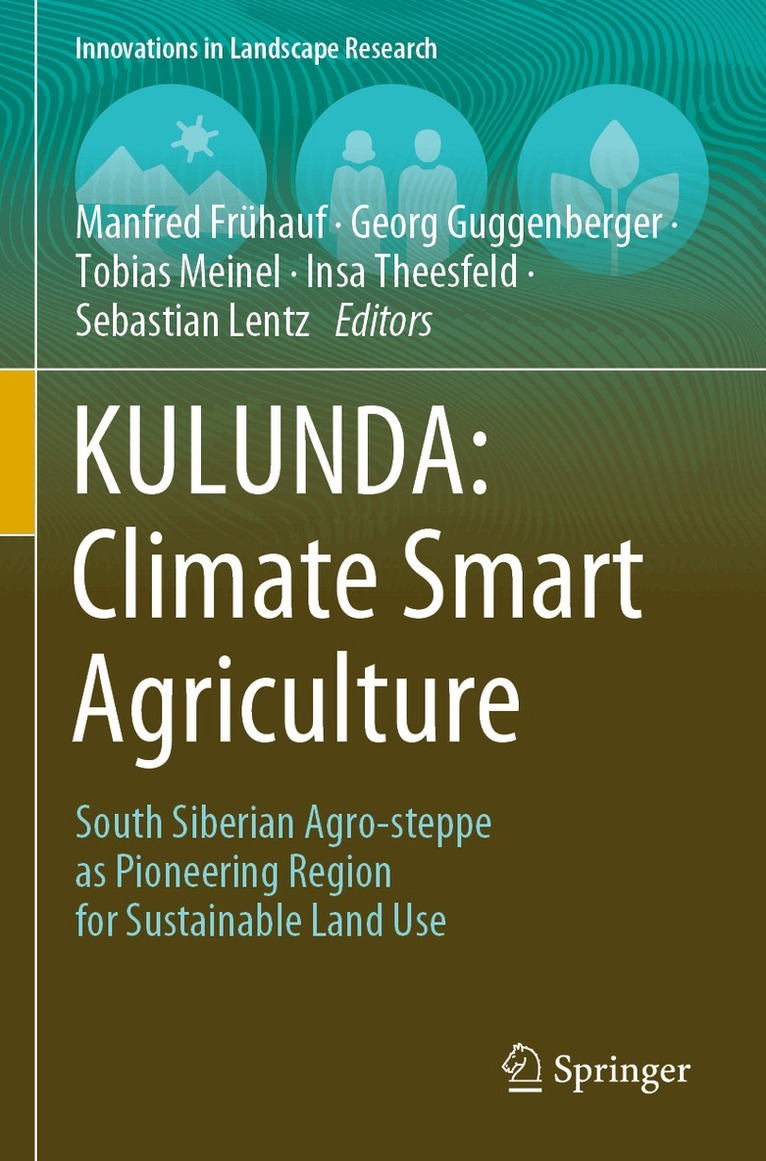
    KULUNDA: Climate Smart Agriculture

    South Siberian Agro-steppe as Pioneering Region for Sustainable Land Use

    AvManfred Frühauf,Georg Guggenberger

    Häftad, Engelska, 2020

    Del i serien Innovations in Landscape Research

    1 086 kr

    Beställningsvara. Skickas inom 10-15 vardagar. Fri frakt över 249 kr.

    Beskrivning

    This book focuses on a representative example and one of the world’s largest steppe conversions, and provides a detailed overview of the results of the BMBF-funded research project KULUNDA. As part of the Siberian virgin land policy, the Kulunda steppe was transformed into agricultural land from 1954 to 1965.   In the course of the project, a multidisciplinary research team conducted a natural, social-economic and agro-scientific cause-and-effect analysis of (agro-)ecosystem destabilisation, as well as various field trials covering tillage and crop rotation options in their socio-economic context. The ecologically and economically sound findings offer strategies for combining climate smart land utilization, ecosystem restoration and sustainable regional development, and can readily be applied to other virgin land conversion efforts. In addition, the findings on the Eurasian steppes will expand the current conversion literature, which mainly consists of the ‘Dust Bowl’ literature of the North American plains. Given its scope, the book will appeal to scientists, professionals, and students in the environmental, geo- and climate sciences.

    Produktinformation

    • Utgivningsdatum:2020-10-31
    • Mått:155 x 235 x 30 mm
    • Vikt:820 g
    • Format:Häftad
    • Språk:Engelska
    • Serie:Innovations in Landscape Research
    • Antal sidor:522
    • Förlag:Springer Nature Switzerland AG
    • ISBN:9783030159290

    Utforska kategorier

    • Geovetenskap inom Naturvetenskap och teknik
    • Miljövetenskap och miljöpolitik inom Naturvetenskap och teknik
    • Lantbruksteknik inom Naturvetenskap och teknik

    Mer om författaren

    Prof. Dr.h.c.mult. Manfred Frühauf began his academic career by studying geography. In 1993 he was offered the Professorship (chair) of Geoecology at the Martin Luther University in Halle-Wittenberg, Germany. In the following years his research focused on Environmental Geography; Urban Ecology, Geomorphology and Climate Change. But his main research interest was in investigating the impacts of land-use change as well as climate change on soil degradation, especially in the steppe regions of Russia and Kazakhstan. Until his retirement in autumn 2017 he served several terms as director of the Institute of Geosciences and Geography and as dean of the faculty. In recognition of his achievements in the development of cooperation in research and teaching, he has been awarded honorary doctorates by three Russian universities. Professor Frühauf passed away shortly after completing this book.   Prof. Dr. Georg Guggenbergeris Acting Director of the Institute of Soil Science at the Leibniz University of Hannover, Germany. His focus is on biogeochemical processes of carbon and nutrient cycling within the soil and its response and feedback to external drivers such as climate change and land-use change. He has published nearly 200 papers in peer-reviewed journals.   Prof. Dr. Sebastian Lentz is Director of the Leibniz Institute for Regional Geography in Leipzig, Germany, and holds the Chair for Regional Geography at the University of Leipzig. His research interests focus on Cultural and Social Geography, Regional Geography of Europe, mainly Eastern Europe, and the successor states of the Soviet Union. Another field of expertise is Cartography, particularly thematic mapping. He is speaker of the Leibniz ScienceCampus “Eastern Europe – Global Area”, serves on the Academic Advisory Board of the Centre for East European and International Studies (Berlin) and is Vice President of the Leibniz Association. Prof. Dr. Insa Theesfeld (Ph.D.) is a Professor of Agricultural, Environmental and Food Policy and Governance at the Martin Luther University in Halle-Wittenberg, Germany. An agricultural and institutional economist, her research particularly addresses the compatibility between formal institutions and society’s norms and values, an aspect that influences effective policy implementation. In 2019 she was selected as the next president of the International Association for the Study of the Commons (IASC).   Prof. Dr. Tobias Meinel studied geography and geoecology at the University of Halle-Wittenberg, Germany. He obtained his doctorate from the University of Halle, with a thesis on soil degradation in Siberian semiarid steppe regions. Meinel then worked at the Chair of Geoecology in Halle, focusing on the connection between crop farming and soil degradation. In 2007, Meinel took a position at the Amazonen-Werke in Kazakhstan, where he helped develop sustainable crop farming in the steppe regions. In 2012, the Altai State Agricultural University in Barnaul awarded him an honorary professorship in recognition of his achievements.

    Innehållsförteckning

    • Foreword.- Chapter 1: Background to the natural landscape and the consequences of the ecosystem conversion.- Chapter 2: Socio-economic and institutional drivers and impacts of land use change.- Chapter 3: Potentials and Strategies of adapted land use as basis for ecological and social-economic sustainable development of the rural landscape.- Chapter 4: Change in Regional Development.- Chapter 5: Summary and outlook.- Acknowledgement.