• Fri frakt över 249 kr
  • •
  • Snabba leveranser
  • •
  • Billiga böcker
Kundservice

Du är på sajten för privatpersoner.

Företag, bibliotek eller offentlig verksamhet?

Du handlar på classic.bokus.com, där alla dina funktioner finns intakta.
Till classic.bokus.com
Bokus logotyp. Gå till startsidan.
  • Erbjudanden
  • Nyheter
  • Student
  • Topplistor
  • Barn & ungdom
  • Bokus Play
  • E-böcker
  • Pocketböcker
  • Spel & pussel

10% rabatt på allt med kod: NYSTART10 →

Sidfot

Mina sidor

    Hjälp

    • Kundservice
    • Vanliga frågor och svar
    • Frakt och leverans
    • Retur vid ångerrätt
    • Reklamera vara
    • Betalning
    • Köpvillkor
    • Allmänna villkor
    • Information om webbplatsens tillgänglighet

    Om Bokus

    • Om oss
    • Pressrum
    • För studenter
    • För företag
    • För bibliotek och offentlig verksamhet
    • För leverantörer
    • Hållbarhet

    Populärt

    • Aktuella erbjudanden
    • Presentkort
    • Studentlitteratur
    • Nya böcker
    • Topplistor
    • Signerade böcker
    • Engelska böcker

    Inspiration

    • Boktips
    • BookTok
    • Populära bokserier
    • Barnbokskaraktärer
    • Populära författare
    Logotyp för Bokus
    Följ oss på Facebook (extern länk)Följ oss på Instagram (extern länk)Följ oss på YouTube (extern länk)Följ oss på TikTok (extern länk)
    bokus @ CookiesAnpassa cookiesIntegritetspolicyKöpvillkor
    Till Citymail hemsida (extern länk)Till Budbee hemsida (extern länk)Till Postnord hemsida (extern länk)Till Schenker hemsida (extern länk)Till Early Bird hemsida (extern länk)Till Walleys hemsida (extern länk)
    1. Samhälle och politik
    2. Samhälle och kultur
    3. Kultur och medier
    4. Kulturvetenskap

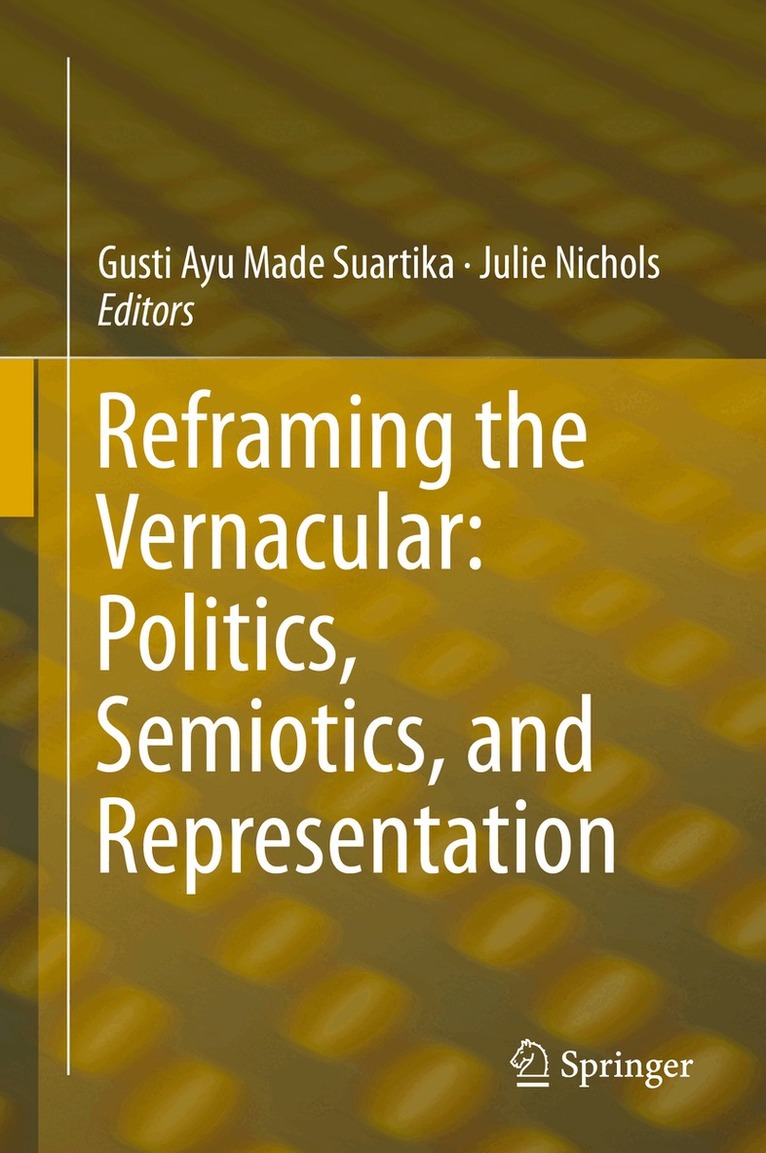
    Reframing the Vernacular: Politics, Semiotics, and Representation

    AvGusti Ayu Made Suartika,Julie Nichols

    Inbunden, Engelska, 2019

    547 kr

    Beställningsvara. Skickas inom 10-15 vardagar. Fri frakt över 249 kr.

    Beskrivning

    The aim of this book is to reflect on ''vernacularity'' and culture. It concentrates on two major domains: first it attempts to reframe our understanding of vernacularity by addressing the subject in the context of globalisation, cross-disciplinarity, and development, and second, it discusses the phenomenon of how vernacularity has been treated, used, employed, manipulated, practiced, maintained, learned, reconstructed, preserved and conserved, at the level of individual and community experience. Scholars from a wide variety of knowledge fields have participated in enriching and engaging discussions, as to how both domains can be addressed.To expedite these aims, this book adopts the theme "Reframing the Vernacular: Politics, Semiotics, and Representation",organised around the following major sub-themes:• Transformation in the vernacular built environment• Vernacular architecture and representation• The meaning of home• Symbolic intervention and interpretation of vernacularity• The semiotics of place• The politics of ethnicity and settlement• Global tourism and its impacts on vernacular settlement• Vernacular built form and aesthetics• Technology and construction in vernacular built forms• Vernacular language - writing and oral traditions

    Produktinformation

    • Utgivningsdatum:2019-10-31
    • Mått:155 x 235 x 20 mm
    • Vikt:646 g
    • Format:Inbunden
    • Språk:Engelska
    • Antal sidor:271
    • Förlag:Springer Nature Switzerland AG
    • ISBN:9783030224479

    Utforska kategorier

    • Kulturvetenskap inom Samhälle och politik
    • Referensverk och tvärvetenskap inom Samhälle och politik
    • Byggnadsteknik inom Naturvetenskap och teknik

    Mer om författaren

    Gusti Ayu Made Suartika is Head of international programs at the Department of Architecture, Planning & Development, Udayana University, Bali; Head of The Centre for Cultural Communication and Space (CCCS); and also Head of the Smart City Research Centre. Her research interests in urban planning in developing countries are revealed in her publications.  Books include Morphing Bali-The State, Planning, and Culture and Vernacular Transformations-Architecture, Place and Tradition. She has a wide range of academic publications including journals such as Space and Culture, Habitat International, the Journal of Urban Design and the Wiley Encyclopaedia of social Science. Current research includes vernacular architecture and culture, the public realm in Indonesia, and smart city concepts applied to developing countries. She is enthusiastic in dedicating her academic endeavours, research activities, publications, and public works to facilitate the Commons in the formation of physically and socially liveable towns and their built form.Julie Nichols lectures in architecture and sustainable design. Julie is the founder of Vernacular Knowledge Research Group [VKRG] and executive member of the Australian Research Centre for Interactive Virtual Environments. Julie’s main research interests link the fields of digital humanities, vernacular architectural history and theorythrough drawing and representation practices. Julie’s interdisciplinary research includes:multimodal methods for post-disaster management of built cultural heritage sites; re-conceptualising vernacular architecture; theories of spatial design in Australia and Indonesia. Julie’s first monograph, Maps and Meanings: Urban Cartography and Urban Design (2014), traces changing roles of the map in the creation of settlements in Southeast Asian and European cities in 17th& 18th centuries.Julie received commendation for End-User Engagement in 2017 for “The Aceh Method: digitally Distributed Architectural Ethnography in Trauma Mitigation for Post-disaster Reconstruction,” and two Australian DFAT Awards for documentation of vernacular architecture.

    Innehållsförteckning

    • 1. Landfill Vernacular.- 2. ‘Bale Kulkul’ Architecture as the Representation of Balinese Autonomy Tradition.- 3. Cultural Burning and the Interstices of Two Vernacular Cultural Forms.- 4. The Effects ‘Share-Economy’ Based Accommodation Service on Vernacular Settlement (Case Study: Yogyakarta’s Sultanate Palace Complex).- 5. The Shift of Symbolic Meaning of Joglo Houses For People In Brayut Tourism Village.- 6. Designing for Vernacular Landscape through Ecosystem-Approach: A case of Floating Settlements at Dal Lake, Kashmir.- 7. Place Making as Ordering Life Case Study: The Bali Aga Village, Pengotan.- 8. Identifying Local Builders’ Roles in Physical Transformation of Minangkabau’s Rumah Gadang.- 9. Transformation in Vernacular Architecture of Baiga Tribe of Central India.- 10. Meaning, Time, Communication: Reflecting on the “Aceh Method” and Vernacular.- 11. Identity Representation and Conflict Prevention in Community Mosques of Malang Raya, East Java, Indonesia.- 12. Transformation versus Preservation of Vernacular Architecture in Bali: A Lesson from Bali Aga Villages.- 13. Coping Strategies in Vernacular Architecture: Adaptation and Adjustment for Contemporary Needs at Pinggan Village, Kintamani, Bali.- 14. Vernacularity and Place: Re-presentation of Fishing Huts of Bahrain at the Venice Biennale.- 15. Relation of Binary Opposition Structure (Rwa-Bhineda) Mount-Ocean : A Case Study on Cultural Heritage of Pura Batukaru-Pakendungan/Tanah Lot in the Perspective of Ecofeminism in Bali.- 16. Preventive Measures and Formulas for the Sustainability of Vernacular Settlements in Malaysia.- 17. Physical Attributes Significant in Preserving the Social Sustainability of the Traditional Malay Settlement.- 18. Revisiting the Minangkabau Traditional House in the Central Area of Sumatra: The Case of Limapuluh Koto and Bangkinang.- 19. The Influence of Cultural Acculturation on Architecture Keraton Kasepuhan Cirebon.- 20. Transformation of Traditional Vernacular Settlements: Lessons from the Kathmandu Valley.