• Fri frakt över 249 kr
  • •
  • Snabba leveranser
  • •
  • Billiga böcker
Kundservice

Du är på sajten för privatpersoner.

Företag, bibliotek eller offentlig verksamhet?

Du handlar på classic.bokus.com, där alla dina funktioner finns intakta.
Till classic.bokus.com
Bokus logotyp. Gå till startsidan.
  • Erbjudanden
  • Nyheter
  • Student
  • Topplistor
  • Barn & ungdom
  • Bokus Play
  • E-böcker
  • Pocketböcker
  • Spel & pussel

10% rabatt på allt med kod: NYSTART10 →

Sidfot

Mina sidor

    Hjälp

    • Kundservice
    • Vanliga frågor och svar
    • Frakt och leverans
    • Retur vid ångerrätt
    • Reklamera vara
    • Betalning
    • Köpvillkor
    • Allmänna villkor
    • Information om webbplatsens tillgänglighet

    Om Bokus

    • Om oss
    • Pressrum
    • För studenter
    • För företag
    • För bibliotek och offentlig verksamhet
    • För leverantörer
    • Hållbarhet

    Populärt

    • Aktuella erbjudanden
    • Presentkort
    • Studentlitteratur
    • Nya böcker
    • Topplistor
    • Signerade böcker
    • Engelska böcker

    Inspiration

    • Boktips
    • BookTok
    • Populära bokserier
    • Barnbokskaraktärer
    • Populära författare
    Logotyp för Bokus
    Följ oss på Facebook (extern länk)Följ oss på Instagram (extern länk)Följ oss på YouTube (extern länk)Följ oss på TikTok (extern länk)
    bokus @ CookiesAnpassa cookiesIntegritetspolicyKöpvillkor
    Till Citymail hemsida (extern länk)Till Budbee hemsida (extern länk)Till Postnord hemsida (extern länk)Till Schenker hemsida (extern länk)Till Early Bird hemsida (extern länk)Till Walleys hemsida (extern länk)
    1. Naturvetenskap och teknik
    2. Matematik och naturvetenskap
    3. Biologi
    4. Biovetenskap

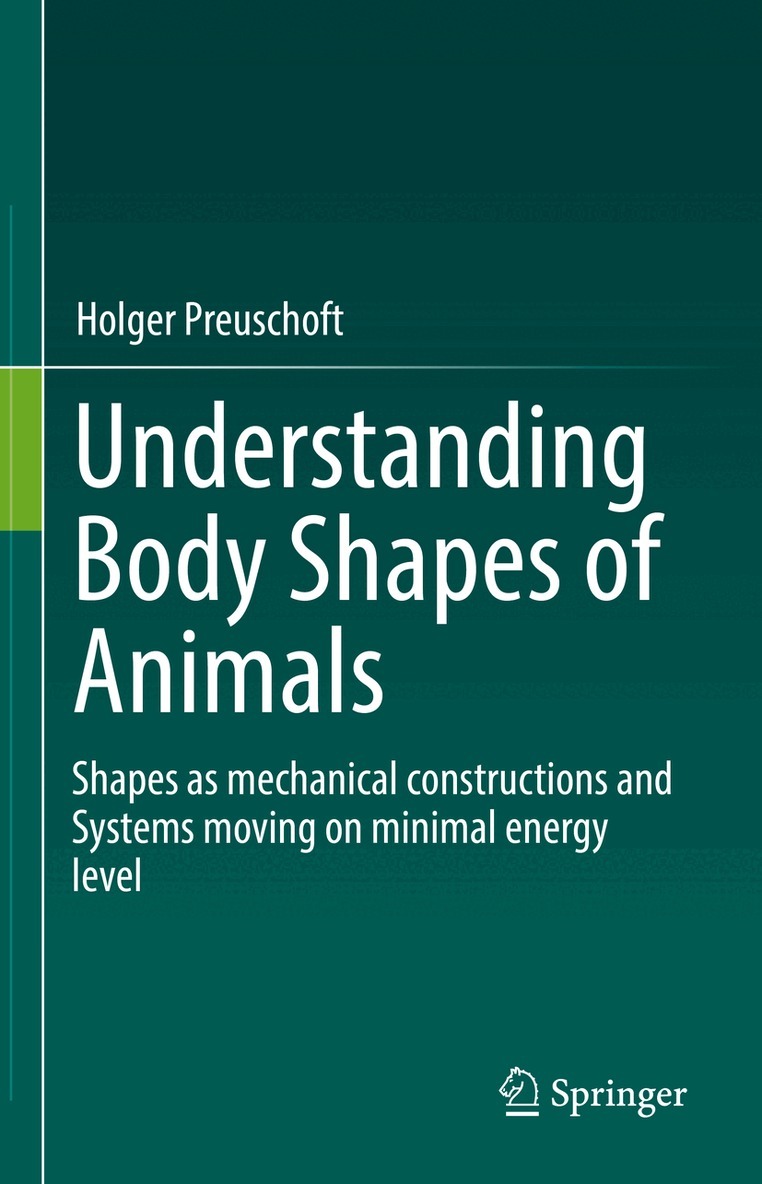
    Understanding Body Shapes of Animals

    Shapes as mechanical constructions and Systems moving on minimal energy level

    AvHolger Preuschoft

    Häftad, Engelska, 2025

    1 949 kr

    Beställningsvara. Skickas inom 10-15 vardagar. Fri frakt över 249 kr.

    Fler format och utgåvor

    Inbunden

    1 949 kr

    E-bok

    2 592 kr

    Beskrivning

    This book discusses how and why animals evolved into particular shapes. The book identifies the physical laws which decide over the evolutionary (selective) value of body shape and morphological characters. Comparing the mechanical necessities with morphological details, the author attempts to understand how evolution works, and which sorts of limitations are set by selection.The book explains morphological traits in more biomechanical detail without getting lost in physics, or in methods. Most emphasis is placed on the proximate question, namely the identification of the mechanical stresses which must be sustained by the respective body parts, when they move the body or its parts against resistance.In the first part of the book the focus is on ‘primitive’ animals and later on the emphasis shifts to highly specialized mammals. Readers will learn more about living and fossil animals.A section of the book is dedicated to human evolution but not to produce anotherevolutionary tree, nor to refine a former one, but to contribute to answering the question: “WHY early humans have developed their particular body shape".

    Produktinformation

    • Utgivningsdatum:2025-07-17
    • Mått:155 x 235 x 32 mm
    • Vikt:890 g
    • Format:Häftad
    • Språk:Engelska
    • Antal sidor:581
    • Förlag:Springer Nature Switzerland AG
    • ISBN:9783030276706

    Utforska kategorier

    • Biovetenskap inom Naturvetenskap och teknik
    • Klassisk mekanik inom Naturvetenskap och teknik
    • Zoologi inom Naturvetenskap och teknik

    Mer om författaren

    Prof. Dr. Holger Preuschoft is an Emeritus Professor at the Center for Anatomy, Ruhr-Universität in Bochum, Germany. 13 years back he was awarded the title "Docteur honoris causa" by the Université Louis Pasteur in Strasbourg, France. He has published more than 196 papers, and edited 9 multi-author books over the course of his career.

    Innehållsförteckning

    • Chapter1: Why this book?.- Chapter2: Head.- Chapter3: Axial skeleton in aquatic animals.- Chapter4: Axial skeleton and muscle arrangement in terrestrial tetrapods.- Chapter5: What have the extremities of “lower tetrapods” in common? And Why?.- Chapter6: Birds.- Chapter7: Land-living mammals.- Chapter8: Primates, the group including humans.- Chapter9: Evolution of hominids.- Chapter10: Summary, Conclusions and Open questions.