• Fri frakt över 249 kr
  • •
  • Snabba leveranser
  • •
  • Billiga böcker
Kundservice

Du är på sajten för privatpersoner.

Företag, bibliotek eller offentlig verksamhet?

Du handlar på classic.bokus.com, där alla dina funktioner finns intakta.
Till classic.bokus.com
Bokus logotyp. Gå till startsidan.
  • Erbjudanden
  • Student
  • Topplistor
  • Barn & ungdom
  • Bokus Play
  • E-böcker
  • Ljudböcker
  • Pocketböcker
  • Spel & pussel

Upp till 25% på utvalda nyheter →

Sidfot

Mina sidor

    Hjälp

    • Kundservice
    • Vanliga frågor och svar
    • Frakt och leverans
    • Retur vid ångerrätt
    • Reklamera vara
    • Betalning
    • Köpvillkor
    • Allmänna villkor
    • Information om webbplatsens tillgänglighet

    Om Bokus

    • Om oss
    • Pressrum
    • För studenter
    • För företag
    • För bibliotek och offentlig verksamhet
    • För leverantörer
    • Hållbarhet

    Populärt

    • Aktuella erbjudanden
    • Presentkort
    • Studentlitteratur
    • Nya böcker
    • Topplistor
    • Signerade böcker
    • Engelska böcker

    Inspiration

    • Boktips
    • BookTok
    • Populära bokserier
    • Barnbokskaraktärer
    • Populära författare
    Logotyp för Bokus
    Följ oss på Facebook (extern länk)Följ oss på Instagram (extern länk)Följ oss på YouTube (extern länk)Följ oss på TikTok (extern länk)
    bokus @ CookiesAnpassa cookiesIntegritetspolicyKöpvillkor
    Till Citymail hemsida (extern länk)Till Budbee hemsida (extern länk)Till Postnord hemsida (extern länk)Till Schenker hemsida (extern länk)Till Early Bird hemsida (extern länk)Till Walleys hemsida (extern länk)
    1. Naturvetenskap och teknik
    2. Matematik och naturvetenskap
    3. Naturvetenskap:allmänt
    4. Populärvetenskap

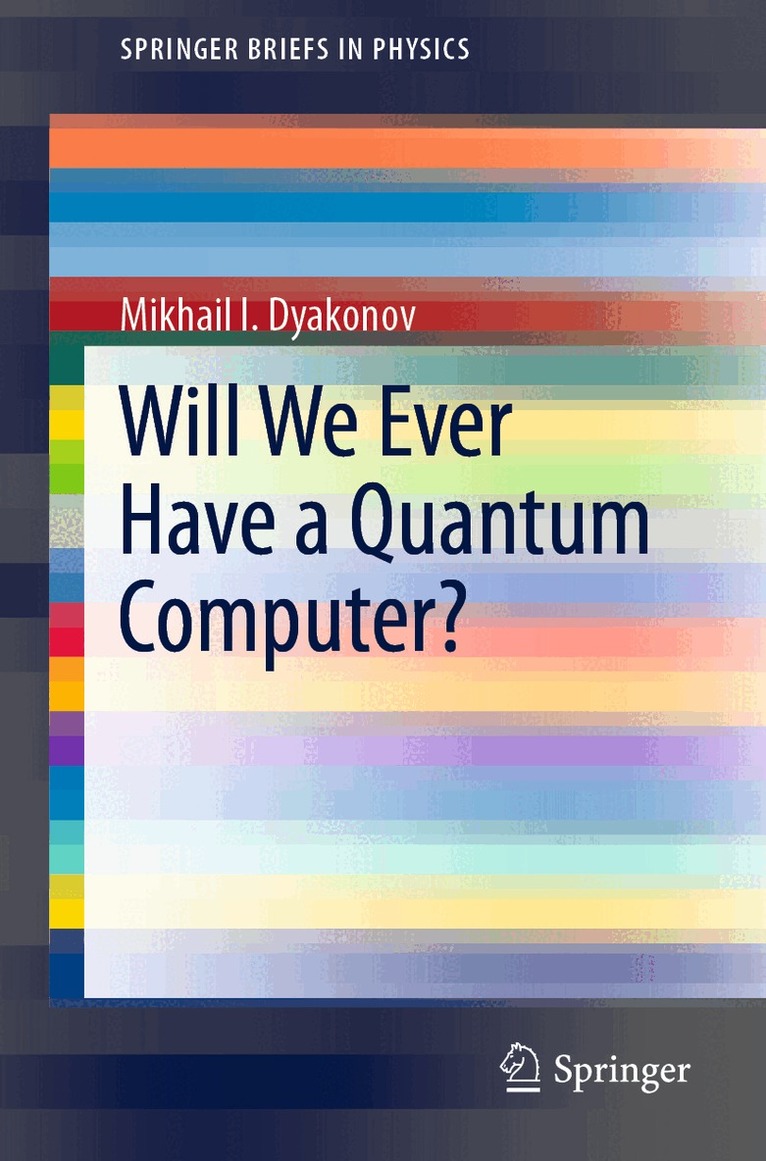
    Will We Ever Have a Quantum Computer?

    AvMikhail I. Dyakonov

    Häftad, Engelska, 2020

    Del i serien SpringerBriefs in Physics

    817 kr

    Beställningsvara. Skickas inom 10-15 vardagar. Fri frakt över 249 kr.

    Fler format och utgåvor

    E-bok

    1 026 kr

    Beskrivning

    This book addresses a broad community of physicists, engineers, computer scientists and industry professionals, as well as the general public, who are aware of the unprecedented media hype surrounding the supposedly imminent new era of quantum computing. The central argument of this book is that the feasibility of quantum computing in the physical world is extremely doubtful. The hypothetical quantum computer is not simply a quantum variant of the conventional digital computer, but rather a quantum extension of a classical analog computer operating with continuous parameters. In order to have a useful machine, the number of continuous parameters to control would have to be of such an astronomically large magnitude as to render the endeavor virtually infeasible. This viewpoint is based on the author’s expert understanding of the gargantuan challenges that would have to be overcome to ever make quantum computing a reality. Knowledge of secondary-school-level physics and math will be sufficient for understanding most of the text.

    Produktinformation

    • Utgivningsdatum:2020-03-24
    • Mått:155 x 235 x 14 mm
    • Vikt:118 g
    • Format:Häftad
    • Språk:Engelska
    • Serie:SpringerBriefs in Physics
    • Antal sidor:49
    • Förlag:Springer Nature Switzerland AG
    • ISBN:9783030420185

    Utforska kategorier

    • Populärvetenskap inom Naturvetenskap och teknik
    • Systemvetenskap och AI inom Data och IT
    • Informationsteknik: allmänt inom Data och IT

    Mer om författaren

    Mikhail Dyakonov received his PhD (1966) in theoretical physics from the Ioffe Physical-Technical Institute in Saint Petersburg (Leningrad), USSR. He worked as a Principal Scientist at the Ioffe Institute until 1998, when he became a Professor at the University of Montpellier, France. His fields of interest include quantum effects in atomic physics, solid-state physics, spin physics, and the physics of 2D electrons. He is the recipient of the State Prize of the USSR, the Beller Lectureship Award from the American Physical Society, and the Félix Robin great prize of the French Physics Society.His name is associated with several physical phenomena: the Dyakonov-Perel spin relaxation mechanism, Dyakonov surface waves, and Dyakonov-Shur plasma wave instability. Together with V.I. Perel, in 1971 he predicted the Spin Hall Effect, which has since become a subject of great interest and intensive study. He is the editor of the book Spin Physics in Semiconductors, published by Springer in 2008 (1st edition) and 2017 (2nd edition).

    Innehållsförteckning

    • Introduction.- Brief history of quantum computing, starting with the invention of Shor's algorithm (1994).- Introduction to quantum mechanics for pedestrians.- Electron spin as a qubit.- The main ideas and promises of quantum computing.- Current state of the art.