• Fri frakt över 249 kr
  • •
  • Snabba leveranser
  • •
  • Billiga böcker
Kundservice

Du är på sajten för privatpersoner.

Företag, bibliotek eller offentlig verksamhet?

Du handlar på classic.bokus.com, där alla dina funktioner finns intakta.
Till classic.bokus.com
Bokus logotyp. Gå till startsidan.
  • Erbjudanden
  • Nyheter
  • Student
  • Topplistor
  • Barn & ungdom
  • Bokus Play
  • E-böcker
  • Pocketböcker
  • Spel & pussel

Må bättre, för mindre! Upp till 50% rabatt på hälsoböcker

Sidfot

Mina sidor

    Hjälp

    • Kundservice
    • Vanliga frågor och svar
    • Frakt och leverans
    • Retur vid ångerrätt
    • Reklamera vara
    • Betalning
    • Köpvillkor
    • Allmänna villkor
    • Information om webbplatsens tillgänglighet

    Om Bokus

    • Om oss
    • Pressrum
    • För studenter
    • För företag
    • För bibliotek och offentlig verksamhet
    • För leverantörer
    • Hållbarhet

    Populärt

    • Aktuella erbjudanden
    • Presentkort
    • Studentlitteratur
    • Nya böcker
    • Topplistor
    • Signerade böcker
    • Engelska böcker

    Inspiration

    • Boktips
    • BookTok
    • Populära bokserier
    • Barnbokskaraktärer
    • Populära författare
    Logotyp för Bokus
    Följ oss på Facebook (extern länk)Följ oss på Instagram (extern länk)Följ oss på YouTube (extern länk)Följ oss på TikTok (extern länk)
    bokus @ CookiesAnpassa cookiesIntegritetspolicyKöpvillkor
    Till Citymail hemsida (extern länk)Till Budbee hemsida (extern länk)Till Postnord hemsida (extern länk)Till Schenker hemsida (extern länk)Till Early Bird hemsida (extern länk)Till Walleys hemsida (extern länk)
    1. Naturvetenskap och teknik
    2. Matematik och naturvetenskap
    3. Matematik
    4. Tillämpad matematik

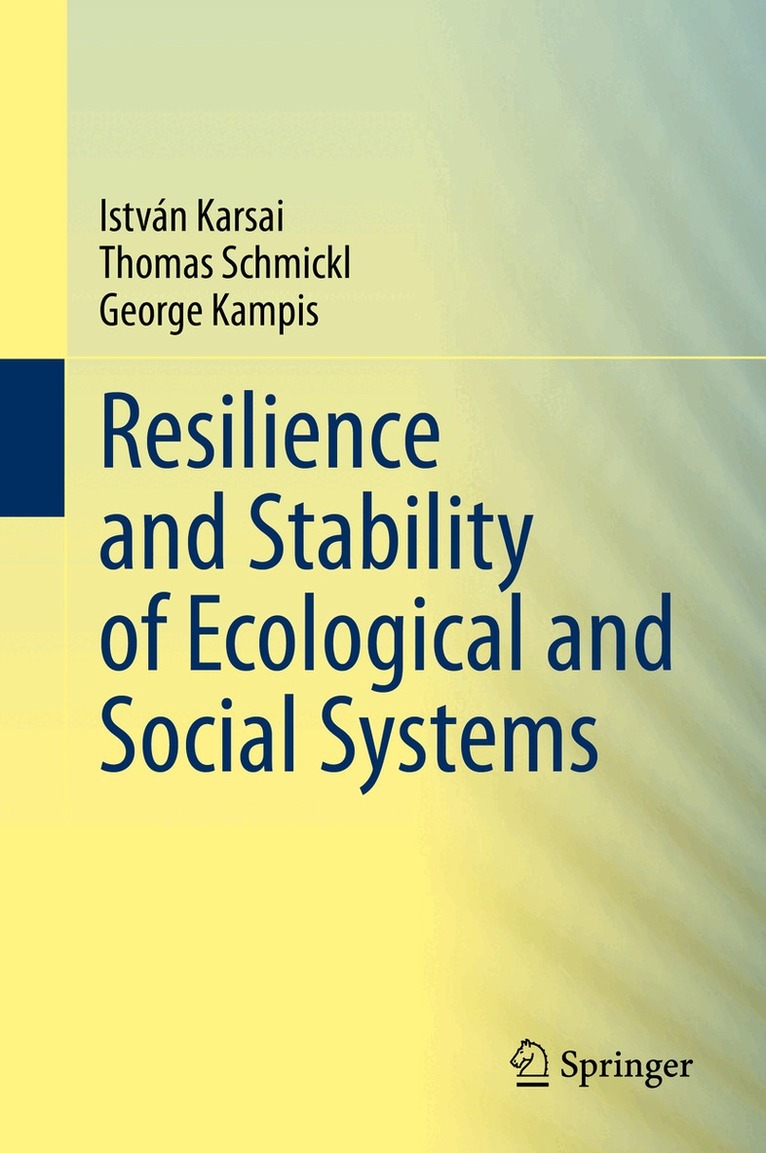
    Resilience and Stability of Ecological and Social Systems

    AvIstván Karsai,Thomas Schmickl

    Inbunden, Engelska, 2020

    547 kr

    Beställningsvara. Skickas inom 10-15 vardagar. Fri frakt över 249 kr.

    Fler format och utgåvor

    Häftad

    547 kr

    Beskrivning

    This monograph, co-authored by three longtime collaborators, aims to promote the interdisciplinary field of mathematical biology by providing accessible new approaches to study natural systems. As there is currently scarce literature on the applications of mathematical modelling for biology research, this book presents a new way of studying interactions at the level of populations, societies, ecosystems, and biomes through open-sourced modeling platforms. It offers an interdisciplinary approach to analyzing natural phenomena—for example, by showing how master equations developed to describe electrical circuits can also describe biological systems mathematically. Ultimately it promotes a method of study based on modelling and mathematical principles, facilitating collaboration between mathematicians, biologists, engineers, and other researchers to enrich knowledge of the world’s ecosystems.

    Produktinformation

    • Utgivningsdatum:2020-10-21
    • Mått:155 x 235 x 16 mm
    • Vikt:436 g
    • Format:Inbunden
    • Språk:Engelska
    • Antal sidor:157
    • Upplaga:20001
    • Förlag:Springer Nature Switzerland AG
    • ISBN:9783030545598

    Utforska kategorier

    • Tillämpad matematik inom Naturvetenskap och teknik
    • Biovetenskap inom Naturvetenskap och teknik

    Recensioner i media

    “The book provides a good overview of the set of aspects that must be considered in order to understand ecosystem dynamics. This is important for predicting the future functioning of ecological and social systems.” (Fatima T. Adylova, zbMATH 1458.92002, 2021)

    Innehållsförteckning

    • Understanding Ecosystem Stability and Resilience through Mathematical Modeling.- The importance of life history and population interactions in population growth.- Habitat fragmentation.- Forest fires: fire management and the power law.- Material flow, task partition and self-organization in wasp societies.- Ants and Bees: common stomach regulation provide stability for societies.- Generalization of the common stomach: integral control at the supra-individual level.- Modeling techniques.