• Fri frakt över 249 kr
  • •
  • Snabba leveranser
  • •
  • Billiga böcker
Kundservice

Du är på sajten för privatpersoner.

Företag, bibliotek eller offentlig verksamhet?

Du handlar på classic.bokus.com, där alla dina funktioner finns intakta.
Till classic.bokus.com
Bokus logotyp. Gå till startsidan.
  • Erbjudanden
  • Nyheter
  • Student
  • Topplistor
  • Barn & ungdom
  • Bokus Play
  • E-böcker
  • Pocketböcker
  • Spel & pussel

10% rabatt på allt med kod NYSTART10 →

Sidfot

Mina sidor

    Hjälp

    • Kundservice
    • Vanliga frågor och svar
    • Frakt och leverans
    • Retur vid ångerrätt
    • Reklamera vara
    • Betalning
    • Köpvillkor
    • Allmänna villkor
    • Information om webbplatsens tillgänglighet

    Om Bokus

    • Om oss
    • Pressrum
    • För studenter
    • För företag
    • För bibliotek och offentlig verksamhet
    • För leverantörer
    • Hållbarhet

    Populärt

    • Aktuella erbjudanden
    • Presentkort
    • Studentlitteratur
    • Nya böcker
    • Topplistor
    • Signerade böcker
    • Engelska böcker

    Inspiration

    • Boktips
    • BookTok
    • Populära bokserier
    • Barnbokskaraktärer
    • Populära författare
    Logotyp för Bokus
    Följ oss på Facebook (extern länk)Följ oss på Instagram (extern länk)Följ oss på YouTube (extern länk)Följ oss på TikTok (extern länk)
    bokus @ CookiesAnpassa cookiesIntegritetspolicyKöpvillkor
    Till Citymail hemsida (extern länk)Till Budbee hemsida (extern länk)Till Postnord hemsida (extern länk)Till Schenker hemsida (extern länk)Till Early Bird hemsida (extern länk)Till Walleys hemsida (extern länk)
    1. Ekonomi och Ledarskap
    2. Ledarskapsböcker

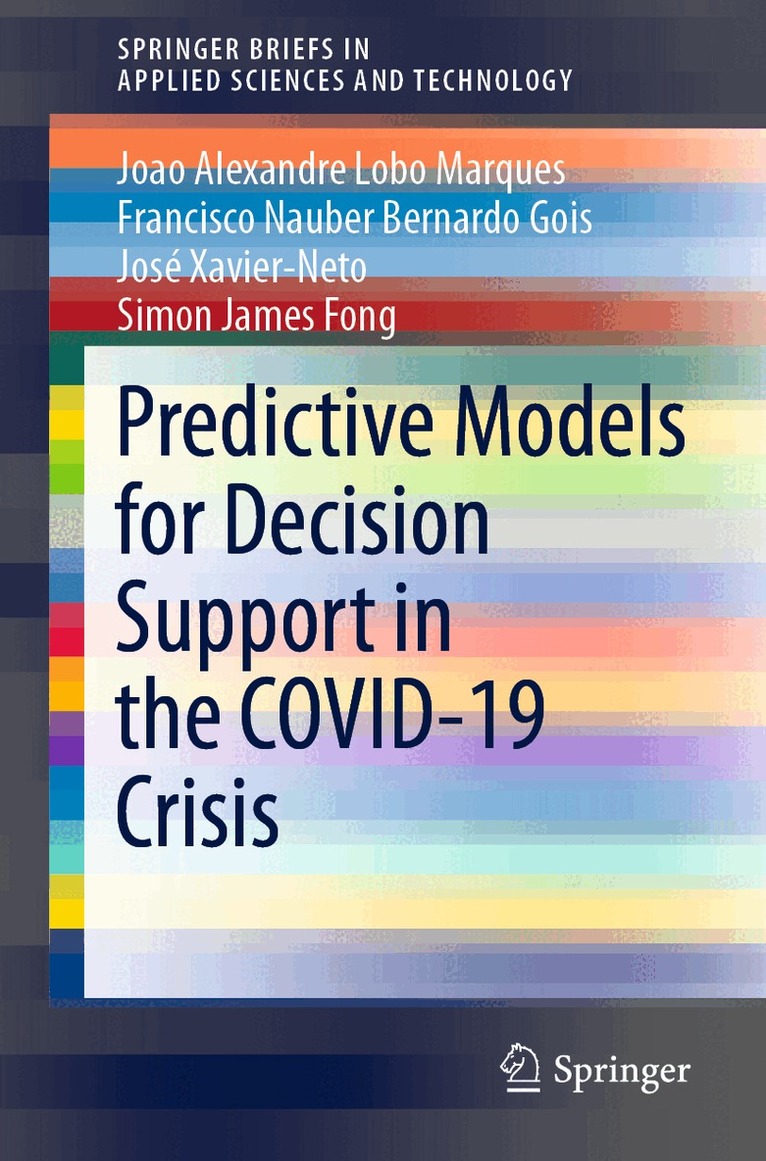
    Predictive Models for Decision Support in the COVID-19 Crisis

    AvJoao Alexandre Lobo Marques,Francisco Nauber Bernardo Gois

    Häftad, Engelska, 2020

    Del i serien SpringerBriefs in Applied Sciences and Technology

    674 kr

    Beställningsvara. Skickas inom 10-15 vardagar. Fri frakt över 249 kr.

    Beskrivning

    COVID-19 has hit the world unprepared, as the deadliest pandemic of the century. Governments and authorities, as leaders and decision makers fighting the virus, enormously tap into the power of artificial intelligence and its predictive models for urgent decision support. This book showcases a collection of important predictive models that used during the pandemic, and discusses and compares their efficacy and limitations.Readers from both healthcare industries and academia can gain unique insights on how predictive models were designed and applied on epidemic data. Taking COVID19 as a case study and showcasing the lessons learnt, this book will enable readers to be better prepared in the event of virus epidemics or pandemics in the future.

    Produktinformation

    • Utgivningsdatum:2020-12-01
    • Mått:155 x 235 x 12 mm
    • Vikt:176 g
    • Format:Häftad
    • Språk:Engelska
    • Serie:SpringerBriefs in Applied Sciences and Technology
    • Antal sidor:98
    • Förlag:Springer Nature Switzerland AG
    • ISBN:9783030619121

    Utforska kategorier

    • Ledarskapsböcker inom Ekonomi och Ledarskap
    • Teknik: allmänt inom Naturvetenskap och teknik
    • Företagsekonomi inom Ekonomi och Ledarskap

    Mer om författaren

    Professor João Alexandre Lobo Marques gained his master’s degree in 2007 and his PhD in 2009, both from the Federal University of Ceará, UFC, Brasil. He works as an associate professor at the University of Saint Joseph, Macau, and as a visiting associate professor at the Chinese Academy of Sciences. He is the CEO and co-founder of the XS Innovation Group in Brazil, which is focused on bioengineering innovation for education. He has published over 60 journal and conference papers, and has co-authored three books. His research interests include computational and artificial intelligence, data sciences, and neuroeconomics.Professor Francisco Nauber Bernardo Gois is an adjunct professor at the Federal University of Ceará. He holds a master’s degree and a PhD from the University of Fortaleza, gained in 2010 and 2017 respectively. He has experience in computer science, with emphasis on machine learning and software testing, deep learning, continuous integration, testing and extreme programming.Dr José Xavier Neto holds a medical degree from Federal University of Ceará and a PhD from the University of São Paulo, which he gained in 1989 and 1993 respectively. He has worked in medical research for decades, including his current role as the Chief Health Scientist of Ceará and a Visiting Professor at the Federal University of Ceará. He has been involved in creating an experimental model for developmental neuropathy induced by the Zika virus, as well as leading a multidisciplinary team which described the first fossilised heart. Professor Simon James Fong gained his master’s degree and PhD from La Trobe University in 1994 and 1998 respectively. He has worked in several academic positions, including his current role as Associate Professor at the University of Macau. He has been on the committee for several conferences, including acting as chair, and has worked as a book series editor. His research interests include data mining, artificial intelligence, machine learning, and biomedical applications.

    Recensioner i media

    “This book is … of great interest for mathematical modelers--it nicely summarizes many important tools, with concrete examples, that could be adapted for other situations. … I strongly recommend this book to advanced undergraduate engineers and mathematicians as well as specialists dealing with dynamical system modeling.” (Arturo Ortiz-Tapia, Computing Reviews, July 26, 2022)

    Innehållsförteckning

    • Chapter 1. Prediction for Decision Support during the COVID-19 Pandemic.- Chapter 2. Epidemiology Compartmental Models - SIR, SEIR and SEIR with Intervention.- Chapter 3. Forecasting COVID-19 Time Series based on an Auto Regressive Model.- Chapter 4. Nonlinear Prediction for the COVID-19 Data based on Quadratic Kalman Filtering.- Chapter 5. Artificial Intelligence Prediction for the COVID-19 Data based on LSTM Neural Networks and H2O AutoML.- Chapter 6. Predicting the Geographic Spread of the COVID-19 Pandemic: a case study from Brazil.