• Fri frakt över 249 kr
  • •
  • Snabba leveranser
  • •
  • Billiga böcker
Kundservice

Du är på sajten för privatpersoner.

Företag, bibliotek eller offentlig verksamhet?

Du handlar på classic.bokus.com, där alla dina funktioner finns intakta.
Till classic.bokus.com
Bokus logotyp. Gå till startsidan.
  • Erbjudanden
  • Nyheter
  • Student
  • Topplistor
  • Barn & ungdom
  • Bokus Play
  • E-böcker
  • Pocketböcker
  • Spel & pussel

Må bättre, för mindre! Upp till 50% rabatt på hälsoböcker

Sidfot

Mina sidor

    Hjälp

    • Kundservice
    • Vanliga frågor och svar
    • Frakt och leverans
    • Retur vid ångerrätt
    • Reklamera vara
    • Betalning
    • Köpvillkor
    • Allmänna villkor
    • Information om webbplatsens tillgänglighet

    Om Bokus

    • Om oss
    • Pressrum
    • För studenter
    • För företag
    • För bibliotek och offentlig verksamhet
    • För leverantörer
    • Hållbarhet

    Populärt

    • Aktuella erbjudanden
    • Presentkort
    • Studentlitteratur
    • Nya böcker
    • Topplistor
    • Signerade böcker
    • Engelska böcker

    Inspiration

    • Boktips
    • BookTok
    • Populära bokserier
    • Barnbokskaraktärer
    • Populära författare
    Logotyp för Bokus
    Följ oss på Facebook (extern länk)Följ oss på Instagram (extern länk)Följ oss på YouTube (extern länk)Följ oss på TikTok (extern länk)
    bokus @ CookiesAnpassa cookiesIntegritetspolicyKöpvillkor
    Till Citymail hemsida (extern länk)Till Budbee hemsida (extern länk)Till Postnord hemsida (extern länk)Till Schenker hemsida (extern länk)Till Early Bird hemsida (extern länk)Till Walleys hemsida (extern länk)
    1. Djur och Natur
    2. Naturböcker
    3. Växtböcker

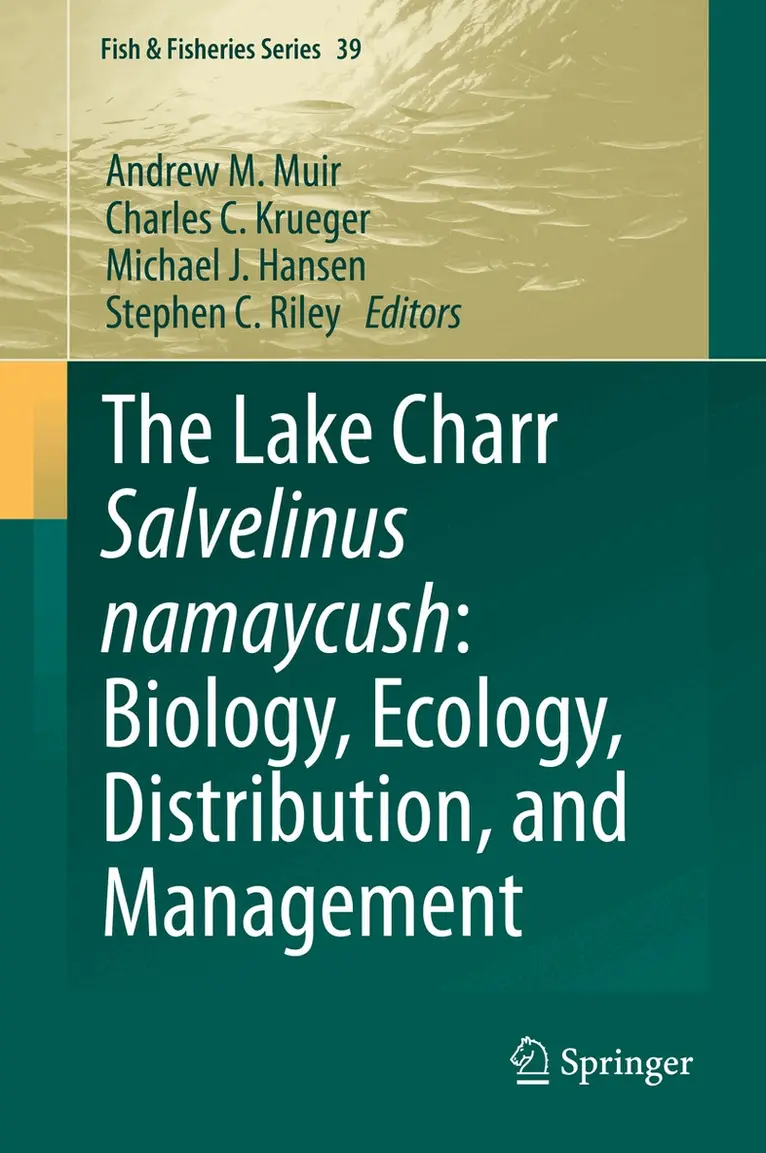
    Lake Charr Salvelinus namaycush: Biology, Ecology, Distribution, and Management

    AvAndrew M. Muir,Charles C. Krueger

    Inbunden, Engelska, 2021

    Del 39 i serien Fish & Fisheries Series

    1 842 kr

    Beställningsvara. Skickas inom 10-15 vardagar. Fri frakt över 249 kr.

    Beskrivning

    The lake charr Salvelinus namaycush is a ubiquitous member of cold-water lake ecosystems in previously glaciated regions of northern continental U.S., Alaska, and Canada that often support important commercial, recreational, and subsistence fisheries. The lake charr differs from other charrs by its large size, longevity, iteroparity, top-predator specialization, reduced sexual dimorphism, prevalence of lacustrine spawning, and use of deepwater habitat. The species is remarkably variable in phenotype, physiology, and life history, some of which is reflected in its ecology and genetics, with as many as four morphs or ecotypes co-occurring in a single lake. The lake charr is often the top predator in these systems, but is highly adaptable trophically, and is frequently planktivorous in small lakes. The lake charr by their name highlights their common habitat, lakes both large and small, but often frequents rivers and occasionally moves into the Arctic Ocean.  Movement and behaviour of lake charr are motivated by access to cool, well-oxygenated water, foraging opportunities, predator avoidance, and reproduction. Owing to their broad distribution and trophic level, the lake charr serves as a sentinel of anthropogenic change. This volume will provide an up-to-date summary of what is currently known about lake charr from distribution to genetics to physiology to ecology.  The book provides a compilation and synthesis of available information on the lake charr, beginning with an updated distribution and a revised treatment of the paleoecology of the species. Understanding of ecological and genetic diversity and movement and behaviour of the species has advanced remarkably since the last major synthesis on the species over 40 years ago. Mid-sections of the book provide detailed accounts of the biology and life history of the species, and later sections are devoted to threats to conservation and fishery management practices usedto ensure sustainability.  A new standard lake charr-specific terminology is also presented. The book will be a valuable reference text for biologists around the world, ecologists, and fishery managers, and of interest to the angling public.

    Produktinformation

    • Utgivningsdatum:2021-03-04
    • Mått:155 x 235 x 35 mm
    • Vikt:963 g
    • Format:Inbunden
    • Språk:Engelska
    • Serie:Fish & Fisheries Series
    • Antal sidor:497
    • Upplaga:21001
    • Förlag:Springer Nature Switzerland AG
    • ISBN:9783030622589

    Utforska kategorier

    • Växtböcker inom Djur och Natur
    • Botanik inom Naturvetenskap och teknik
    • Biovetenskap inom Naturvetenskap och teknik

    Mer om författaren

    ​Dr. Andrew Muir is Science Director for the Great Lakes Fishery Commission, a treaty organization formed by the 1955 Convention on Great Lakes Fisheries between Canada and the United States. He is responsible for administering fishery and sea lamprey research programs and a science transfer program throughout the Great Lakes Basin. He earned a Ph.D. in Fisheries Science from Purdue University (2008) and an M.Sc. (2004) and B.Sc. (2000) in Zoology from the University of Guelph. His current research is focused on the patterns and processes generating and maintaining diversity in deepwater food webs of North American large lakes, invasive species, and ecological connectivity. He has been fortunate to work with a number of great scientists, sampling and experiencing lake charr throughout their distribution, including the Mackenzie Great Lakes of the Northwest Territories.Michael Hansen recently retired from the US Geological Survey, Hammond Bay Biological Station, where he served as supervisor and research fishery biologist. He previously held positions in fishery science and management at the University of Wisconsin–Stevens Point (1996–2013), US Fish & Wildlife Service, Great Lakes Science Center (1990–1996), Wisconsin Department of Natural Resources, Bureau of Fisheries Management (1984–1990), and EA Engineering, Science & Technology (1981–1984).  He earned a PhD from Michigan State University (1994), MS from Cornell University (1983), and BS from the University of Wisconsin–Stevens Point (1979). He has published extensively on the management and ecology of lake charr, among his 135 journal articles, book chapters, and agency publications.Stephen Riley recently retired from the U. S. Geological Survey Great Lakes Science Center in Ann Arbor, Michigan, where he served as a research fishery biologist.  Stephen earned a B.Sc. (1984) and M.Sc. (1986) in Biology from the University of Waterloo and a Ph.D. in Fishery and Wildlife Biology from Colorado State University (1992).  He has conducted research on salmonid ecology and management throughout North America.Dr. Charles “Chuck” Krueger is the T.F. Waters Professor of Aquatic Ecology and Conservation at Michigan State University, and former Director of the Great Lakes Acoustic Telemetry Observation System.  In addition, he has worked for the Wisconsin Department of Natural Resources, U.S. Fish and Wildlife Service, Great Lakes Fishery Commission, and Cornell University. He is keenly interested in discovering the ecological characteristics of fish species of conservation concern and linking those results to their restoration, conservation, and wise use in fisheries.  The discovery process is made through a variety of disciplines including investigating morphology, trophic ecology, behavior, and population genetics.

    Innehållsförteckning

    • Introduction. The Lake Charr: Biology, Ecology, Distribution, and Management.- Distribution.- Paleoecology.- Ecological Diversity.- Genetic Diversity.- Habitat.- Movement Ecology and Behavior.- Life History and Population Dynamics.- Trophic Ecology.- Reproduction.- Contaminants and Ecotoxicology.- A General, Life History Based Model for Sustainable Exploitation of Lake Charr across their Range.- Terminology Issues in Lake Charr Early Development.