• Fri frakt över 249 kr
  • •
  • Snabba leveranser
  • •
  • Billiga böcker
Kundservice

Du är på sajten för privatpersoner.

Företag, bibliotek eller offentlig verksamhet?

Du handlar på classic.bokus.com, där alla dina funktioner finns intakta.
Till classic.bokus.com
Bokus logotyp. Gå till startsidan.
  • Erbjudanden
  • Nyheter
  • Student
  • Topplistor
  • Barn & ungdom
  • Bokus Play
  • E-böcker
  • Pocketböcker
  • Spel & pussel

10% rabatt på allt med kod: NYSTART10 →

Sidfot

Mina sidor

    Hjälp

    • Kundservice
    • Vanliga frågor och svar
    • Frakt och leverans
    • Retur vid ångerrätt
    • Reklamera vara
    • Betalning
    • Köpvillkor
    • Allmänna villkor
    • Information om webbplatsens tillgänglighet

    Om Bokus

    • Om oss
    • Pressrum
    • För studenter
    • För företag
    • För bibliotek och offentlig verksamhet
    • För leverantörer
    • Hållbarhet

    Populärt

    • Aktuella erbjudanden
    • Presentkort
    • Studentlitteratur
    • Nya böcker
    • Topplistor
    • Signerade böcker
    • Engelska böcker

    Inspiration

    • Boktips
    • BookTok
    • Populära bokserier
    • Barnbokskaraktärer
    • Populära författare
    Logotyp för Bokus
    Följ oss på Facebook (extern länk)Följ oss på Instagram (extern länk)Följ oss på YouTube (extern länk)Följ oss på TikTok (extern länk)
    bokus @ CookiesAnpassa cookiesIntegritetspolicyKöpvillkor
    Till Citymail hemsida (extern länk)Till Budbee hemsida (extern länk)Till Postnord hemsida (extern länk)Till Schenker hemsida (extern länk)Till Early Bird hemsida (extern länk)Till Walleys hemsida (extern länk)
    1. Naturvetenskap och teknik
    2. Matematik och naturvetenskap
    3. Kemi
    4. Fysikalisk kemi

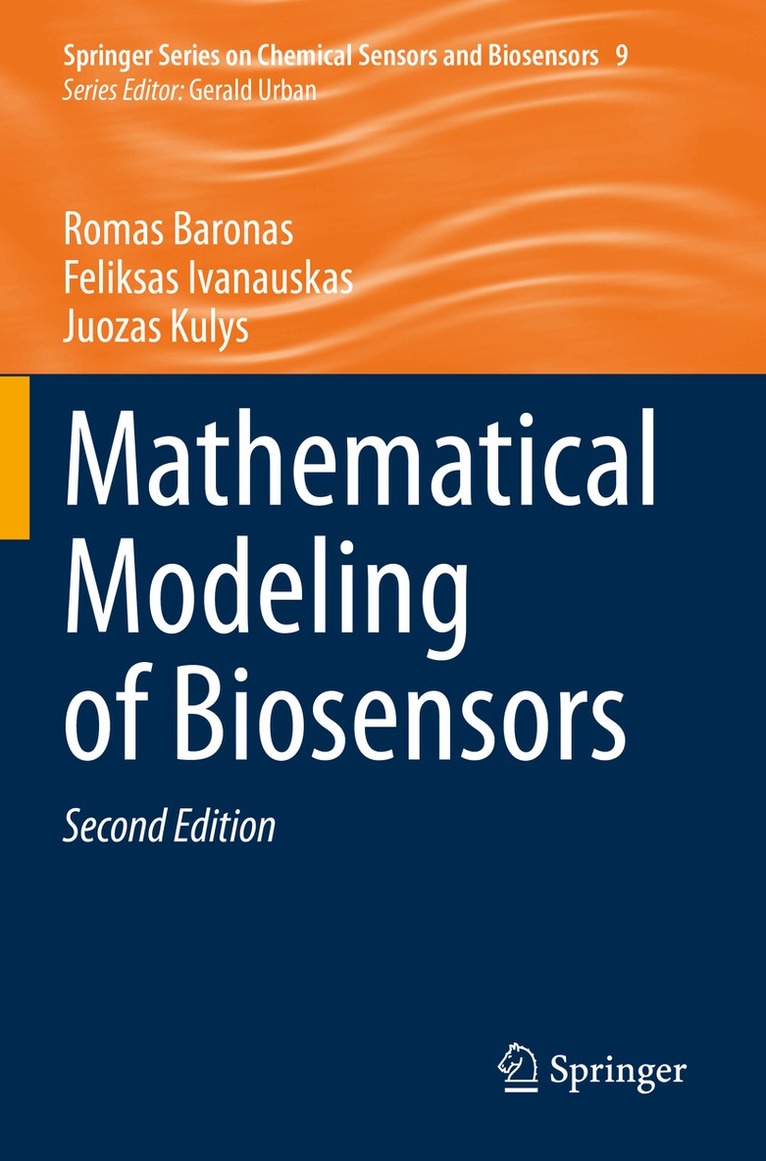
    Mathematical Modeling of Biosensors

    AvRomas Baronas,Feliksas Ivanauskas

    Häftad, Engelska, 2022

    Del 9 i serien Springer Series on Chemical Sensors and Biosensors

    1 785 kr

    Beställningsvara. Skickas inom 10-15 vardagar. Fri frakt över 249 kr.

    Fler format och utgåvor

    Inbunden

    2 008 kr

    Häftad

    1 802 kr

    Beskrivning

    This newly designed and enlarged edition offers an up-to-date presentation of biosensor development and modeling from both a chemical and a mathematical point of view. An entire new chapter in particular is dedicated to optimal design of biosensors. Two more new chapters discuss biosensors which utilize microbial cells and are based on carbon nanotubes respectively. All the other chapters have been revised and updated. The book contains unique modeling methods for amperometric, potentiometric and optical  biosensors based mainly on biocatalysts . It examines processes that occur in the sensors' layers and at their interface, and it provides analytical and numerical methods to solve equations of conjugated enzymatic (chemical) and diffusion processes. The action of single enzyme as well as polyenzyme biosensors and biosensors based on chemically modified electrodes is studied. The modeling of biosensors that contain perforated membranes and multipart mass transport profiles is critically investigated. Furthermore, it is fully described how signals can be biochemically amplified, how cascades of enzymatic substrate conversion are triggered, and how signals are processed via a chemometric approach and artificial neuronal networks. The results of digital modeling are compared with both proximal analytical solutions and experimental data.

    Produktinformation

    • Utgivningsdatum:2022-02-17
    • Mått:155 x 235 x 26 mm
    • Vikt:715 g
    • Format:Häftad
    • Språk:Engelska
    • Serie:Springer Series on Chemical Sensors and Biosensors
    • Antal sidor:456
    • Upplaga:2
    • Förlag:Springer Nature Switzerland AG
    • ISBN:9783030655075

    Utforska kategorier

    • Fysikalisk kemi inom Naturvetenskap och teknik
    • Biokemisk teknik inom Naturvetenskap och teknik
    • Matematisk fysik inom Naturvetenskap och teknik

    Mer om författaren

    Romas Baronas he is a Professor at the Institute of Computer Science of the Vilnius University (Lithuania) since 2005, and his main research interests cover computational modeling of nonlinear phenomena in life sciences. He received his Ph.D. in Computer Science at the same university in 2000, and from 2006 to 2017 he headed the Department of Software Engineering at the Vilnius University. He was the director of the Institute of Computer Science in 2018-2019, and as of 2019, he also works as the chairman of the Research Council of Lithuania. In 2012 he was awarded the Lithuanian Science Prize. Feliksas Ivanauskas is a Professor Emeritus of the Vilnius University (Lithuania). He joint this university in 1972 as Senior Lecturer, and later on, as Associate Professor, Professor, Head of the Department of Mathematical Software, Head of the Department of Differential Equations and Numerical Mathematics, Head of the Department of Computer Science II, and Dean ofFaculty of Mathematics and Informatics.He received his Ph.D. in Mathematics from the Moscow State University and the second degree (Habilitation Doctor) in Mathematics from the Institute of Mathematical Modeling, Russia AS (Moscow), in 1974 and 1992, respectively. He has published 250+ scientific articles and holds two patents on solid-state sources of light. Prof. Ivanauskas received the Lithuanian National Prizes in Science 1995 and 2010. He was Chair of the Division of Mathematical, Physical and Chemical Sciences of Lithuanian Academy of Science from 2009 until 2017.Juozas Kulys is a Professor Emeritus of the Life Sciences Center of Vilnius University (Lithuania), and his main scientific interests focus on chemical problems of biocatalysis, biosensors development and modeling. He received his Ph.D. from the M. V. Lomonosov Moscow State University (Russia) in 1970, and the second degree (Habilitation Doctor) at the N. N. Semenov Chemical Physics Institute in1982. In 1984 he was assessed as Professor of Physical Chemistry, and worked as Senior Research Associate, Head of the Department of Enzyme Chemistry (1974-2016) and as a Director (1986-1992) of the Institute of Biochemistry of Vilnius University (Lithuania). From 2001 until 2018 he was also the Head of the Department and professor of Chemistry and Bioengineering of Vilnius Gediminas Technical University (Lithuania). He was awarded the State Science Prize (1987), the Baltic Assembly Premium of Science (1995), National Science Premium (2002), and he was elected as a member of the Lithuania Academy of Sciences (1990).

    Innehållsförteckning

    • Introduction to Modeling of Biosensors.- Effects of Diffusion Limitations on the Response and Sensitivity of Biosensors.- Biosensors Utilizing Consecutive and Parallel Substrates Conversion.- Biosensors Response Amplification with Cyclic Substrates Conversion.- Biosensors Utilizing Synergistic Substrates Conversion.- Biosensors Acting in Injection Mode.- Chemically Modified Enzyme and Biomimetic Catalysts Electrodes.- Biosensors with Porous and Perforated Membranes.- Biosensors Utilizing Non Michaelis-Menten Kinetics.- Biosensors Based on Microreactors.- Modeling Carbon Nanotube Based Biosensors.- Modeling Biosensors Utilizing Microbial Cells.- Application of Mathematical Modeling to Optimal Design of Biosensors.