• Fri frakt över 249 kr
  • •
  • Snabba leveranser
  • •
  • Billiga böcker
Kundservice

Du är på sajten för privatpersoner.

Företag, bibliotek eller offentlig verksamhet?

Du handlar på classic.bokus.com, där alla dina funktioner finns intakta.
Till classic.bokus.com
Bokus logotyp. Gå till startsidan.
  • Erbjudanden
  • Nyheter
  • Student
  • Topplistor
  • Barn & ungdom
  • Bokus Play
  • E-böcker
  • Pocketböcker
  • Spel & pussel

10% rabatt på allt med kod: NYSTART10 →

Sidfot

Mina sidor

    Hjälp

    • Kundservice
    • Vanliga frågor och svar
    • Frakt och leverans
    • Retur vid ångerrätt
    • Reklamera vara
    • Betalning
    • Köpvillkor
    • Allmänna villkor
    • Information om webbplatsens tillgänglighet

    Om Bokus

    • Om oss
    • Pressrum
    • För studenter
    • För företag
    • För bibliotek och offentlig verksamhet
    • För leverantörer
    • Hållbarhet

    Populärt

    • Aktuella erbjudanden
    • Presentkort
    • Studentlitteratur
    • Nya böcker
    • Topplistor
    • Signerade böcker
    • Engelska böcker

    Inspiration

    • Boktips
    • BookTok
    • Populära bokserier
    • Barnbokskaraktärer
    • Populära författare
    Logotyp för Bokus
    Följ oss på Facebook (extern länk)Följ oss på Instagram (extern länk)Följ oss på YouTube (extern länk)Följ oss på TikTok (extern länk)
    bokus @ CookiesAnpassa cookiesIntegritetspolicyKöpvillkor
    Till Citymail hemsida (extern länk)Till Budbee hemsida (extern länk)Till Postnord hemsida (extern länk)Till Schenker hemsida (extern länk)Till Early Bird hemsida (extern länk)Till Walleys hemsida (extern länk)
    1. Naturvetenskap och teknik
    2. Geovetenskap
    3. Geovetenskap
    4. Geologi

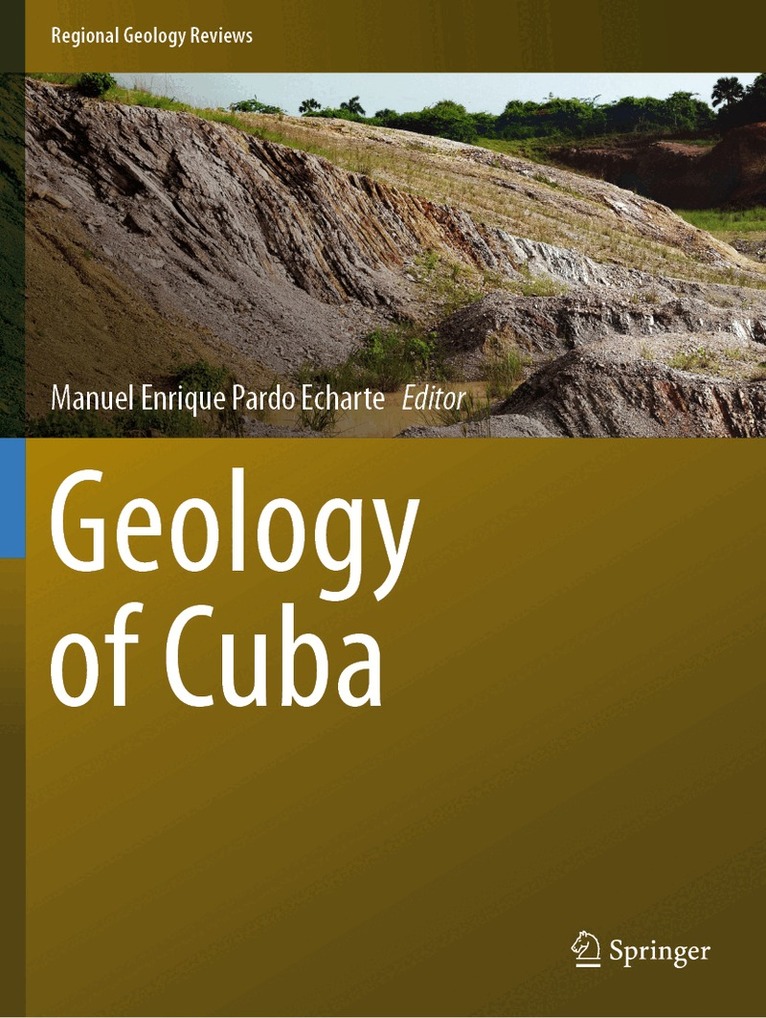
    Geology of Cuba

    AvManuel Enrique Pardo Echarte

    Häftad, Engelska, 2022

    Del i serien Regional Geology Reviews

    1 734 kr

    Beställningsvara. Skickas inom 10-15 vardagar. Fri frakt över 249 kr.

    Beskrivning

    The evolution of geological cartography in Cuba in its more than 135 years of history has been possible through the consultation of numerous archival reports, publications, maps and personal interviews with different authors and geologists of vast experience. A brief critical analysis is made of the increase in the degree of geological knowledge of the country since the elaboration of the Geological Sketch of the Cuban Island at a scale of 1: 2 000 000 (Fernández de Castro, 1883), first of Cuba and of Ibero-America, until the most recent Digital Geological Map of Cuba at scale 1: 100 000 (Pérez Aragón, 2016). Cuba and its surroundings are a geological mosaic in the southeast corner of the North American plate with rocks from many different origins, from Proterozoic to Quaternary, extended along the southern border of the plate. From the Eocene, this belt has been dissected by several great faults, related to the development of some great oceanic depressions (Cayman trough and Yucatan basin). The fossil record of Cuba, which covers approximately the last 200 million years of life on Earth, is rich in very varied fossils, witnessing a wide diversity of organisms, both animals and plants, that inhabited the Antillean and Caribbean region; and that constitute the inheritance of the biological diversity that the current Cuban archipelago exhibits. As a result of the preparation of the Cuban Metallogenic Map at scale 1: 250 000, forty-one models and eight sub-models of metallic mineral deposits were identified. These models, of descriptive–genetic type, together with the analysis of their spatial distribution and their relationship with geology, allowed the identification and mapping of ten mineral systems, linked to the geodynamic environments present in the Cuban territory. Cuba has large deposits of limestone, loam, dolomite, kaolin, gypsum and anhydrite, rock salt, marbles, sands and clays of different types, zeolites, peat, therapeutic peloids and many more. Thereare manifestations of decorative and precious rocks such as jasper, jadeite, different varieties of quartz and even xylopals. A compilation of geochemical data of oceanic basalt samples from previous works, together with data of analyzed samples during this study in order to discuss geochemical criteria based on immobile element (proxies for fractionation indices, alkalinity, mantle flow and subduction addition), provide a comprehensive ophiolite classification according to their tectonic setting. This book addresses different facets of the geological knowledge of Cuba: history of its cartography, marine geology, fossil record, stratigraphy, tectonics, classification of its ophiolites, quaternary deposits, metallogeny and minerageny.

    Produktinformation

    • Utgivningsdatum:2022-05-06
    • Mått:210 x 279 x 19 mm
    • Vikt:830 g
    • Format:Häftad
    • Språk:Engelska
    • Serie:Regional Geology Reviews
    • Antal sidor:308
    • Förlag:Springer Nature Switzerland AG
    • ISBN:9783030678005

    Utforska kategorier

    • Geologi inom Naturvetenskap och teknik
    • Miljövetenskap och miljöpolitik inom Naturvetenskap och teknik
    • Kemi inom Naturvetenskap och teknik

    Mer om författaren

    The volume editor, Prof. Dr. Manuel E. Pardo Echarte, has more than 40 years of experience in scientific research. He graduated in Geophysical Engineering at José Antonio Echeverría Havana Technological University, Cujae, La Habana, Cuba, in 1974, and obtained a Ph.D. in Geological-Mineralogical Sciences at the same university in 1987. He is currently a Titular professor there.   He is the author of the Patent “Method of Redox Potential Measurement in Soils and Its Combined Application with Kappametry for the Purposes of Geological Prospecting” (2000) and co-author of the Protected Work Software "Sistema Redox" (2005). He  has contributed to a wide range of publications, including monographs: “Unconventional Methods for Oil & Gas Exploration in Cuba: The Redox Complex” (Springer, 2016), “Oil and Gas Exploration in Cuba: Geological-Structural Cartography using Potential Fields and Airborne Gamma Spectrometry” (Springer, 2017), “Offshore Exploration ofOil and Gas in Cuba using Digital Elevation Models (DEMs)” (Springer,2018) and "Non-seismic an Non-conventional Exploration Methods for Oil and Gas in Cuba" (Springer, 2019).

    Innehållsförteckning

    • 1. Geological Cartography of Cuba.- 2. Geology of the Marine Territory of Cuba.- 3. Synthesis of Fossil Record of Cuba.- 4. Stratigraphy of Cuba.- 5. An Overview to the Tectonics of Cuba.- 6. Geochemical Fingerprinting of Ancient Oceanic Basalts: Classification of the Cuban Ophiolites.- 7. Stratigraphy of the Quaternary Deposits in Cuba.- 8. Mineral Systems of Cuba: a Panoramic Vision of Cuban Metallogeny.- 9. The Minerageny of Cuba.