Manuel Enrique Pardo Echarte – författare
Visar alla böcker från författaren Manuel Enrique Pardo Echarte. Handla med fri frakt och snabb leverans.
11 produkter
Non-seismic and Non-conventional Exploration Methods for Oil and Gas in Cuba
Av Manuel Enrique Pardo Echarte, Osvaldo Rodríguez Morán m. fl.
Häftad, 2019
551 kr
Lägg i varukorg
This book assesses the use of various non-seismic and non-conventional oil and gas exploration methods in Cuba. In addition to discussing the benefits of these methods, the book demonstrates how they can be combined with geological data and conventional methods, leading to a better evaluation of …
Non-seismic and Non-conventional Exploration Methods for Oil and Gas in Cuba
Av Orelvis Delgado Lopez, Osvaldo Rodriguez Moran m. fl.
E-bok, 2019
710 kr
Lägg i varukorg
This book assesses the use of various non-seismic and non-conventional oil and gas exploration methods in Cuba. In addition to discussing the benefits of these methods, the book demonstrates how they can be combined with geological data and conventional methods, leading to a better evaluation of …
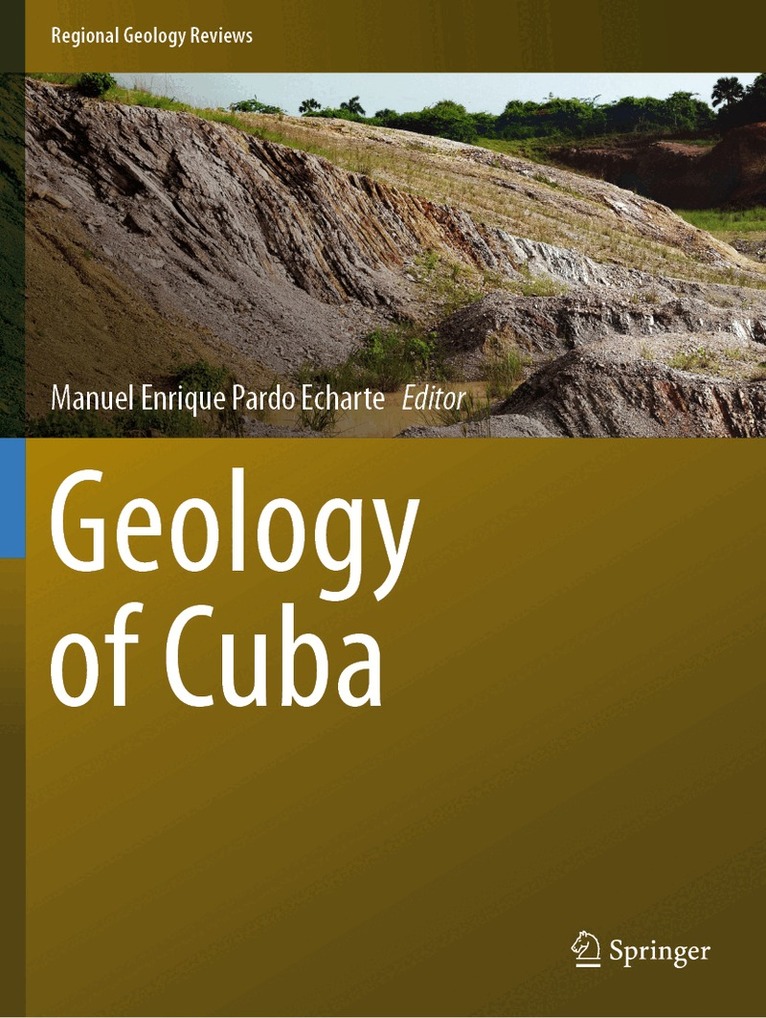
Geology of Cuba
Av Manuel Enrique Pardo Echarte
Inbunden, 2021
1861 kr
Lägg i varukorg
The evolution of geological cartography in Cuba in its more than 135 years of history has been possible through the consultation of numerous archival reports, publications, maps and personal interviews with different authors and geologists of vast experience. A brief critical analysis is made of …
Geology of Cuba
Av Manuel Enrique Pardo Echarte
E-bok, 2021
2274 kr
Lägg i varukorg
The evolution of geological cartography in Cuba in its more than 135 years of history has been possible through the consultation of numerous archival reports, publications, maps and personal interviews with different authors and geologists of vast experience. A brief critical analysis is made of …
Geology of Cuba
Av Manuel Enrique Pardo Echarte
Häftad, 2022
1752 kr
Lägg i varukorg
The evolution of geological cartography in Cuba in its more than 135 years of history has been possible through the consultation of numerous archival reports, publications, maps and personal interviews with different authors and geologists of vast experience. A brief critical analysis is made of …
Geological-Structural Mapping and Favorable Sectors for Oil and Gas in Cuba
Non-seismic Exploration Methods
Av Manuel Enrique Pardo Echarte, Osvaldo Rodríguez Morán m. fl.
Häftad, 2022
552 kr
Lägg i varukorg
The so-called "Non-conventional geophysical-geochemical exploration methods" are used, in the particular case of oil and gas exploration, for the detection and mapping of active microseepage of light hydrocarbons with a vertical nature on the gas-oil accumulations.The non-seismic exploration …
Geological-Structural Mapping and Favorable Sectors for Oil and Gas in Cuba
Non-seismic Exploration Methods
Av Orelvis Delgado Lopez, Jessica Morales Gonzalez m. fl.
E-bok, 2022
718 kr
Lägg i varukorg
The so-called "Non-conventional geophysical-geochemical exploration methods" are used, in the particular case of oil and gas exploration, for the detection and mapping of active microseepage of light hydrocarbons with a vertical nature on the gas-oil accumulations. The non-seismic exploration …
Oil and Gas Exploration in Cuba
Geological-Structural Cartography using Potential Fields and Airborne Gamma Spectrometry
Av Manuel Enrique Pardo Echarte, Jorge Luis Cobiella Reguera
Häftad, 2017
552 kr
Lägg i varukorg
A summary of the results achieved in the geological-structural mapping, by potential fields and airborne gamma spectrometry data, of the units of igneous and metamorphic rocks in the western regions (Havana-Matanzas), central (Cienfuegos, Villa Clara-Sancti Spiritus) and central-eastern …
Oil and Gas Exploration in Cuba
Geological-Structural Cartography using Potential Fields and Airborne Gamma Spectrometry
Av Jorge Luis Cobiella Reguera, Manuel Enrique Pardo Echarte
E-bok, 2017
734 kr
Lägg i varukorg
A summary of the results achieved in the geological-structural mapping, by potential fields and airborne gamma spectrometry data, of the units of igneous and metamorphic rocks in the western regions (Havana-Matanzas), central (Cienfuegos, Villa Clara-Sancti Spiritus) and central-eastern …
Offshore Exploration of Oil and Gas in Cuba using Digital Elevation Models (DEMs)
Av Manuel Enrique Pardo Echarte, Odalys Reyes Paredes m. fl.
Häftad, 2018
552 kr
Lägg i varukorg
This book provides an overview of the major changes induced by hydrocarbons (HCs) affecting rocks and surface sediments and their implications for non-seismic exploration methods, particularly for marine territories near Cuba. It examines the use of a digital elevation model (DEM) at 90x90m …
Offshore Exploration of Oil and Gas in Cuba using Digital Elevation Models (DEMs)
Av Valia Suarez Leyva, Odalys Reyes Paredes m. fl.
E-bok, 2018
718 kr
Lägg i varukorg
This book provides an overview of the major changes induced by hydrocarbons (HCs) affecting rocks and surface sediments and their implications for non-seismic exploration methods, particularly for marine territories near Cuba. It examines the use of a digital elevation model (DEM) at 90x90m …