• Fri frakt över 249 kr
  • •
  • Snabba leveranser
  • •
  • Billiga böcker
Kundservice

Du är på sajten för privatpersoner.

Företag, bibliotek eller offentlig verksamhet?

Du handlar på classic.bokus.com, där alla dina funktioner finns intakta.
Till classic.bokus.com
Bokus logotyp. Gå till startsidan.
  • Erbjudanden
  • Nyheter
  • Student
  • Topplistor
  • Barn & ungdom
  • Bokus Play
  • E-böcker
  • Pocketböcker
  • Spel & pussel

10% studentrabatt med kod TERM26

Sidfot

Mina sidor

    Hjälp

    • Kundservice
    • Vanliga frågor och svar
    • Frakt och leverans
    • Retur vid ångerrätt
    • Reklamera vara
    • Betalning
    • Köpvillkor
    • Allmänna villkor
    • Information om webbplatsens tillgänglighet

    Om Bokus

    • Om oss
    • Pressrum
    • För studenter
    • För företag
    • För bibliotek och offentlig verksamhet
    • För leverantörer
    • Hållbarhet

    Populärt

    • Aktuella erbjudanden
    • Presentkort
    • Studentlitteratur
    • Nya böcker
    • Topplistor
    • Signerade böcker
    • Engelska böcker

    Inspiration

    • Boktips
    • BookTok
    • Populära bokserier
    • Barnbokskaraktärer
    • Populära författare
    Logotyp för Bokus
    Följ oss på Facebook (extern länk)Följ oss på Instagram (extern länk)Följ oss på YouTube (extern länk)Följ oss på TikTok (extern länk)
    bokus @ CookiesAnpassa cookiesIntegritetspolicyKöpvillkor
    Till Citymail hemsida (extern länk)Till Budbee hemsida (extern länk)Till Postnord hemsida (extern länk)Till Schenker hemsida (extern länk)Till Early Bird hemsida (extern länk)Till Walleys hemsida (extern länk)
    1. Naturvetenskap och teknik
    2. Teknik och industri
    3. Elektronik och kommunikationer

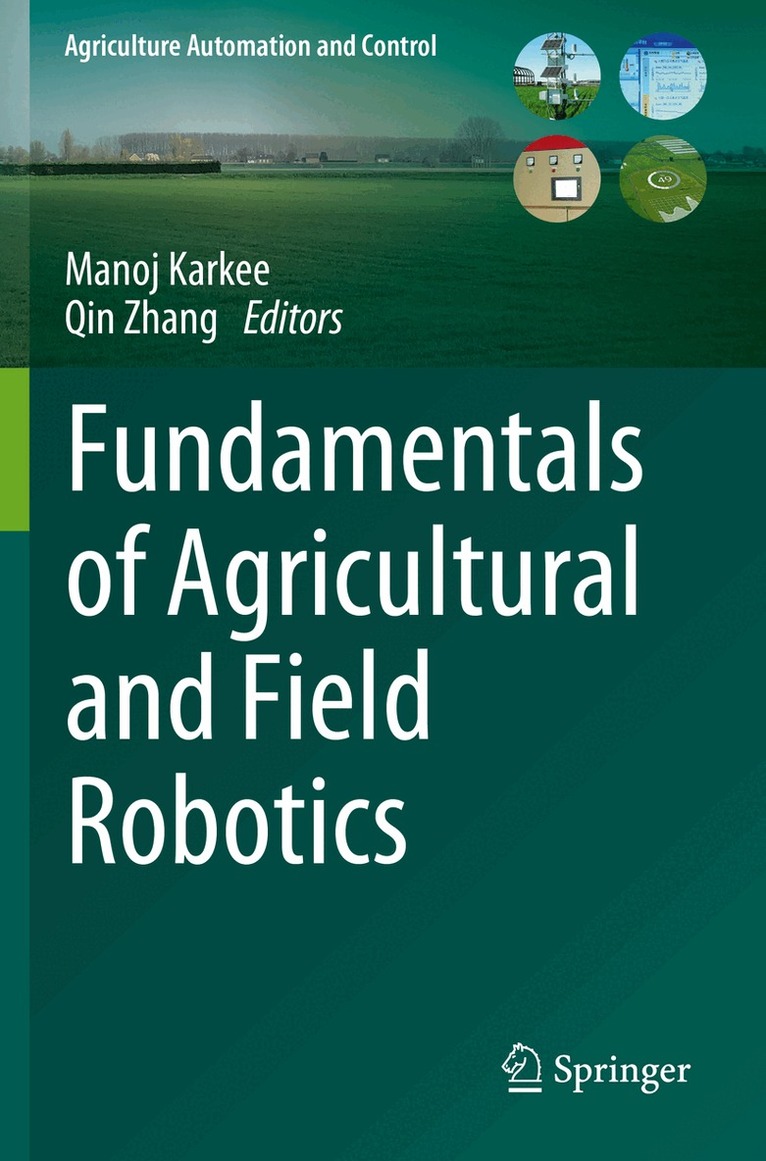
    Fundamentals of Agricultural and Field Robotics

    AvManoj Karkee,Qin Zhang

    Inbunden, Engelska, 2021

    Del i serien Agriculture Automation and Control

    2 394 kr

    Beställningsvara. Skickas inom 10-15 vardagar. Fri frakt över 249 kr.

    Beskrivning

    Over the past century, mechanization has been an important means for optimizing resource utilization, improving worker health and safety and reducing labor requirements in farming while increasing productivity and quality of 4F (Food, Fuel, Fiber, Feed). Recognizing this contribution, agricultural mechanization was considered as one of the top ten engineering achievements of 20th century by the National Academy of Engineering. Accordingly farming communities have adopted increasing level of automation and robotics to further improve the precision management of crops (including input resources), increase productivity and reduce farm labor beyond what has been possible with conventional mechanization technologies. It is more important than ever to continue to develop and adopt novel automation and robotic solutions into farming so that some of the most complex agricultural tasks, which require huge amount of seasonal labor such as fruit and vegetable harvesting, couldbe automated while meeting the rapidly increasing need for 4F. In addition, continual innovation in and adoption of agricultural automation and robotic technologies is essential to minimize the use of depleting resources including water, minerals and other chemicals so that sufficient amount of safe and healthy food can be produced for current generation while not compromising the potential for the future generation. This book aims at presenting the fundamental principles of various aspects of automation and robotics as they relate to production agriculture (the branch of agriculture dealing with farming operations from field preparation to seeding, to harvesting and field logistics). The building blocks of agricultural automation and robotics that are discussed in the book include sensing and machine vision, control, guidance, manipulation and end-effector technologies. The fundamentals and operating principles of these technologies are explained with examples from cutting-edge research and development currently going on around the word. This book brings together scientists, engineers, students and professionals working in these and related technologies to present their latest examples of agricultural automation and robotics research, innovation and development while explaining the fundamentals of the technology. The book, therefore, benefits those who wish to develop novel agricultural engineering solutions and/or to adopt them in the future.


    Produktinformation

    • Utgivningsdatum:2021-07-28
    • Mått:155 x 235 x 31 mm
    • Vikt:869 g
    • Format:Inbunden
    • Språk:Engelska
    • Serie:Agriculture Automation and Control
    • Antal sidor:455
    • Upplaga:21001
    • Förlag:Springer Nature Switzerland AG
    • ISBN:9783030703998

    Utforska kategorier

    • Elektronik och kommunikationer inom Naturvetenskap och teknik
    • Geografi inom Naturvetenskap och teknik
    • Agronomi inom Naturvetenskap och teknik

    Mer om författaren

    Manoj KarkeeDr. Manoj Karkee is an Associate Professor in the Biological Systems Engineering Department at Washington State University (WSU) and is the co-director of WSU-University of Technology Sydney joint center on #AgRobotics. He was born and raised in eastern hills of Nepal. He received his diploma in Civil Engineering and undergraduate in Computer Engineering from Tribhuvan University, Nepal. His MS was in remote sensing and GIS from Asian Institute of Technology, Thailand and his PhD was in Agricultural Engineering and Human Computer Interaction from Iowa State University. Dr. Karkee leads a strong research program in the area of sensing, machine vision and #AgRobotics at the WSU Center for Precision and Automated Agricultural Systems (CPAAS). He has published more than 65 peer-reviewed journal articles, and more than 25 referred conference papers. He has also been awarded two US patents, and has published one book (edited) and eight book chapters. Dr. Karkee is currently serving as an elected chair for International Federation of Automatic Control (IFAC) Technical Committee on ‘Control in Agriculture’, as an associate editor for ‘Transactions of the ASABE’, as a guest editor for ‘Sensors’, and an Adjunct Professor for Zhejiang University in China. Dr. Karkee was recognized as ‘2019 Pioneer in Artificial Intelligence and IoT’ by Connected World magazine and was featured as the ‘Western Innovator’ by Capital Press. Qin Zhang Dr. Qin Zhang is the Director of the Center for Precision and Automated Agricultural Systems (CPAAS) of Washington State University (WSU), and a Professor of Agricultural Automation in the Department of Biological Systems Engineering, WSU.  His research interests are in the areas of agricultural automation, agricultural robotics, and off-road equipment mechatronics.  Prior to his current position, he was a faculty member at the University of Illinois at Urbana-Champaign, worked at Caterpillar Inc., and taught at Zhejiang Agricultural University in China. Based on his research outcomes, he has authored/edited seven books, written more than a dozen separate book chapters, edited three conference proceedings, published over 180 peer reviewed journal articles, and been awarded 11 U.S. patents.  He is currently serving as the Editor-in-Chief for Computers and Electronics in Agriculture.  Dr. Qin Zhang received his B.S. degree in engineering from Zhejiang Agricultural University, China; M.S. degree from the University of Idaho and Ph.D. degree from the University of Illinois at Urbana-Champaign.  Dr. Qin Zhang is an ASABE Fellow and is serving or served as a guest or an adjunct professor for 9 other universities.

    Innehållsförteckning

    • Preface.- Chapter 1.- Agricultural and Field Robotics: An Introduction.- Part I. Sensing and Machine Vision.- Chapter 2. Sensors I: Color Imaging and Basics of Image Processing.- Chapter 3. Sensors II: 3D Sensing Techniques and Systems.- Chapter 4. Sensors III: Spectral Sensing and Data Analysis.- Chapter 5. Crop Scouting and Surrounding Awareness for Specialty Crops.- Chapter 6. Crop Sensing and Its Application in Precision Agriculture and Crop Phenotyping.- Part II: Mechanisms, Dynamics and Control.- Chapter 7. Robotic Manipulation and Optimization for Agricultural and Field Applications.- Chapter 8. End-effector Technologies.- Chapter 9. Control Techniques in Robotic Harvesting.- Chapter 10. Guidance, Auto-Steering Systems and Control.- Chapter 11. Automated Infield Sorting and Handling of Apples.- Chapter 12. Modeling, Simulation and Visualization of Agricultural and Field Robotic Systems.- Part III: Emerging Topics in Agricultural and Field Robotics.- Chapter 13.  Advanced Learning and Classification Techniques for Agricultural and Field Robotics.- Chapter 14. Digital Farming and Field Robotics - Internet of Things, Cloud Computing and Big Data.- Chapter 15. Human-Machine Interactions.- Chapter 16. Machinery-Canopy Interactions in Tree Fruit Crops.- Index.