• Fri frakt över 249 kr
  • •
  • Snabba leveranser
  • •
  • Billiga böcker
Kundservice

Du är på sajten för privatpersoner.

Företag, bibliotek eller offentlig verksamhet?

Du handlar på classic.bokus.com, där alla dina funktioner finns intakta.
Till classic.bokus.com
Bokus logotyp. Gå till startsidan.
  • Erbjudanden
  • Nyheter
  • Student
  • Topplistor
  • Barn & ungdom
  • Bokus Play
  • E-böcker
  • Pocketböcker
  • Spel & pussel

10% rabatt på allt med kod NYSTART10 →

Sidfot

Mina sidor

    Hjälp

    • Kundservice
    • Vanliga frågor och svar
    • Frakt och leverans
    • Retur vid ångerrätt
    • Reklamera vara
    • Betalning
    • Köpvillkor
    • Allmänna villkor
    • Information om webbplatsens tillgänglighet

    Om Bokus

    • Om oss
    • Pressrum
    • För studenter
    • För företag
    • För bibliotek och offentlig verksamhet
    • För leverantörer
    • Hållbarhet

    Populärt

    • Aktuella erbjudanden
    • Presentkort
    • Studentlitteratur
    • Nya böcker
    • Topplistor
    • Signerade böcker
    • Engelska böcker

    Inspiration

    • Boktips
    • BookTok
    • Populära bokserier
    • Barnbokskaraktärer
    • Populära författare
    Logotyp för Bokus
    Följ oss på Facebook (extern länk)Följ oss på Instagram (extern länk)Följ oss på YouTube (extern länk)Följ oss på TikTok (extern länk)
    bokus @ CookiesAnpassa cookiesIntegritetspolicyKöpvillkor
    Till Citymail hemsida (extern länk)Till Budbee hemsida (extern länk)Till Postnord hemsida (extern länk)Till Schenker hemsida (extern länk)Till Early Bird hemsida (extern länk)Till Walleys hemsida (extern länk)
    1. Samhälle och politik
    2. Samhälle och kultur
    3. Kultur och medier
    4. Referensverk och tvärvetenskap

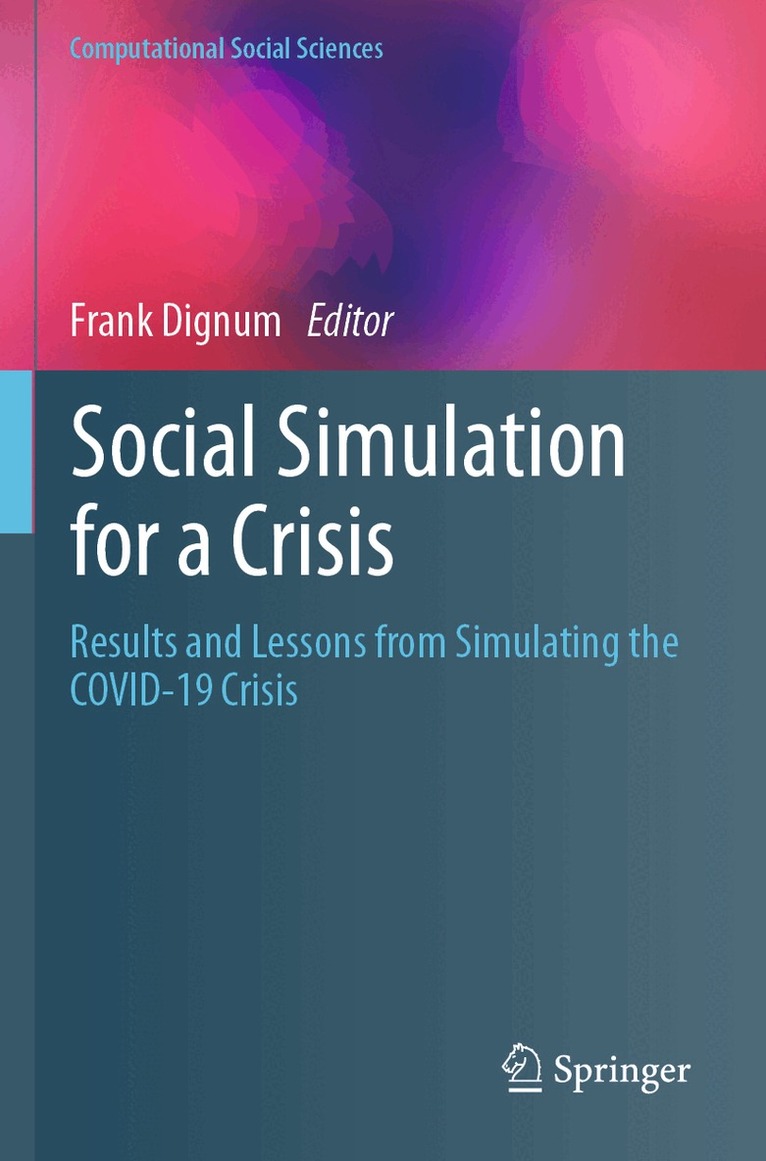
    Social Simulation for a Crisis

    Results and Lessons from Simulating the COVID-19 Crisis

    AvFrank Dignum

    Häftad, Engelska, 2022

    Del i serien Computational Social Sciences

    1 750 kr

    Beställningsvara. Skickas inom 5-8 vardagar. Fri frakt över 249 kr.

    Beskrivning

    Simulating for a crisis is far more than creating a simulation of a crisis situation. In order for a simulation to be useful during a crisis, it should be created within the space of a few days to allow decision makers to use it as quickly as possible. Furthermore, during a crisis the aim is not to optimize just one factor, but to balance various, interdependent aspects of life. In the COVID-19 crisis, decisions had to be made concerning e.g. whether to close schools and restaurants, and the (economic) consequences of a 3 or 4-week lock-down had to be considered. As such, rather than one simulation focusing on a very limited aspect, a framework allowing the simulation of several different scenarios focusing on different aspects of the crisis was required. Moreover, the results of the simulations needed to be easily understandable and explainable: if a simulation indicates that closing schools has no effect, this can only be used if the decision makers can explain why this is the case. This book describes how a simulation framework was created for the COVID-19 crisis, and demonstrates how it was used to simulate a wide range of scenarios that were relevant for decision makers at the time. It also discusses the usefulness of the approach, and explains the decisions that had to be made along the way as well as the trade-offs. Lastly, the book examines the lessons learned and the directions for the further development of social simulation frameworks to make them better suited to crisis situations, and to foster a more resilient society.

    Produktinformation

    • Utgivningsdatum:2022-06-10
    • Mått:155 x 235 x 26 mm
    • Vikt:703 g
    • Format:Häftad
    • Språk:Engelska
    • Serie:Computational Social Sciences
    • Antal sidor:453
    • Förlag:Springer Nature Switzerland AG
    • ISBN:9783030763992

    Utforska kategorier

    • Referensverk och tvärvetenskap inom Samhälle och politik
    • Biokemisk teknik inom Naturvetenskap och teknik
    • Kombinatorik och grafteori inom Naturvetenskap och teknik

    Mer om författaren

    Frank Dignum is a Dutch computer scientist. Since February 2019 he is a Professor of Socially-Aware AI at Umeå University and a part-time associate professor at the Department of Information and Computing Sciences of the Utrecht University. He also is a honorary principle research fellow in the Department of Computing and Information Systems at the University of Melbourne. Dignum is best known from his work on software agents, multi-agent systems and fundamental aspects of social agents including norms, social rules and communication. This work is performed in the context of social simulations, games and dialogue management systems.Dignum received his PhD in 1989 from the VU University Amsterdam. He started his academic career as assistant professor and chair of the department of Computer Science at the University of Swaziland in 1990. In 1992 he moved back to Portugal and became assistant professor at the Instituto Superior Técnico in Lisbon. After coming back in the Netherlands in 1993 as assistant professor at Eindhoven University of Technology, in 2000 he was appointed Associate professor at the Department of Information and Computing Sciences of the Utrecht University.

    Innehållsförteckning

    • Part 1. ASOCC Theory and Platform.- Chapter 1. Introduction.- Chapter 2. Foundations.- Chapter 3. From Theories to Implementation.- Chapter 4. Simulation Use.- Part II. Scenario's and Submodels.- Chapter 5. Closing of Schools.- Chapter 6. Testing & Smart Testing.- Chapter 7. Deployment and Effects of an App for Tracking and Tracing Contacts.- Chapter 8. How Culture Influences the Management of a Pandemic: Simulating the Effect of Culture on the Effective Management of the COVID-19 crisis,- Chapter 9. Economics.- Chapter 10. Exit Strategies.- Part III. Results and Lessons Learned.- Chapter 11. Extensible Model-Building in Crises.- Chapter 12. Comparative Validation of Simulation Models for the COVID-19 Pandemic.- Chapter 13. Supporting Policy Makers in a Crisis.- Chapter 14. From Crisis to Resilience Support.- Chapter 15. Challenges and Issues.- Chapter 16. Conclusions.