• Fri frakt över 249 kr
  • •
  • Snabba leveranser
  • •
  • Billiga böcker
Kundservice

Du är på sajten för privatpersoner.

Företag, bibliotek eller offentlig verksamhet?

Du handlar på classic.bokus.com, där alla dina funktioner finns intakta.
Till classic.bokus.com
Bokus logotyp. Gå till startsidan.
  • Erbjudanden
  • Nyheter
  • Student
  • Topplistor
  • Barn & ungdom
  • Bokus Play
  • E-böcker
  • Pocketböcker
  • Spel & pussel

Må bättre, för mindre! Upp till 50% rabatt på hälsoböcker

Sidfot

Mina sidor

    Hjälp

    • Kundservice
    • Vanliga frågor och svar
    • Frakt och leverans
    • Retur vid ångerrätt
    • Reklamera vara
    • Betalning
    • Köpvillkor
    • Allmänna villkor
    • Information om webbplatsens tillgänglighet

    Om Bokus

    • Om oss
    • Pressrum
    • För studenter
    • För företag
    • För bibliotek och offentlig verksamhet
    • För leverantörer
    • Hållbarhet

    Populärt

    • Aktuella erbjudanden
    • Presentkort
    • Studentlitteratur
    • Nya böcker
    • Topplistor
    • Signerade böcker
    • Engelska böcker

    Inspiration

    • Boktips
    • BookTok
    • Populära bokserier
    • Barnbokskaraktärer
    • Populära författare
    Logotyp för Bokus
    Följ oss på Facebook (extern länk)Följ oss på Instagram (extern länk)Följ oss på YouTube (extern länk)Följ oss på TikTok (extern länk)
    bokus @ CookiesAnpassa cookiesIntegritetspolicyKöpvillkor
    Till Citymail hemsida (extern länk)Till Budbee hemsida (extern länk)Till Postnord hemsida (extern länk)Till Schenker hemsida (extern länk)Till Early Bird hemsida (extern länk)Till Walleys hemsida (extern länk)
    1. Samhälle och politik
    2. Politik och statsskick
    3. Centralt styre och förvaltning

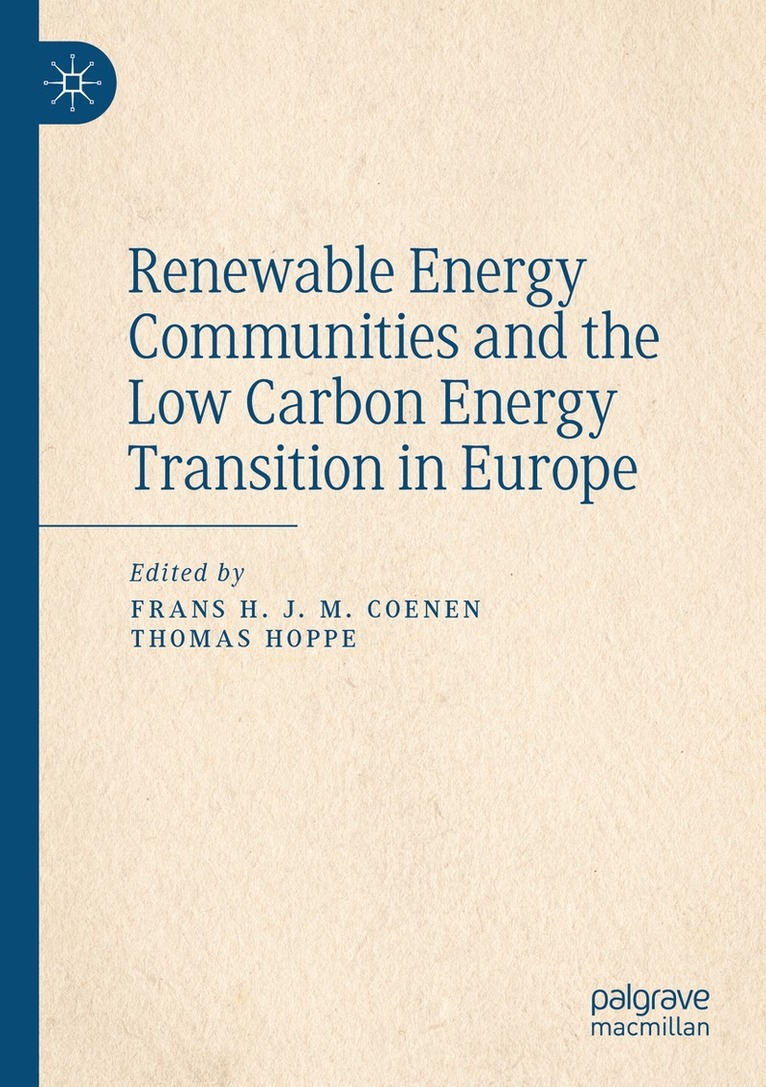
    Renewable Energy Communities and the Low Carbon Energy Transition in Europe

    AvFrans H. J. M. Coenen,Thomas Hoppe

    Häftad, Engelska, 2023

    1 302 kr

    Beställningsvara. Skickas inom 10-15 vardagar. Fri frakt över 249 kr.

    Beskrivning

    This volume addresses renewable energy communities, and in particular renewable energy cooperatives (REScoops), in the context of the revised EU Renewables Directive. It provides a comprehensive account of the history and development of the renewable energy community movement in over six different countries of continental Europe. It addresses their visions, strategy, organisation, agency, and more particularly the challenges they encounter. This is of particular importance to gain more understanding into how renewable energy communities fare in domestic energy markets where they are confronted with regime institutions, structures and incumbents’ agency that tend to favour maintaining of the status quo while blocking attempts to empower and institutionalise renewable energy communities as market entrants having a disruptive, radical green and localist agenda. This volume will be an invaluable reference for academics and practitioners with an interest in social innovation insustainable transitions, the role of community energy in energy markets, their agency, as well as an outlook to the impact that the EU Renewables Directive may have to change national legislation and policy frameworks to create a level playing field that is essentially more fair and beneficial to renewable energy communities.

    Produktinformation

    • Utgivningsdatum:2023-01-05
    • Mått:148 x 210 x 17 mm
    • Vikt:401 g
    • Format:Häftad
    • Språk:Engelska
    • Antal sidor:289
    • Förlag:Springer Nature Switzerland AG
    • ISBN:9783030844424

    Utforska kategorier

    • Centralt styre och förvaltning inom Samhälle och politik
    • Energiteknik inom Naturvetenskap och teknik
    • Miljövetenskap och miljöpolitik inom Naturvetenskap och teknik

    Mer om författaren

    Frans H.J.M. Coenen is Associate Professor within the Faculty of Behavioural, Management and Social sciences of the University of Twente.  Over the years, his research particular focused on local and regional sustainable development and capacity development for sustainable development. He takes a special interest in participation in sustainable development in relation to the quality of environmental decision-making.  He is specialised in environmental policy planning and in public policy evaluation.  At this moment, he is involved in several research projects in the field of renewable energy and the local energy transition.Thomas Hoppe holds a Master’s degree in Public Administration specializing in Public Policy and Environmental Policy, and a PhD in Public Policy at the University of Twente. He is currently  Associate Professor within the Faculty of Technology, Policy and Management at Delft University of Technology. His research line is about governance of energy transition in cities and regions, focusing on low carbon cities, policy and social innovation. This more specifically includes community energy and co-creation. Dr. Hoppe has been involved in multiple European Union research projects and has co-edited eight special issues in academic journals. He is chairman of the Platform of Social Innovation in the Energy Transition, and is in the Editorial Board of Energy, Sustainability and Society.

    Innehållsförteckning

    • Chapter 1: Introduction.- Chapter 2: “What are Energy Communities Under the EU’s Clean Energy Package?”.- Chapter 3: Community energy on the east side of the Baltic Sea Region: from standstill to first steps.- Chapter 4: Clean energy transition in Southeast Europe: The paradigm of Greece from a fossil fuel mediator to a community energy hub.- Chapter 5: The community energy sector in Italy; historical perspective and recent evolution.- Chapter 6: Community Energy in Germany: From Technology Pioneers to Professionalisation under Uncertainty.- Chapter 7: Support structures for renewable energy communities.- Chapter 8: Energy Communities promoting Home Energy Savings: Interventions, Theory and Results.- Chapter 9: Creating an enabling policy framework for inclusive energy communities: a gender perspective.- Chapter 10: Housing communities as low-carbon energy pioneers Experiences from the Netherlands.- Chapter 11: Conclusion.