• Fri frakt över 249 kr
  • •
  • Snabba leveranser
  • •
  • Billiga böcker
Kundservice

Du är på sajten för privatpersoner.

Företag, bibliotek eller offentlig verksamhet?

Du handlar på classic.bokus.com, där alla dina funktioner finns intakta.
Till classic.bokus.com
Bokus logotyp. Gå till startsidan.
  • Erbjudanden
  • Student
  • Topplistor
  • Barn & ungdom
  • Bokus Play
  • E-böcker
  • Ljudböcker
  • Pocketböcker
  • Spel & pussel

Upp till 25% på utvalda nyheter →

Sidfot

Mina sidor

    Hjälp

    • Kundservice
    • Vanliga frågor och svar
    • Frakt och leverans
    • Retur vid ångerrätt
    • Reklamera vara
    • Betalning
    • Köpvillkor
    • Allmänna villkor
    • Information om webbplatsens tillgänglighet

    Om Bokus

    • Om oss
    • Pressrum
    • För studenter
    • För företag
    • För bibliotek och offentlig verksamhet
    • För leverantörer
    • Hållbarhet

    Populärt

    • Aktuella erbjudanden
    • Presentkort
    • Studentlitteratur
    • Nya böcker
    • Topplistor
    • Signerade böcker
    • Engelska böcker

    Inspiration

    • Boktips
    • BookTok
    • Populära bokserier
    • Barnbokskaraktärer
    • Populära författare
    Logotyp för Bokus
    Följ oss på Facebook (extern länk)Följ oss på Instagram (extern länk)Följ oss på YouTube (extern länk)Följ oss på TikTok (extern länk)
    bokus @ CookiesAnpassa cookiesIntegritetspolicyKöpvillkor
    Till Citymail hemsida (extern länk)Till Budbee hemsida (extern länk)Till Postnord hemsida (extern länk)Till Schenker hemsida (extern länk)Till Early Bird hemsida (extern länk)Till Walleys hemsida (extern länk)
    1. Naturvetenskap och teknik
    2. Matematik och naturvetenskap
    3. Kemi
    4. Fysikalisk kemi

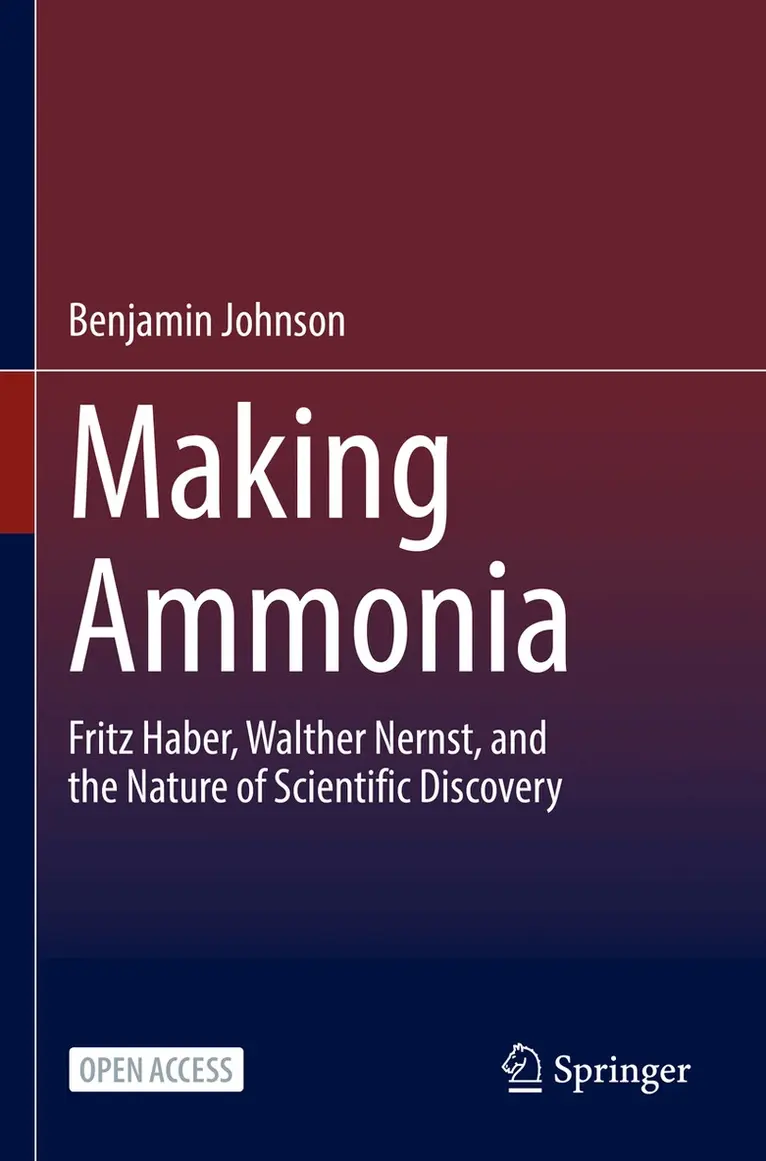
    Making Ammonia

    Fritz Haber, Walther Nernst, and the Nature of Scientific Discovery

    AvBenjamin Johnson

    Häftad, Engelska, 2022

    439 kr

    Beställningsvara. Skickas inom 10-15 vardagar. Fri frakt över 249 kr.

    Fler format och utgåvor

    Inbunden

    547 kr

    Beskrivning

    This Open Access book discusses the progress of science and the transfer of scientific knowledge to technological application. It also identifies the factors necessary to achieve this progress. Based on a case study of the physical chemist Fritz Haber's discovery of ammonia synthesis between 1903 and 1909, the book places Haber's work in historical and scientific (physicochemical) context. The scientific developments of the preceding century are framed in a way that emphasizes the confluence of knowledge needed for Haber's success. Against this background, Haber's work is presented in detail along with the indispensable contributions of his colleague, the physical chemist, Walter Nernst, and their assistants. The detailed accounts of scientific advancement remind us of the physical basis on which our scientific theories and ideas are built. Without this reminder we often forget how complex, and how beautiful achievements in science can be.

    Produktinformation

    • Utgivningsdatum:2022-05-11
    • Mått:155 x 235 x 24 mm
    • Vikt:458 g
    • Format:Häftad
    • Språk:Engelska
    • Antal sidor:278
    • Förlag:Springer Nature Switzerland AG
    • ISBN:9783030855345

    Utforska kategorier

    • Fysikalisk kemi inom Naturvetenskap och teknik
    • Naturvetenskapens historia inom Naturvetenskap och teknik

    Mer om författaren

    Dr. Benjamin Johnson completed his Ph.D. in physics in 2010 at the Technische Universität Berlin with a thesis on thin layer solar cells investigated with X-ray spectroscopic methods. His later research focused on catalytic materials for alternative fuels. In 2015, Dr. Johnson began research in the field of science history, investigating progress in science and technological innovation. His work has resulted in a detailed portrayal of Fritz Haber’s discovery of ammonia synthesis in the first decade of the twentieth century. Continuing in the direction of scientific and technological development, Dr. Johnson is now applying these ideas to prospective technologies for the current energy transition. His approach combines the natural sciences with history and science communication to provide a roadmap for science-based governance incorporating voices from civil society

    Recensioner i media

    “Making Ammonia is a well-written and engaging book that makes a significant contribution to our understanding of the history of the ammonia synthesis. Johnson’s book is particularly strong in its exploration of the social and political context in which Fritz Haber worked and provides us with a vivid account of how cultural, technical, and social factors concur in producing a scientific discovery.” (Massimiliano Badino, The British Journal for the History of Science, Vol. 57 (2), June, 2024)

    Innehållsförteckning

    • Part I: A Confluence of Factors.- Chapter 1. The Object of Investigation.- Chapter 2. The Scientification of Agriculture.- Chapter 3. Advances in Organic Chemistry, Catalysis, and the Chemical Industry.- Chapter 4. The Mystery of Ammonia Synthesis.- Chapter 5. Physical Chemistry: Uniting Two Branches of Science.- Chapter 6. The Scientific Breakthrough (1903-1908).- Chapter 7. The Challenge of Technical Implementation.- Chapter 8. Reflections on Scientific Discovery and The Haze.- Part II: The Scientific Breakthrough.- Chapter 9. The State of Ammonia Synthesis at the turn of the Twentieth Century: The Arena for Discovery.- Chapter 10. Fritz Haber’s Work and Thought as He Began Work on Ammonia Synthesis.- Chapter 11. The Scientific Publications on Ammonia Synthesis.- Chapter 12. Haber’s Cooperation with BASF.- Chapter 13. The Role of Physical Chemistry as a Theory.- Chapter 14. Further Reflections on Scientific Discovery and The Haze.- Appendix A. Approximations of Free Energy Fitting Functions.- Appendix B. Theoretical Determinations of the Free Energy: Hermann von Helmholtz and Walther Nernst.- Part III: The Haze.- Chapter 15. Terminology.- Chapter 16. Normal Science.- Chapter 17. The Structure of The Haze.- Chapter 18. Dynamic of The Haze.- Chapter 19. Between Science and Industry: The Stage of 10-100.- Chapter 20. Risk and the Acceptance of Failure.- Chapter 21. The Haze: Interdependencies in Science.- Chapter 22. One Final Element.