• Fri frakt över 249 kr
  • •
  • Snabba leveranser
  • •
  • Billiga böcker
Kundservice

Du är på sajten för privatpersoner.

Företag, bibliotek eller offentlig verksamhet?

Du handlar på classic.bokus.com, där alla dina funktioner finns intakta.
Till classic.bokus.com
Bokus logotyp. Gå till startsidan.
  • Erbjudanden
  • Nyheter
  • Student
  • Topplistor
  • Barn & ungdom
  • Bokus Play
  • E-böcker
  • Pocketböcker
  • Spel & pussel

10% rabatt på allt med kod NYSTART10 →

Sidfot

Mina sidor

    Hjälp

    • Kundservice
    • Vanliga frågor och svar
    • Frakt och leverans
    • Retur vid ångerrätt
    • Reklamera vara
    • Betalning
    • Köpvillkor
    • Allmänna villkor
    • Information om webbplatsens tillgänglighet

    Om Bokus

    • Om oss
    • Pressrum
    • För studenter
    • För företag
    • För bibliotek och offentlig verksamhet
    • För leverantörer
    • Hållbarhet

    Populärt

    • Aktuella erbjudanden
    • Presentkort
    • Studentlitteratur
    • Nya böcker
    • Topplistor
    • Signerade böcker
    • Engelska böcker

    Inspiration

    • Boktips
    • BookTok
    • Populära bokserier
    • Barnbokskaraktärer
    • Populära författare
    Logotyp för Bokus
    Följ oss på Facebook (extern länk)Följ oss på Instagram (extern länk)Följ oss på YouTube (extern länk)Följ oss på TikTok (extern länk)
    bokus @ CookiesAnpassa cookiesIntegritetspolicyKöpvillkor
    Till Citymail hemsida (extern länk)Till Budbee hemsida (extern länk)Till Postnord hemsida (extern länk)Till Schenker hemsida (extern länk)Till Early Bird hemsida (extern länk)Till Walleys hemsida (extern länk)
    1. Ekonomi och Ledarskap
    2. Företagsekonomi
    3. Entreprenörskap

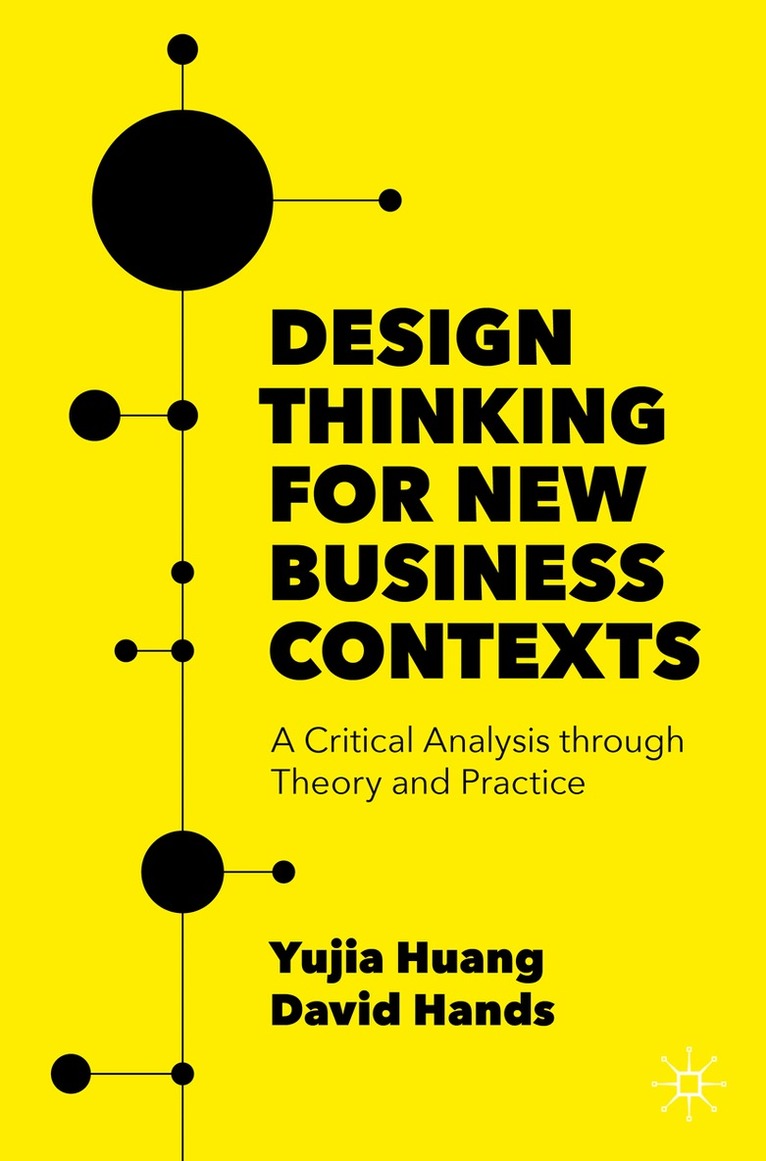
    Design Thinking for New Business Contexts

    A Critical Analysis through Theory and Practice

    AvYujia Huang,David Hands

    Häftad, Engelska, 2022

    1 007 kr

    Beställningsvara. Skickas inom 10-15 vardagar. Fri frakt över 249 kr.

    Beskrivning

    This textbook identifies and critically explores the new business landscape through the lens of design thinking and contemporary industry practice, bridging the divide between the design and business domains. The book outlines the evolution of design thinking and the relationship between business and design, as well as provides in-depth studies of design thinking in turbulent business contexts, that includes the themes of sustainability, branding and organisational innovation. At its core, it articulates that design thinking is vital to establishing dynamic interdisciplinary thinking models that lead to organizational innovation. Featuring case studies and learning tasks, the book presents design thinking for readers as an organisational philosophy as opposed to a simple problem-solving tool.

    Produktinformation

    • Utgivningsdatum:2022-04-28
    • Mått:155 x 235 x 23 mm
    • Vikt:358 g
    • Format:Häftad
    • Språk:Engelska
    • Antal sidor:210
    • Förlag:Springer Nature Switzerland AG
    • ISBN:9783030942052

    Utforska kategorier

    • Entreprenörskap inom Ekonomi och Ledarskap
    • Affärsutveckling inom Ekonomi och Ledarskap
    • Industrier och branscher inom Ekonomi och Ledarskap

    Mer om författaren

    Yujia Huang is a lecturer at University of Dundee, Scotland. Drawing upon her extensive industry experience and academic development in design, she adopts a systematic and transdisciplinary approach that critically addresses individual, organisational, and social problems and innovation. Her expertise lies in design thinking applications, design-driven business innovation, and user-centred design research.David Hands is an academic and leading author on all aspects of transformational design leadership. His research interests are varied and diverse, encompassing design driven innovation, design policy development and implementation, knowledge diffusion and strategic growth within SME's and large organisations.

    Innehållsförteckning

    • 1 Introduction.- 1.1 Introduction.- 1.2 Background to Design Thinking for new Business Contexts.- 1.3 Structure of Content.- 1.4 Using the Book: A Reader’s Guide.- 2 Evolution of the Relationship Between Design and Business Activities.- 2.1 Introduction.- 2.2 Design Thinking and Design[ing].- 2.3 Design Thinking and Business Planning Activities.- 2.4 Design Thinking and Business Strategy.- 2.5 Design Thinking in SMES.- References.- 3 Crossing Boundaries: Design into Business and Management.- 3.1 Introduction.- 3.2 Design for Business: The Critical Imperative.- 3.3 Teaching Design in Design Schools.- 3.4 Teaching Business Management in Business Schools.- 3.5 Academia and Industry: Design Alliances.- References.- 4 Organisational Complexity and Change by Design.- 4.1 Introduction.- 4.2 Managing Complexity and theOrganisation.- 4.3 Managing Uncertainty in Unpredictable Times.- 4.4 Organisational Change Management.- 4.5 A Designerly Approach to Organisational Change.- References.- 5 Business Thinking Through Design.- 5.1 Introduction.- 5.2 Economic Systems that Shape Business Environments.- 5.3 New Economic Systems Reshaping the Business Environment.- 5.4 Types of Organisations.- 5.5 Business Structures.- 5.6 Business Composition.- 5.7 Design Thinking: Tensions and Challenges.- References.- 6 Design Thinking for Sustainable Futures.- 6.1 Introduction.- 6.2 Mission Impossible?.- 6.3 Sustainable Futures.- 6.4 Corporate Social Responsibility.- 6.5 Social Enterprises—A Hybrid Business Model.- References.- 7 Design Thinking for Branding.- 7.1 Introduction.- 7.2 Brand Audit, Consumer Ethnography, and Design Thinking.- 7.3 Identifying Branding Problems and/or Opportunities.- 7.4 Design Thinking and the Development of Branding Strategies.- References.- 8 Design Thinking: Practice and Applications.- 8.1 Introduction.- 8.2 Design Processes, Methods and Tools.- 8.3 Case Example 1: Hitachi ABB Power Grids.- 8.4 Case Example 2: Maas Global.- 8.5 Understanding the Student Learning Experience Through a Design Methods Approach.- References.- 9 Design Directions and Future Trajectories.- 9.1 Introduction.- 9.2 Design Influences and Contested Territories.- 9.3 Democratic Design.- 9.4 Data and Design.- 9.5 Design Directions in an Era of Uncertainty.- References.- 10 Summary.- 10.1 The Design Nexus: Reflections and Reorganisation.- 10.2 Design Values.- 10.3 Design Commonwealth.- 10.4 Design Perspectives.- 10.5 Design Transformations.- 10.6 Design Futures.- 10.7 Final Reflections.