• Fri frakt över 249 kr
  • •
  • Snabba leveranser
  • •
  • Billiga böcker
Kundservice

Du är på sajten för privatpersoner.

Företag, bibliotek eller offentlig verksamhet?

Du handlar på classic.bokus.com, där alla dina funktioner finns intakta.
Till classic.bokus.com
Bokus logotyp. Gå till startsidan.
  • Erbjudanden
  • Nyheter
  • Student
  • Topplistor
  • Barn & ungdom
  • Bokus Play
  • E-böcker
  • Pocketböcker
  • Spel & pussel

10% rabatt på allt med kod: NYSTART10 →

Sidfot

Mina sidor

    Hjälp

    • Kundservice
    • Vanliga frågor och svar
    • Frakt och leverans
    • Retur vid ångerrätt
    • Reklamera vara
    • Betalning
    • Köpvillkor
    • Allmänna villkor
    • Information om webbplatsens tillgänglighet

    Om Bokus

    • Om oss
    • Pressrum
    • För studenter
    • För företag
    • För bibliotek och offentlig verksamhet
    • För leverantörer
    • Hållbarhet

    Populärt

    • Aktuella erbjudanden
    • Presentkort
    • Studentlitteratur
    • Nya böcker
    • Topplistor
    • Signerade böcker
    • Engelska böcker

    Inspiration

    • Boktips
    • BookTok
    • Populära bokserier
    • Barnbokskaraktärer
    • Populära författare
    Logotyp för Bokus
    Följ oss på Facebook (extern länk)Följ oss på Instagram (extern länk)Följ oss på YouTube (extern länk)Följ oss på TikTok (extern länk)
    bokus @ CookiesAnpassa cookiesIntegritetspolicyKöpvillkor
    Till Citymail hemsida (extern länk)Till Budbee hemsida (extern länk)Till Postnord hemsida (extern länk)Till Schenker hemsida (extern länk)Till Early Bird hemsida (extern länk)Till Walleys hemsida (extern länk)
    1. Naturvetenskap och teknik
    2. Teknik och industri
    3. Teknik: allmänt

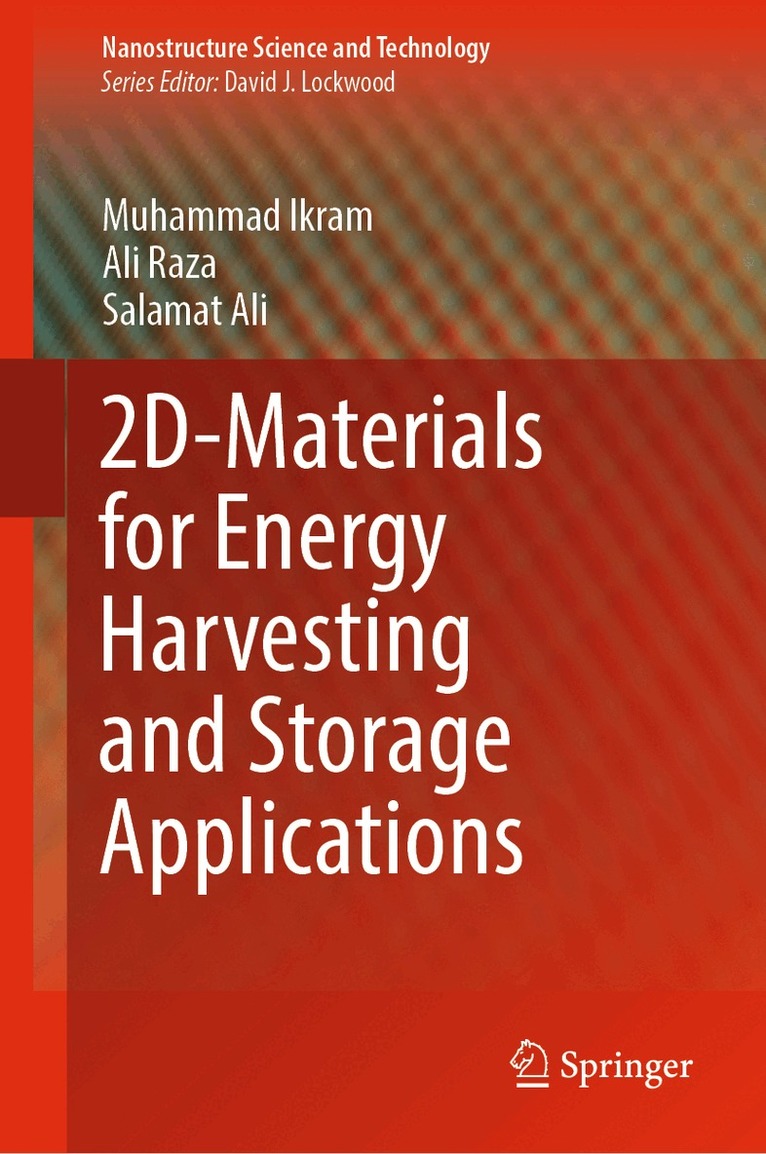
    2D-Materials for Energy Harvesting and Storage Applications

    AvMuhammad Ikram,Ali Raza

    Inbunden, Engelska, 2022

    Del i serien Nanostructure Science and Technology

    1 734 kr

    Beställningsvara. Skickas inom 10-15 vardagar. Fri frakt över 249 kr.

    Fler format och utgåvor

    Häftad

    1 734 kr

    Beskrivning

    This authored monograph presents the state-of-the-art improvements in 2D materials, focusing on their most significant achievements, as well as recent emergence and potential applications. The book discusses synthetic protocols as well as the structural chemistry and physical properties of various 2D materials and explores their energy-related utilization. The main energy harvesting applications such as piezoelectric generators, solar cells and hydrogen evolution reactions are analyzed, while special focus is also given to the related energy storage technologies such as rechargeable batteries, supercapacitors and wearable energy storage devices. This volume sheds new light on 2D materials and their applications and will be a useful tool for graduates and academics working in the fields of materials science, materials physics and chemistry.

    Produktinformation

    • Utgivningsdatum:2022-03-02
    • Mått:155 x 235 x 21 mm
    • Vikt:571 g
    • Format:Inbunden
    • Språk:Engelska
    • Serie:Nanostructure Science and Technology
    • Antal sidor:250
    • Förlag:Springer Nature Switzerland AG
    • ISBN:9783030960209

    Utforska kategorier

    • Teknik: allmänt inom Naturvetenskap och teknik
    • Kemi inom Naturvetenskap och teknik
    • Maskinteknik och material inom Naturvetenskap och teknik

    Mer om författaren

    Dr. Muhammad Ikram obtained his Master's degree (M. Phil Physics) from Bahauddin Zakariya University, Multan, Pakistan in 2010. He obtained his Ph.D. degree in Physics from the Department of Physics, Government College University (GCU) Lahore through the Pak-US joint project between the Department of Physics, GCU Lahore, Pakistan, and the University of Delaware, USA in 2015. He served as deputy director of Manuscript Science at Punjab textbook board (Pakistan). Later on (2017-to date), Ikram joined the Department of Physics, GC University Lahore as an Assistant Professor of Physics and Principal of Solar Cell Applications Lab. Ikram received the Seal of Excellence Marie Skłodowska Curie Actions Individual Fellowship in 2017 and 2020. In 2021, Ikram was included in the 2 % top scientists from Pakistan announced by Stanford University. His research interest involves the synthesis and characterization of inorganic semiconductor nanomaterials, 2D materials for water treatment optoelectronic, and electrocatalytic applications.Mr. Ali Raza obtained his B.S (Physics) degree from the University of Gujrat (Punjab, Pakistan) in 2016 and his Master's degree (M. Phil) in Material Physics from Riphah International University, Islamabad Pakistan in 2019. Raza completed his M. Phil research work in the Solar Cell Applications Lab at GCU Lahore (Punjab, Pakistan) and later worked as a Research Associate in the same lab on the field of catalytic and energy harvesting applications of pure and engineered 2D materials (TMDCs, Graphene, h-BN, and MXenes). Currently, he is serving as Lecturer (Research) at the Department of Physics, University of Sialkot, Punjab, and has enrolled as a Ph.D. scholar at CAS Key Laboratory of Design and Assembly of Functional Nanostructures, Fujian Institute of Research on the Structure of Matter, CAS.  His current research directions are the fabrication of functional 2D-Materials for catalytic and other energy-harvesting applications.Prof.  Dr. Salamat Ali is working as a Professor of Physics at Riphah Institute of Computing and Applied Sciences (RICAS), Riphah International University Lahore Campus, and Retired as a Full Professor of Physics from GC University Lahore. He has completed his Ph.D. in 1996 from the Durham University, U.K. in Superconductivity and Magnetism and his Post-Doc. in 2006 from the K.F. University of Graz, Austria, with specialization in Nanotechnology. He also completed training in Solar Cell Technology from the University of Delaware, USA in 2012. His current research interests include Water purifications, Sensor technology, Development of medicines for cancer treatment. He has 35 years of experience in Material Science.

    Innehållsförteckning

    • Introduction.- Advances in Ultrathin 2D-materials.- Composition and Materials Chemistry.- Synthetic Protocols.- 2D-Heterostructures.- Energy-related Applications.- Concluding Remarks and Outlook.