• Fri frakt över 249 kr
  • •
  • Snabba leveranser
  • •
  • Billiga böcker
Kundservice

Du är på sajten för privatpersoner.

Företag, bibliotek eller offentlig verksamhet?

Du handlar på classic.bokus.com, där alla dina funktioner finns intakta.
Till classic.bokus.com
Bokus logotyp. Gå till startsidan.
  • Erbjudanden
  • Nyheter
  • Student
  • Topplistor
  • Barn & ungdom
  • Bokus Play
  • E-böcker
  • Pocketböcker
  • Spel & pussel

10% rabatt på allt med kod NYSTART10 →

Sidfot

Mina sidor

    Hjälp

    • Kundservice
    • Vanliga frågor och svar
    • Frakt och leverans
    • Retur vid ångerrätt
    • Reklamera vara
    • Betalning
    • Köpvillkor
    • Allmänna villkor
    • Information om webbplatsens tillgänglighet

    Om Bokus

    • Om oss
    • Pressrum
    • För studenter
    • För företag
    • För bibliotek och offentlig verksamhet
    • För leverantörer
    • Hållbarhet

    Populärt

    • Aktuella erbjudanden
    • Presentkort
    • Studentlitteratur
    • Nya böcker
    • Topplistor
    • Signerade böcker
    • Engelska böcker

    Inspiration

    • Boktips
    • BookTok
    • Populära bokserier
    • Barnbokskaraktärer
    • Populära författare
    Logotyp för Bokus
    Följ oss på Facebook (extern länk)Följ oss på Instagram (extern länk)Följ oss på YouTube (extern länk)Följ oss på TikTok (extern länk)
    bokus @ CookiesAnpassa cookiesIntegritetspolicyKöpvillkor
    Till Citymail hemsida (extern länk)Till Budbee hemsida (extern länk)Till Postnord hemsida (extern länk)Till Schenker hemsida (extern länk)Till Early Bird hemsida (extern länk)Till Walleys hemsida (extern länk)
    1. Naturvetenskap och teknik
    2. Matematik och naturvetenskap
    3. Fysik
    4. Tillämpad fysik

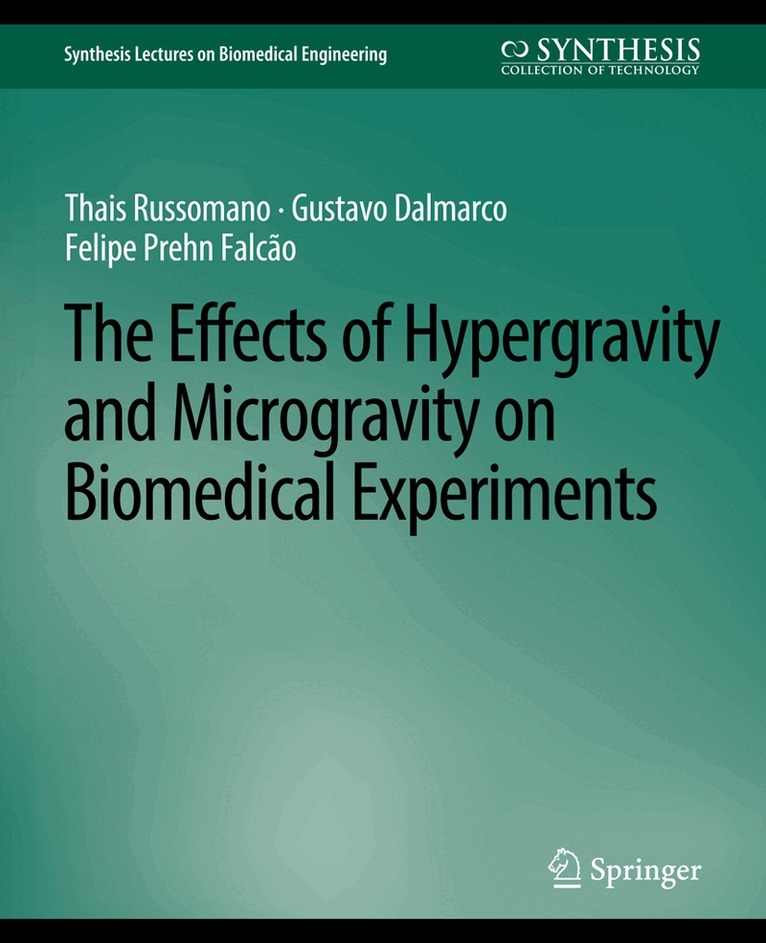
    Effects of Hypergravity and Microgravity on Biomedical Experiments, The

    AvThais Russomano,Gustavo Dalmarco

    Häftad, Engelska, 2007

    Del i serien Synthesis Lectures on Biomedical Engineering

    318 kr

    Beställningsvara. Skickas inom 10-15 vardagar. Fri frakt över 249 kr.

    Beskrivning

    Take one elephant and one man to the top of a tower and simultaneously drop. Which will hit the ground first? You are a pilot of a jet fighter performing a high-speed loop. Will you pass out during the maneuver? How can you simulate being an astronaut with your feet still firmly placed on planet Earth? In the aerospace environment, human, animal, and plant physiology differs significantly from that on Earth, and this book provides reasons for some of these changes. The challenges encountered by pilots in their missions can have implications on the health and safety of not only themselves but others. Knowing the effects of hypergravity on the human body during high-speed flight led to the development of human centrifuges. We also need to better understand the physiological responses of living organisms in space. It is therefore necessary to simulate weightlessness through the use of specially adapted equipment, such as clinostats, tilt tables, and body suspension devices. Each of theseideas, and more, is addressed in this review of the physical concepts related to space flights, microgravity, and hypergravity simulations. Basic theories, such as Newton’s law and Einstein’s principle are explained, followed by a look at the biomedical effects of experiments performed in space life sciences institutes, universities, and space agencies. Table of Contents: General Concepts in Physics - Definition of Physical Terms / The Effects of Hypergravity on Biomedical Experiments / The Effects of Microgravity on Biomedical Experiments / References

    Produktinformation

    • Utgivningsdatum:2007-12-31
    • Mått:191 x 235 x 5 mm
    • Vikt:169 g
    • Format:Häftad
    • Språk:Engelska
    • Serie:Synthesis Lectures on Biomedical Engineering
    • Antal sidor:70
    • Förlag:Springer International Publishing AG
    • ISBN:9783031004964
    • Originaltitel:Effects of Hypergravity and Microgravity on Biomedical Experiments, The

    Utforska kategorier

    • Tillämpad fysik inom Naturvetenskap och teknik
    • Teknik: allmänt inom Naturvetenskap och teknik
    • Biomedicinsk teknik inom Medicin

    Mer om författaren

    Thais Russomano graduated with a degree in medicine from the Federal University of Pelotas, Brazil, in 1985, a masters degree in aerospace medicine from Wright State University, United States, in 1991, and a doctor of philosophy degree in space physiology from King’s College London, United Kingdom, in 1998. She is the founder and coordinator of the internationally recognized Centre of Microgravity at PUCRS University Brazil (a unique reference center of Latin America in the study of human space physiology and space biomedical engineering), an associate professor of PUCRS University, a guest scientist at the German Space Agency, and a visiting professor/senior research fellow at King’s College London. She has more than 15 years experience in the fields of aerospace medicine, aerospace bio[1]medicine, aerospace biomedical engineering and telemedicine, including participation in numerous scientific events and publication of more than 200 scientific articles. Research areas and professional experience include microgravity, hypogravity and hypergravity simulations, parabolic flights with the European Space Agency, hyperbaric and hypobaric chambers studies, tests in human centrifuges, rotator (Barany) chair, flight simulators, and lower body negative pressure boxes. She won several national and international awards in the area of space life science research. Gustavo Dalmarco is a biomedical engineer and international researcher in aerospace biomedical engineering. He developed projects with research and teaching institutions, such as the German Space Agency and King’s College London and has five years experience working with aerospace medicine research including one European Space Agency parabolic flight campaign. He is involved in the development of hypergravity and micro[1]gravity simulation devices, lower body negative pressure box, human centrifuge, rotator (Barany) chairs, biofeed[1]back systems, and clinostats . Felipe Prehn Falcão is an automation and control engineer and international researcher in aerospace biomedical engineering based at the Cen[1]tre of Microgravity at PUCRS, Brazil. He has 5 years experience in the development of projects with research and teaching institutions in this area working with the German Space Agency, NASA, and King’s College London. He has experience in aerospace medicine research including participation in a European Space Agency parabolic flight campaign (2006). He is involved in the development of hypergravity and microgravity simulation devices, lower-body negative-pressure box, rotator (Barany) chair, clinostat, human centrifuge, and biofeedback systems. Author Biography 70 Effects of Hyper- and Microgravity on biomedical experiments He was responsible for the conception and development of the Valsalva maneuver equipment, gaining national recognition and an award in the Siemens Prize of Technology Innovation for new projects. He published many scientific articles and papers worldwide during congresses and via journals.

    Innehållsförteckning

    • General Concepts in Physics - Definition of Physical Terms.- The Effects of Hypergravity on Biomedical Experiments.- The Effects of Microgravity on Biomedical Experiments.- References.