• Fri frakt över 249 kr
  • •
  • Snabba leveranser
  • •
  • Billiga böcker
Kundservice

Du är på sajten för privatpersoner.

Företag, bibliotek eller offentlig verksamhet?

Du handlar på classic.bokus.com, där alla dina funktioner finns intakta.
Till classic.bokus.com
Bokus logotyp. Gå till startsidan.
  • Erbjudanden
  • Student
  • Topplistor
  • Barn & ungdom
  • Bokus Play
  • E-böcker
  • Ljudböcker
  • Pocketböcker
  • Spel och pussel

5% studentrabatt – använd koden KURSBOK27 →

Sidfot

Mina sidor

    Hjälp

    • Kundservice
    • Vanliga frågor och svar
    • Frakt och leverans
    • Retur vid ångerrätt
    • Reklamera vara
    • Betalning
    • Köpvillkor
    • Allmänna villkor
    • Information om webbplatsens tillgänglighet

    Om Bokus

    • Om oss
    • Pressrum
    • För studenter
    • För företag
    • För bibliotek och offentlig verksamhet
    • För leverantörer
    • Hållbarhet

    Populärt

    • Aktuella erbjudanden
    • Presentkort
    • Studentlitteratur
    • Nya böcker
    • Topplistor
    • Signerade böcker
    • Engelska böcker

    Inspiration

    • Boktips
    • BookTok
    • Barnbokskaraktärer
    • Populära författare
    Logotyp för Bokus
    Följ oss på Facebook (extern länk)Följ oss på Instagram (extern länk)Följ oss på YouTube (extern länk)Följ oss på TikTok (extern länk)
    bokus @ CookiesAnpassa cookiesIntegritetspolicyKöpvillkor
    Till Citymail hemsida (extern länk)Till Budbee hemsida (extern länk)Till Postnord hemsida (extern länk)Till Schenker hemsida (extern länk)Till Early Bird hemsida (extern länk)Till Walleys hemsida (extern länk)
    1. Data och IT
    2. Människa – datorinteraktion

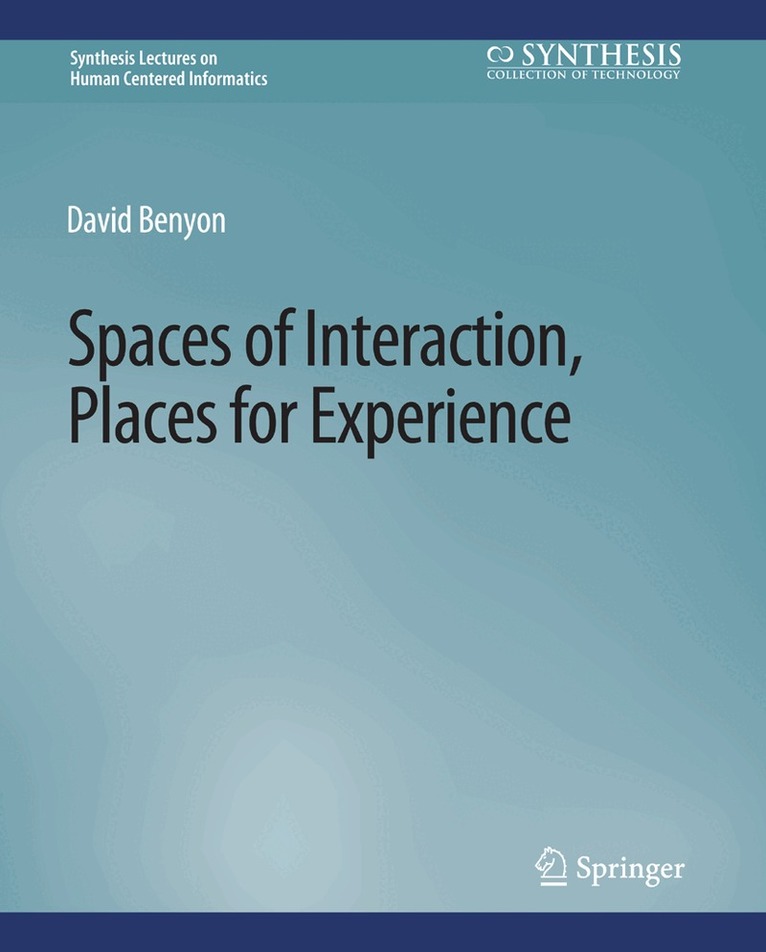
    Spaces of Interaction, Places for Experience

    AvDavid Benyon

    Häftad, Engelska, 2014

    Del i serien Synthesis Lectures on Human-Centered Informatics

    371 kr

    Beställningsvara. Skickas inom 10-15 vardagar. Fri frakt över 249 kr.

    Fler format och utgåvor

    E-bok

    455 kr

    Beskrivning

    Spaces of Interaction, Places for Experience is a book about Human-Computer Interaction (HCI), interaction design (ID) and user experience (UX) in the age of ubiquitous computing. The book explores interaction and experience through the different spaces that contribute to interaction until it arrives at an understanding of the rich and complex places for experience that will be the focus of the next period for interaction design. The book begins by looking at the multilayered nature of interaction and UX—not just with new technologies, but with technologies that are embedded in the world. People inhabit a medium, or rather many media, which allow them to extend themselves, physically, mentally, and emotionally in many directions. The medium that people inhabit includes physical and semiotic material that combine to create user experiences. People feel more or less present in these media and more or less engaged with the content of the media. From this understanding of people in media,the book explores some philosophical and practical issues about designing interactions. The book journeys through the design of physical space, digital space, information space, conceptual space and social space. It explores concepts of space and place, digital ecologies, information architecture, conceptual blending and technology spaces at work and in the home. It discusses navigation of spaces and how people explore and find their way through environments. Finally the book arrives at the concept of a blended space where the physical and digital are tightly interwoven and people experience the blended space as a whole. The design of blended spaces needs to be driven by an understanding of the correspondences between the physical and the digital, by an understanding of conceptual blending and by the desire to design at a human scale. There is no doubt that HCI and ID are changing. The design of “microinteractions” remains important, but there is a bigger picture to consider. UX is spread across devices, over time and across physical spaces. The commingling of the physical and the digital in blended spaces leads to new social spaces and new conceptual spaces. UX concerns the navigation of these spaces as much as it concerns the design of buttons and screens for apps. By taking a spatial perspective on interaction, the book provides new insights into the evolving nature of interaction design.

    Produktinformation

    • Utgivningsdatum:2014-10-01
    • Mått:191 x 235 x 12 mm
    • Vikt:258 g
    • Format:Häftad
    • Språk:Engelska
    • Serie:Synthesis Lectures on Human-Centered Informatics
    • Antal sidor:113
    • Förlag:Springer International Publishing AG
    • ISBN:9783031010781
    • Originaltitel:Spaces of Interaction, Places for Experience

    Utforska kategorier

    • Människa – datorinteraktion inom Data och IT

    Mer om författaren

    David Benyon is Professor of Human-Computer Systems and head of the Center for interaction Design at Edinburgh Napier University in Scotland, UK. He obtained an MSc in Computing and Cognition and completed his Ph.D. in 1993 on the subject of Intelligent User Interfaces. Prof. Benyon has written or edited 11 books on Human-Computer Interaction and Interaction Design and published over 150 academic papers including 30 journal papers. Over the last 7 years he has obtained significant funding to support his research including six major EC grants. Prof. Benyon is a member of several professional societies and is on the editorial board for the journals Knowledge-Based Systems and International Journal of People-Oriented Programming. He has authored a major textbook in the area entitled Designing Interactive Systems (the 3rd edition was published in 2013). One of the key books published by Prof. Benyon is Designing with Blends (with Manuel Imaz, MIT Press, 2007) which has helped to introduceconceptual blending to the interaction design community

    Innehållsförteckning

    • Preface.- Spaces of Interaction.- The Medium of Interaction.- Physical Space.- Digital Space.- Information Space.- Conceptual Space.- Social Space.- Navigating Space.- Blended Spaces.- Places for Experience.- References.- Author Biography.