• Fri frakt över 249 kr
  • •
  • Snabba leveranser
  • •
  • Billiga böcker
Kundservice

Du är på sajten för privatpersoner.

Företag, bibliotek eller offentlig verksamhet?

Du handlar på classic.bokus.com, där alla dina funktioner finns intakta.
Till classic.bokus.com
Bokus logotyp. Gå till startsidan.
  • Erbjudanden
  • Student
  • Topplistor
  • Barn & ungdom
  • Bokus Play
  • E-böcker
  • Ljudböcker
  • Pocketböcker
  • Spel och pussel

Pocketfynda! Hundratals böcker för 49 kr/st →

Sidfot

Mina sidor

    Hjälp

    • Kundservice
    • Vanliga frågor och svar
    • Frakt och leverans
    • Retur vid ångerrätt
    • Reklamera vara
    • Betalning
    • Köpvillkor
    • Allmänna villkor
    • Information om webbplatsens tillgänglighet

    Om Bokus

    • Om oss
    • Pressrum
    • För studenter
    • För företag
    • För bibliotek och offentlig verksamhet
    • För leverantörer
    • Hållbarhet

    Populärt

    • Aktuella erbjudanden
    • Presentkort
    • Studentlitteratur
    • Nya böcker
    • Topplistor
    • Signerade böcker
    • Engelska böcker

    Inspiration

    • Boktips
    • BookTok
    • Barnbokskaraktärer
    • Populära författare
    Logotyp för Bokus
    Följ oss på Facebook (extern länk)Följ oss på Instagram (extern länk)Följ oss på YouTube (extern länk)Följ oss på TikTok (extern länk)
    bokus @ CookiesAnpassa cookiesIntegritetspolicyKöpvillkor
    Till Citymail hemsida (extern länk)Till Budbee hemsida (extern länk)Till Postnord hemsida (extern länk)Till Schenker hemsida (extern länk)Till Early Bird hemsida (extern länk)Till Walleys hemsida (extern länk)
    1. Data och IT
    2. Hårdvara

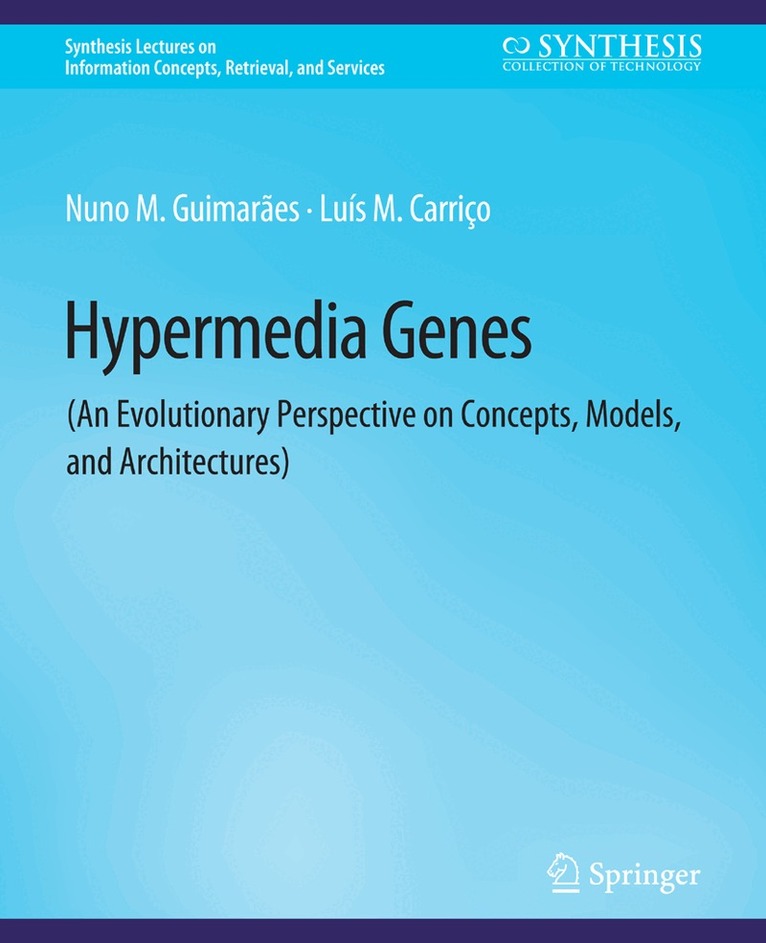
    Hypermedia Genes

    An Evolutionary Perspective on Concepts, Models, and Architectures

    AvNuno Guimaraes,Luis Carrico

    Häftad, Engelska, 2009

    Del i serien Synthesis Lectures on Information Concepts, Retrieval, and Services

    283 kr

    Beställningsvara. Skickas inom 10-15 vardagar. Fri frakt över 249 kr.

    Beskrivning

    The design space of information services evolved from seminal works through a set of prototypical hypermedia systems and matured in open and widely accessible web-based systems. The original concepts of hypermedia systems are now expressed in different forms and shapes. The first works on hypertext invented the term itself, laid out the foundational concept of association or link, and highlighted navigation as the core paradigm for the future information systems. The first engineered systems demonstrated architectural requirements and models and fostered the emergence of the conceptual model related with the information systems and the information design. The artifacts for interaction, navigation, and search, grew from the pioneering systems. Multimedia added a new dimension to hypertext, and mutated the term into hypermedia. The adaptation of the primitive models and mechanisms to the space of continuous media led to a further conceptual level and to the reinvention of information design methods. Hypermedia systems also became an ideal space for collaboration and cooperative work. Information access and sharing, and group work were enabled and empowered by distributed hypermedia systems. As with many technologies, a winning technical paradigm, in our case the World Wide Web, concentrated the design options, the architectural choices and the interaction and navigation styles. Since the late nineties, the Web became the standard framework for hypermedia systems, and integrated a large number of the initial concepts and techniques. Yet, other paths are still open. This lecture maps a simple "genome" of hypermedia systems, based on an initial survey of primitive systems that established architectural and functional characteristics, or traits. These are analyzed and consolidated using phylogenetic analysis tools, to infer families of systems and evolution opportunities. This method may prove to be inspiring for more systematic perspectives of technological landscapes. Table of Contents: Introduction / Original Visions and Concepts / Steps in the Evolution / Information and Structured Documents / Web-Based Environments / Some Research Trends / A Framework of Traits / A Phylogenetic Analysis / Conclusion

    Produktinformation

    • Utgivningsdatum:2009-10-20
    • Mått:191 x 235 x 6 mm
    • Vikt:183 g
    • Format:Häftad
    • Språk:Engelska
    • Serie:Synthesis Lectures on Information Concepts, Retrieval, and Services
    • Antal sidor:75
    • Förlag:Springer International Publishing AG
    • ISBN:9783031011375
    • Originaltitel:Hypermedia Genes

    Utforska kategorier

    • Hårdvara inom Data och IT

    Mer om författaren

    Nuno Guimaraes graduated in Electrical Engineering at the Technical University of Lisbon, Instituto Superior Tecnico (School of Engineering), Portugal, in 1983, where he pursued postgraduate studies (MSc and PhD in Computer and Electrical Engineering). He is currently Full Professor at the Computer Science (Informatics) at the Faculty of Sciences of the University of Lisbon. From 2004 to 2009, he was Dean of the Faculty of Sciences of the University of Lisbon. From 1982 to 1997, he was a researcher of INESC, Instituto de Engenharia de Sistemas e Computadores, Lisbon, Portugal. Since 1990, he was responsible for the "Multimedia and Interaction Techniques" Group, and participated in technical developments and coordination of national and international projects. Between 1989 and 1991, he was a consultant for Bell Labs, AT&T, Murray Hill, New Jersey, "Software Systems Principles Research Lab," working in the areas of User Interfaces and early experiences with Hypertext Systems. From 1996 to 2002, he co-founded several start up companies operating in the areas of Multimedia, Workflow, and Collaborative Computing. He is a Senior Member of ACM. Luis Carrico is an Associate Professor at the University of Lisbon's Department of Computer Science (Informatics). His main research interests have addressed Human Computer Interaction, User Centred Design, Mobile Interface Design, Pervasive Computing, Hypermedia, Groupware, Accessibility, and Ehealth. He received his PhD (2000) in Electrical and Computer Engineering from the Technical University of Lisbon. He has published more than one hundred articles in journals, books, and conferences, and participated in more than eighteen research and development projects, six of which international. He was a member of more than fifty program committees and he is an invited reviewer and evaluator for the European Commission. He is the leader of the AbsInt (Absolute Interaction) team, at the HCIM (Human Computer Interaction and Multimedia)Group, and a senior researcher at LaSIGE (Large Scale Informatics Systems) research unit.

    Innehållsförteckning

    • Introduction.- Original Visions and Concepts.- Steps in the Evolution.- Information and Structured Documents.- Web-Based Environments.- Some Research Trends.- A Framework of Traits.- A Phylogenetic Analysis.- Conclusion.