Luis Carrico – författare
Visar alla böcker från författaren Luis Carrico. Handla med fri frakt och snabb leverans.
4 produkter
4 produkter
Häftad, Engelska, 2009
286 kr
Skickas inom 10-15 vardagar
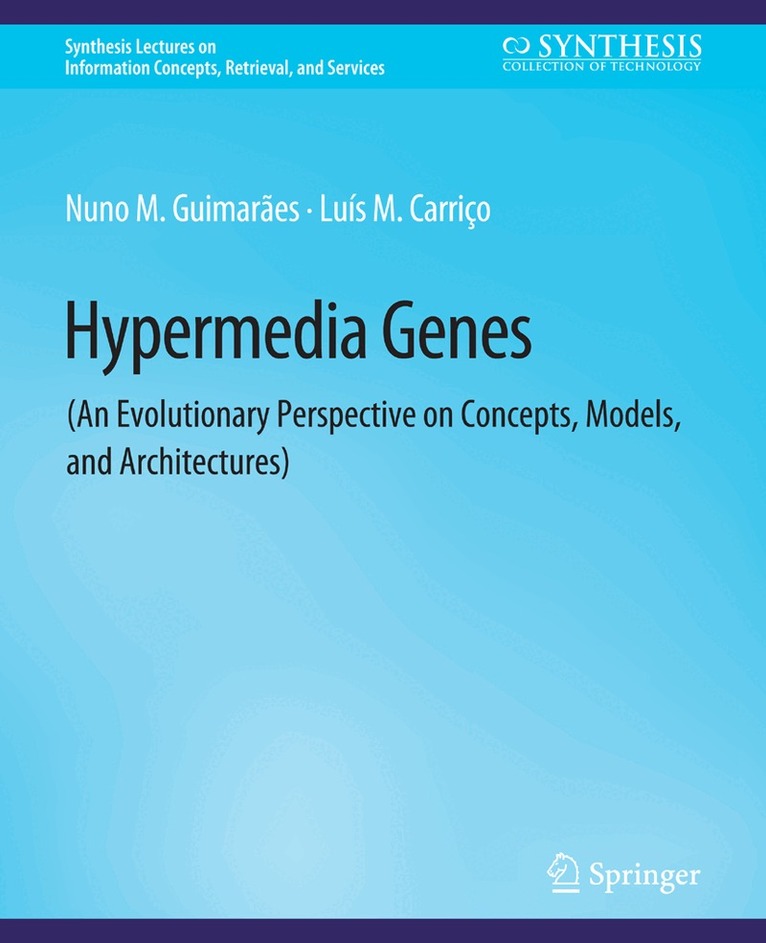
The design space of information services evolved from seminal works through a set of prototypical hypermedia systems and matured in open and widely accessible web-based systems. The original concepts of hypermedia systems are now expressed in different forms and shapes. The first works on hypertext invented the term itself, laid out the foundational concept of association or link, and highlighted navigation as the core paradigm for the future information systems. The first engineered systems demonstrated architectural requirements and models and fostered the emergence of the conceptual model related with the information systems and the information design. The artifacts for interaction, navigation, and search, grew from the pioneering systems. Multimedia added a new dimension to hypertext, and mutated the term into hypermedia. The adaptation of the primitive models and mechanisms to the space of continuous media led to a further conceptual level and to the reinvention of information design methods. Hypermedia systems also became an ideal space for collaboration and cooperative work. Information access and sharing, and group work were enabled and empowered by distributed hypermedia systems. As with many technologies, a winning technical paradigm, in our case the World Wide Web, concentrated the design options, the architectural choices and the interaction and navigation styles. Since the late nineties, the Web became the standard framework for hypermedia systems, and integrated a large number of the initial concepts and techniques. Yet, other paths are still open. This lecture maps a simple "genome" of hypermedia systems, based on an initial survey of primitive systems that established architectural and functional characteristics, or traits. These are analyzed and consolidated using phylogenetic analysis tools, to infer families of systems and evolution opportunities. This method may prove to be inspiring for more systematic perspectives of technological landscapes. Table of Contents: Introduction / Original Visions and Concepts / Steps in the Evolution / Information and Structured Documents / Web-Based Environments / Some Research Trends / A Framework of Traits / A Phylogenetic Analysis / Conclusion
E-bok
PDF, Engelska, 2022362 kr
Läs direkt efter köp
The design space of information services evolved from seminal works through a set of prototypical hypermedia systems and matured in open and widely accessible web-based systems. The original concepts of hypermedia systems are now expressed in different forms and shapes. The first works on hypertext invented the term itself, laid out the foundational concept of association or link, and highlighted navigation as the core paradigm for the future information systems. The first engineered systems demonstrated architectural requirements and models and fostered the emergence of the conceptual model related with the information systems and the information design. The artifacts for interaction, navigation, and search, grew from the pioneering systems. Multimedia added a new dimension to hypertext, and mutated the term into hypermedia. The adaptation of the primitive models and mechanisms to the space of continuous media led to a further conceptual level and to the reinvention of information design methods. Hypermedia systems also became an ideal space for collaboration and cooperative work. Information access and sharing, and group work were enabled and empowered by distributed hypermedia systems. As with many technologies, a winning technical paradigm, in our case the World Wide Web, concentrated the design options, the architectural choices and the interaction and navigation styles. Since the late nineties, the Web became the standard framework for hypermedia systems, and integrated a large number of the initial concepts and techniques. Yet, other paths are still open. This lecture maps a simple "genome" of hypermedia systems, based on an initial survey of primitive systems that established architectural and functional characteristics, or traits. These are analyzed and consolidated using phylogenetic analysis tools, to infer families of systems and evolution opportunities. This method may prove to be inspiring for more systematic perspectives of technological landscapes. Table of Contents: Introduction / Original Visions and Concepts / Steps in the Evolution / Information and Structured Documents / Web-Based Environments / Some Research Trends / A Framework of Traits / A Phylogenetic Analysis / Conclusion
Häftad, Engelska, 2009
566 kr
Skickas inom 10-15 vardagar
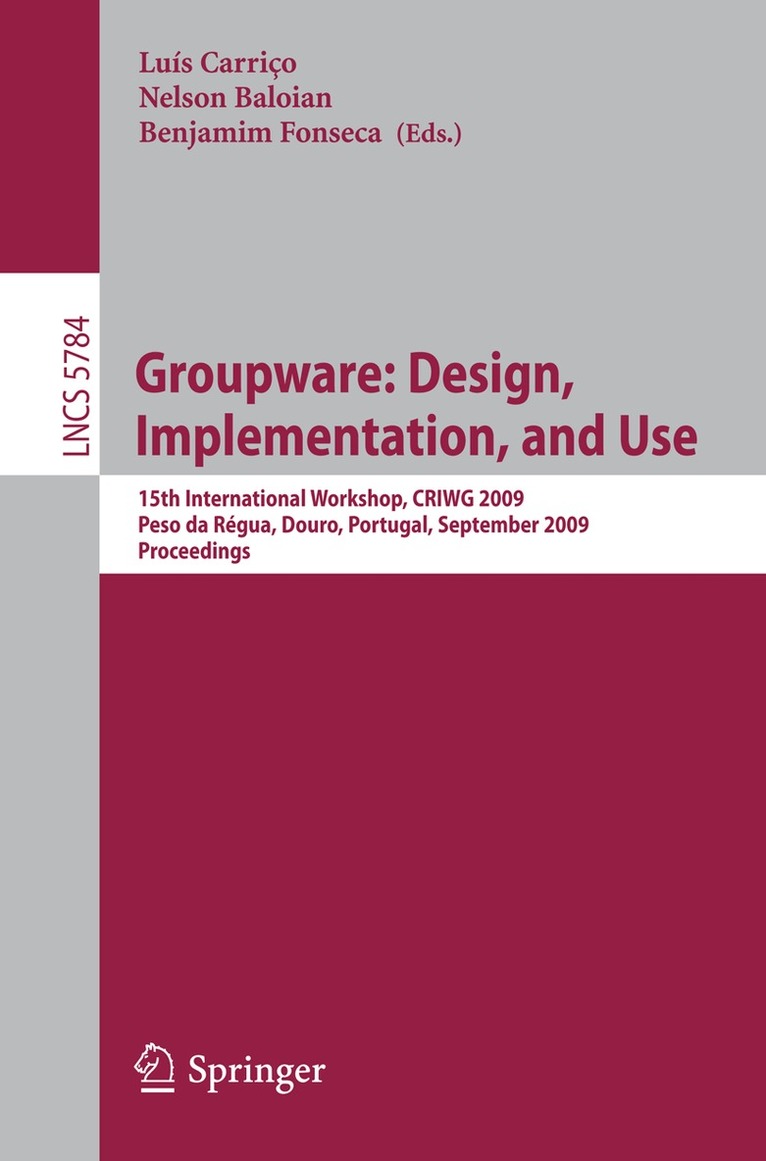
This book constitutes the refereed post-conference proceedings of the 15th International Workshop on Groupware: Design, Implementation, and Use, held in Peso da Régua, Douro, Portugal, during September 13-17, 2009. The 30 papers presented were carefully reviewed and selected from numerous submission. The topics covered are mobile collaboration, social aspects of collaboration, technology for CSCW, groupware evaluation, CSCW design, geo collaboration, collaborative learning, and modeling CSCW.
E-bok
PDF, Engelska, 2009687 kr
Läs direkt efter köp
This book constitutes the refereed post-conference proceedings of the 15th International Workshop on Groupware: Design, Implementation, and Use, held in Peso da Régua, Douro, Portugal, during September 13-17, 2009. The 30 papers presented were carefully reviewed and selected from numerous submission. The topics covered are mobile collaboration, social aspects of collaboration, technology for CSCW, groupware evaluation, CSCW design, geo collaboration, collaborative learning, and modeling CSCW.