Nuno Guimaraes – författare
Visar alla böcker från författaren Nuno Guimaraes. Handla med fri frakt och snabb leverans.
4 produkter
4 produkter
Häftad, Engelska, 2009
284 kr
Skickas inom 10-15 vardagar
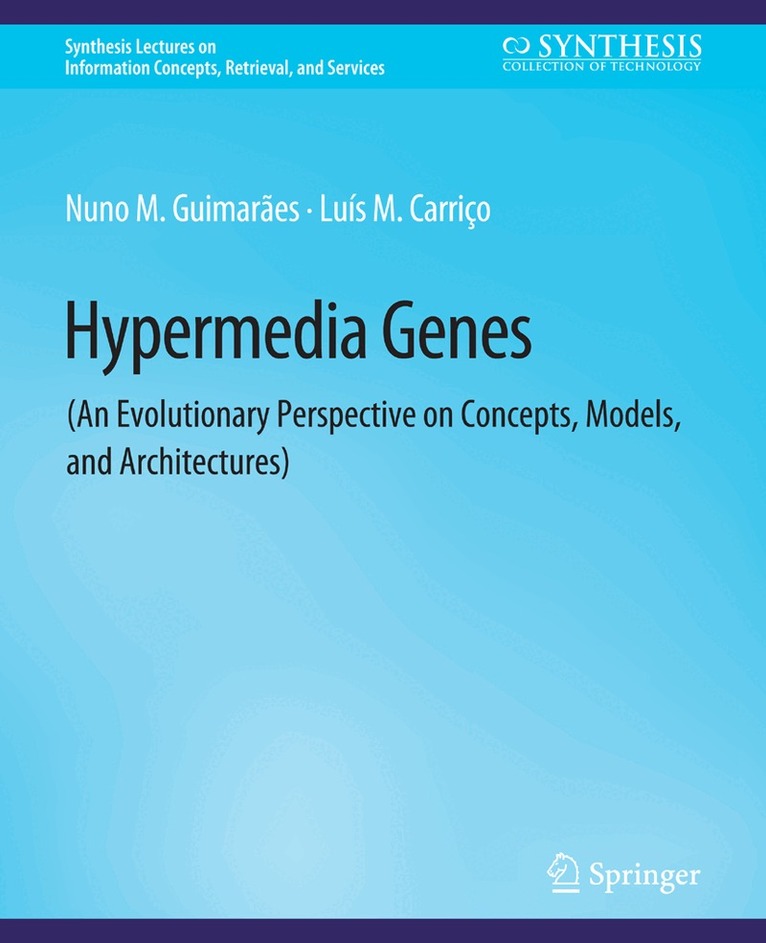
The design space of information services evolved from seminal works through a set of prototypical hypermedia systems and matured in open and widely accessible web-based systems.
E-bok
PDF, Engelska, 2022362 kr
Läs direkt efter köp
The design space of information services evolved from seminal works through a set of prototypical hypermedia systems and matured in open and widely accessible web-based systems. The original concepts of hypermedia systems are now expressed in different forms and shapes. The first works on hypertext invented the term itself, laid out the foundational concept of association or link, and highlighted navigation as the core paradigm for the future information systems. The first engineered systems demonstrated architectural requirements and models and fostered the emergence of the conceptual model related with the information systems and the information design. The artifacts for interaction, navigation, and search, grew from the pioneering systems. Multimedia added a new dimension to hypertext, and mutated the term into hypermedia. The adaptation of the primitive models and mechanisms to the space of continuous media led to a further conceptual level and to the reinvention of information design methods. Hypermedia systems also became an ideal space for collaboration and cooperative work. Information access and sharing, and group work were enabled and empowered by distributed hypermedia systems. As with many technologies, a winning technical paradigm, in our case the World Wide Web, concentrated the design options, the architectural choices and the interaction and navigation styles. Since the late nineties, the Web became the standard framework for hypermedia systems, and integrated a large number of the initial concepts and techniques. Yet, other paths are still open. This lecture maps a simple "genome" of hypermedia systems, based on an initial survey of primitive systems that established architectural and functional characteristics, or traits. These are analyzed and consolidated using phylogenetic analysis tools, to infer families of systems and evolution opportunities. This method may prove to be inspiring for more systematic perspectives of technological landscapes. Table of Contents: Introduction / Original Visions and Concepts / Steps in the Evolution / Information and Structured Documents / Web-Based Environments / Some Research Trends / A Framework of Traits / A Phylogenetic Analysis / Conclusion
Del 1 - Research Reports Esprit
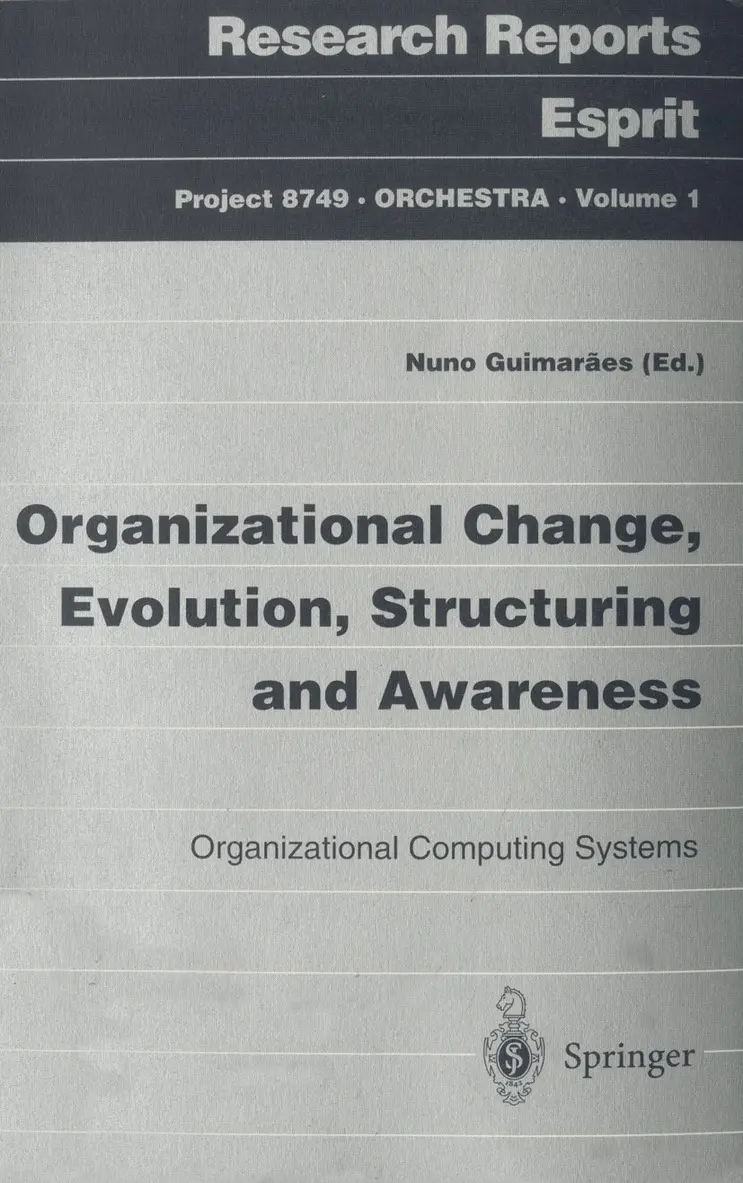
Organizational Change, Evolution, Structuring and Awareness
Organizational Computing Systems
Häftad, Engelska, 1998
561 kr
Skickas inom 10-15 vardagar
This is the final report of the Esprit project Orchestra (Organizational Change, Evolution, Structuring and Awareness). The aim of the project was to design and develop a new-generation groupware system incorporating both advanced technical components and a concern with the organizational dimension of its users. The project integrated social science approaches with information technology and involved developments in workflow modeling and enactment systems, security, corporate systems integration, intelligent communication, and group decision and negotiation tools. Addressed to the European industry and IT community, the report provides a comprehensive technical and business perspective on the project's goals, activities, experience, and results.
E-bok
PDF, Engelska, 2013714 kr
Läs direkt efter köp
The Orchestra (Organizational Change, Evolution, Structuring and Awareness) project, as the name suggests, was the result of the contributions of a number of people and organizations, whose collaborative efforts made the project and its results possible. This report provides readers with a global perspective on the project, its conceptual roots, the developed technologies, the partners, and the users. The following subsection is a long but necessary acknowledgement to a large number of people, from the several organizations that participated in the project: INESC (P), SMD (P), Software AG (DIE), UPM (E), Lisle (E), Novabase (P), EDP (P), Edinfor (P), CN (P), ISCTE (P), UITESA(E), T ASKON (N). Without these organizations and the people mentioned below, the project would not have been possible. The uninvolved reader is therefore asked to forgive us for this long acknowledgement, and go directly to the fIrst chapter. Acknowledgments This is a personal acknowledgment of the contributions of most of those people, and an anticipated apology to anyone who may have been left out of this large list. The persons are mentioned in the order of the organizations they belong to, just for the sake of not losing track of them all.