E-bok, Engelska, 2022
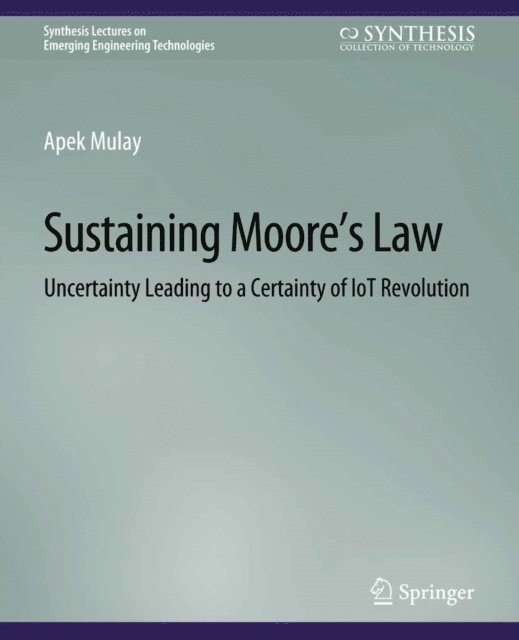
Sustaining Moore's Law
Av Apek Mulay
447 kr
Skickas tisdag 13/10
Beskrivning
In 1965, Intel co-founder Gordon Moore, in ""Cramming more components onto Integrated Circuits"" in Electronics Magazine (April 19, 1965), made the observation that, in the history of computing hardware, the number of transistors on integrated circuits doubles approximately every two years. Since its inception in 1965 until recent times, this law has been used in the semiconductor industry to guide investments for long-term planning as well as to set targets for research and development. These investments have helped in a productive utilization of wealth, which created more employment opportunities for semiconductor industry professionals. In this way, the development of Moore''s Law has helped sustain the progress of today''s knowledge-based economy. While Moore''s Law has, on one hand, helped drive investments toward technological and economic growth, thereby benefiting the consumers with more powerful electronic gadgets, Moore''s Law has indirectly also helped to fuel other innovationsin the global economy. However, the Law of diminishing returns is now questioning the sustainability of further evolution of Moore''s Law and its ability to sustain the progress of today''s knowledge based economy. The lack of liquidity in the global economy is truly bringing the entire industry to a standstill and the dark clouds of an economic depression are hovering over the global economy. What factors have been ignored by the global semiconductor industry leading to a demise of Moore''s Law? Do the existing business models prevalent in the semiconductor industry pose any problems? Have supply chains made that progress unsustainable? In today''s globalized world, have businesses been able to sustain national interests while driving the progress of Moore''s Law? Could the semiconductor industry help the entire global economy move toward a radiance of the new crimson dawn, beyond the veil of the darkest night by sustaining the progress of Moore''s Law? The entire semiconductor industry isnow clamoring for a fresh approach to overcome existing barriers to the progress of Moore''s Law, and this book delivers just that. Moore''s Law can easily continue for the foreseeable future if the chip manufacturing industry becomes sustainable by having a balanced economy. The sustainable progress of Moore''s Law advocates the ""heresy"" of transforming the current economic orthodoxy of monopoly capitalism into free-market capitalism. The next big thing that everybody is looking forward to after mobile revolution is the ""Internet of Things"" (IoT) revolution. While some analysts forecast that the IoT market would achieve 5.4 billion connections worldwide by 2020, the poor consumer purchasing power in global economy makes this forecast truly questionable. Sustaining Moore''s Law presents a blueprint for sustaining the progress of Moore''s Law to bring about IoT Revolution in the global economy.
Produktinformation
- Utgivningsdatum: 2022-06-01
- Format: E-bok
- Språk: Engelska
- Förlag: Springer International Publishing
- ISBN: 9783031020254
Utforska kategorier
Betyg & recensioner
0 recensioner
Inga recensioner tillgängliga.