• Fri frakt över 249 kr
  • •
  • Snabba leveranser
  • •
  • Billiga böcker
Kundservice

Du är på sajten för privatpersoner.

Företag, bibliotek eller offentlig verksamhet?

Du handlar på classic.bokus.com, där alla dina funktioner finns intakta.
Till classic.bokus.com
Bokus logotyp. Gå till startsidan.
  • Erbjudanden
  • Nyheter
  • Student
  • Topplistor
  • Barn & ungdom
  • Bokus Play
  • E-böcker
  • Pocketböcker
  • Spel & pussel

10% rabatt på allt med kod NYSTART10 →

Sidfot

Mina sidor

    Hjälp

    • Kundservice
    • Vanliga frågor och svar
    • Frakt och leverans
    • Retur vid ångerrätt
    • Reklamera vara
    • Betalning
    • Köpvillkor
    • Allmänna villkor
    • Information om webbplatsens tillgänglighet

    Om Bokus

    • Om oss
    • Pressrum
    • För studenter
    • För företag
    • För bibliotek och offentlig verksamhet
    • För leverantörer
    • Hållbarhet

    Populärt

    • Aktuella erbjudanden
    • Presentkort
    • Studentlitteratur
    • Nya böcker
    • Topplistor
    • Signerade böcker
    • Engelska böcker

    Inspiration

    • Boktips
    • BookTok
    • Populära bokserier
    • Barnbokskaraktärer
    • Populära författare
    Logotyp för Bokus
    Följ oss på Facebook (extern länk)Följ oss på Instagram (extern länk)Följ oss på YouTube (extern länk)Följ oss på TikTok (extern länk)
    bokus @ CookiesAnpassa cookiesIntegritetspolicyKöpvillkor
    Till Citymail hemsida (extern länk)Till Budbee hemsida (extern länk)Till Postnord hemsida (extern länk)Till Schenker hemsida (extern länk)Till Early Bird hemsida (extern länk)Till Walleys hemsida (extern länk)
    1. Data och IT
    2. Nätverk och kommunikation

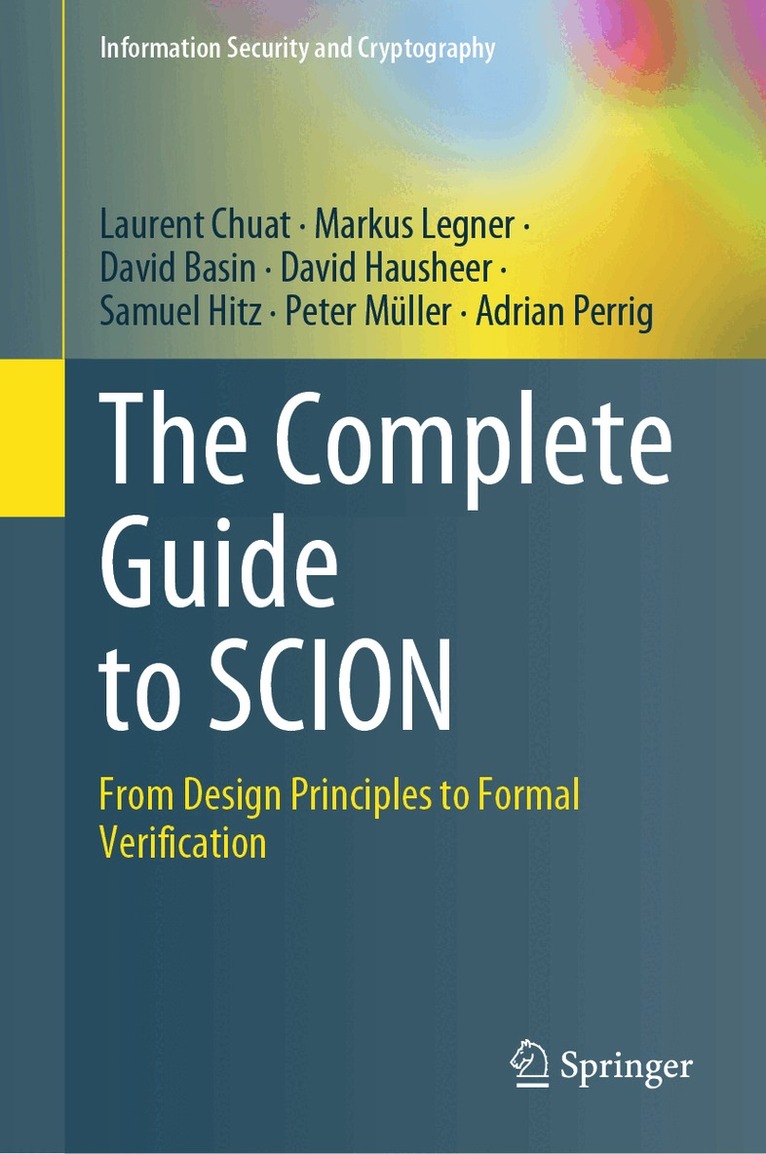
    Complete Guide to SCION

    From Design Principles to Formal Verification

    AvLaurent Chuat,Markus Legner

    Inbunden, Engelska, 2022

    Del i serien Information Security and Cryptography

    1 450 kr

    Beställningsvara. Skickas inom 10-15 vardagar. Fri frakt över 249 kr.

    Fler format och utgåvor

    Häftad

    1 006 kr

    Beskrivning

    When the SCION project started in 2009, the goal was to create an architecture offering high availability and security for basic point-to-point communication. In the five years since the publication of SCION: A Secure Internet Architecture, this next-generation Internet architecture has evolved in terms of both design and deployment.On the one hand, there has been development of exciting new concepts and systems, including a new global time-synchronization system, an inter-domain approach for bandwidth reservations called COLIBRI, and Green Networking, which allows combating global climate change on three fronts. On the other hand, SCION is now also in production use by the Swiss financial ecosystem, and enables participants such as the Swiss National Bank, the Swiss provider of clearing services (SIX), and all Swiss financial institutes to communicate securely and reliably with each other via the Secure Swiss Finance Network.This unique guidebook provides an updated description of SCION's main components, covering new research topics and the most recent deployments. In particular, it presents in-depth discussion of formal verification efforts. Importantly, it offers a comprehensive, thorough description of the current SCION system:Describes the principles that guided SCION's design as a secure and robust Internet architectureProvides a comprehensive description of the next evolution in the way data finds its way through the InternetExplains how SCION can contribute to reducing carbon emissions, by introducing SCION Green NetworkingDemonstrates how SCION not only functions in academic settings but also works in production deploymentsDiscusses additional use cases for driving SCION's adoptionPresents the approaches for formal verification of protocols and codeIllustrated with many colorful figures, pictures, and diagrams, allowing easy access to the concepts and use cases Assembled by a team with extensive experience in the fields of computer networks and security, this text/reference is suitable for researchers, practitioners, and graduate students interested in network security. Also, readers with limited background in computer networking but with a desire to know more about SCION will benefit from an overview of relevant chapters in the beginning of the book.

    Produktinformation

    • Utgivningsdatum:2022-05-17
    • Mått:155 x 235 x 42 mm
    • Vikt:1 174 g
    • Format:Inbunden
    • Språk:Engelska
    • Serie:Information Security and Cryptography
    • Antal sidor:656
    • Förlag:Springer International Publishing AG
    • ISBN:9783031052873

    Utforska kategorier

    • Nätverk och kommunikation inom Data och IT
    • Hårdvara inom Data och IT
    • IT-säkerhet inom Data och IT

    Mer om författaren

    Laurent Chuat is a postdoctoral researcher in the Network Security Group at ETH Zurich, where most of his research focuses on authentication and public-key infrastructures. He obtained his PhD in computer science from ETH Zurich in 2020 and co-authored the book "SCION: A Secure Internet Architecture."Markus Legner is a senior researcher and lecturer in the Network Security Group, where he is conducting research on the design and verification of security protocols. He holds a Bachelor's degree in computer science from ETH Zurich as well as a doctorate in theoretical physics.David Basin is a professor of computer science at ETH Zurich and was head of the department from 2019 to 2020. David received his PhD in computer science from Cornell University in 1989 and his Habilitation in computer science from the University of Saarbrücken in 1996. From 1997 to 2002, he held the Chair of Software Engineering at the University of Freiburg in Germany. He is the founding director of the Zurich Information Security Center (ZISC).David Hausheer is a professor at the Faculty of Computer Science at Otto von Guericke University Magdeburg, where he leads the Networks and Distributed Systems Lab. He received his degree in electrical engineering from ETH Zurich in 2001. Since 2001, he participated in numerous European Union projects. He obtained his PhD in 2005 and was then employed as a senior researcher and lecturer in the Department of Informatics (IFI) at the University of Zurich.Samuel Hitz holds a Master's degree in computer science from ETH Zurich and is the current CTO and previous CEO of Anapaya, which he co-founded with Adrian Perrig, David Basin, and Peter Müller. He has worked on the implementation of SCION and, together with Anapaya's customers, on the real-world deployment and operation of an enterprise-oriented SCION network.Peter Müller has been a professor of computer science at ETH Zurich since 2008. Before joining ETH Zurich, he worked as an IT project manager at Deutsche Bank in Frankfurt and held a position as researcher at Microsoft Research. Peter Müller is working on programming languages, methods, and tools with the goal of enabling programmers to develop correct software.Adrian Perrig is a professor at the Department of Computer Science at ETH Zurich, where he leads the Network Security Group. He is also an adjunct professor of electrical and computer engineering at Carnegie Mellon University. From 2007 to 2012, he served as the technical director for Carnegie Mellon's CyLab. During that time, he led a research project aimed at building a next-generation Internet architecture, which was later renamed SCION.

    Innehållsförteckning

    • Foreword by Joël Mesot.- Foreword by Fritz Steinmann.- Preface.- How to Read This Book.- Acknowledgments.- Introduction.- I SCION Core Components.- Overview.- Authentication.- Control Plane.- Data Plane. II Analysis of the Core Components.-  Functional Properties and Scalability.- Security Analysis.- III Achieving Global Availability Guarantees.- Extensions for the Control Plane.- Monitoring and Filtering.- Extensions for the Data Plane.- Availability Guarantees.- IV SCION in the Real World.- Host Structure.- Deployment and Operation.- SCIONLAB Research Testbed.- Use Cases and Applications.- Green Networking with SCION.- Cryptography.- V Additional Security Systems.- F-PKI: A Flexible End-Entity Public-Key Infrastructure.- RHINE: Secure and Reliable Internet Naming Service.- PILA: Pervasive Internet-Wide Low-Latency Authentication.- VI Formal Verification.- Motivation for Formal Verification.- Design-Level Verification.- Code-Level Verification.- Current Status and Plans.-VII Back Matter.- Related Work.- Bibliography.- Glossary.- Abbreviations.- Index.