• Fri frakt över 249 kr
  • •
  • Snabba leveranser
  • •
  • Billiga böcker
Kundservice

Du är på sajten för privatpersoner.

Företag, bibliotek eller offentlig verksamhet?

Du handlar på classic.bokus.com, där alla dina funktioner finns intakta.
Till classic.bokus.com
Bokus logotyp. Gå till startsidan.
  • Erbjudanden
  • Nyheter
  • Student
  • Topplistor
  • Barn & ungdom
  • Bokus Play
  • E-böcker
  • Pocketböcker
  • Spel & pussel

10% rabatt på allt med kod NYSTART10 →

Sidfot

Mina sidor

    Hjälp

    • Kundservice
    • Vanliga frågor och svar
    • Frakt och leverans
    • Retur vid ångerrätt
    • Reklamera vara
    • Betalning
    • Köpvillkor
    • Allmänna villkor
    • Information om webbplatsens tillgänglighet

    Om Bokus

    • Om oss
    • Pressrum
    • För studenter
    • För företag
    • För bibliotek och offentlig verksamhet
    • För leverantörer
    • Hållbarhet

    Populärt

    • Aktuella erbjudanden
    • Presentkort
    • Studentlitteratur
    • Nya böcker
    • Topplistor
    • Signerade böcker
    • Engelska böcker

    Inspiration

    • Boktips
    • BookTok
    • Populära bokserier
    • Barnbokskaraktärer
    • Populära författare
    Logotyp för Bokus
    Följ oss på Facebook (extern länk)Följ oss på Instagram (extern länk)Följ oss på YouTube (extern länk)Följ oss på TikTok (extern länk)
    bokus @ CookiesAnpassa cookiesIntegritetspolicyKöpvillkor
    Till Citymail hemsida (extern länk)Till Budbee hemsida (extern länk)Till Postnord hemsida (extern länk)Till Schenker hemsida (extern länk)Till Early Bird hemsida (extern länk)Till Walleys hemsida (extern länk)
    1. Ekonomi och Ledarskap
    2. Ledarskapsböcker
    3. Ledarskap och motivation

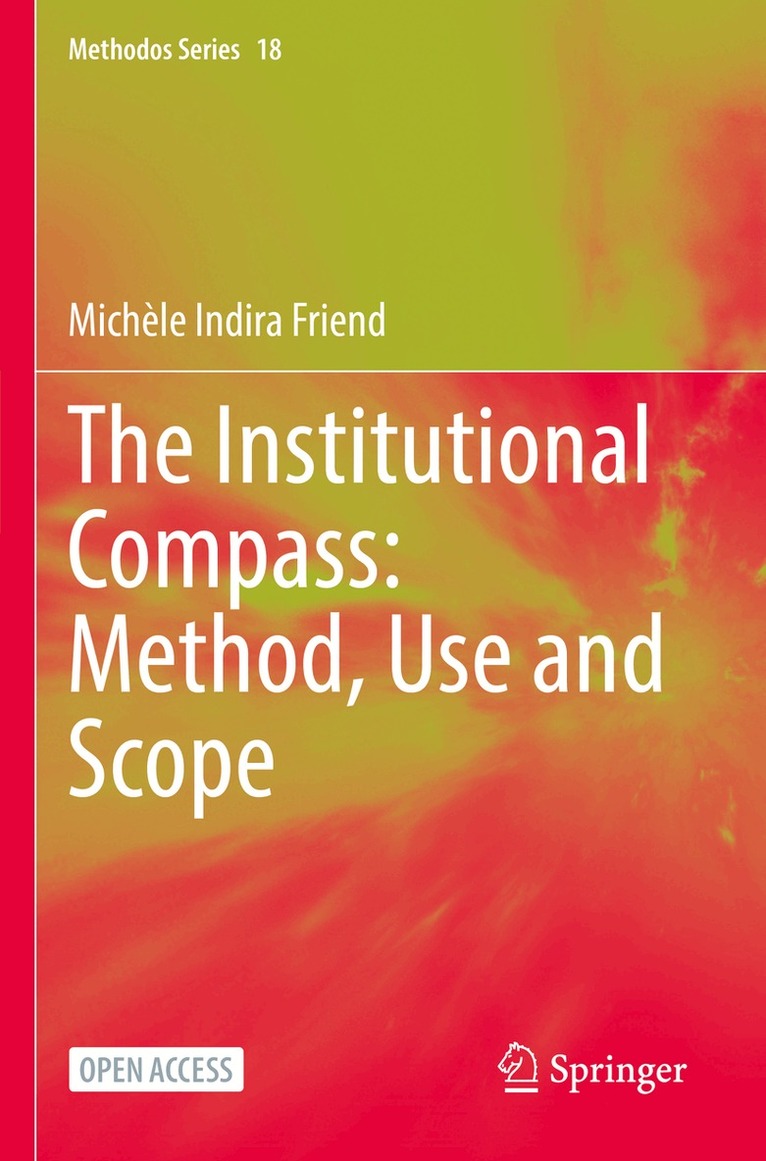
    Institutional Compass: Method, Use and Scope

    AvMichèle Indira Friend

    Häftad, Engelska, 2022

    Del 18 i serien Methodos Series

    438 kr

    Beställningsvara. Skickas inom 10-15 vardagar. Fri frakt över 249 kr.

    Fler format och utgåvor

    Inbunden

    546 kr

    Beskrivning

    This open access book presents a new generation multi-criteria, multi-stake holder, decision aide, called an "institutional compass". Based on hard data, the compass tells us what quality-direction we are heading in as an institution, region, system or organisation. The quality is not chosen from the usual scalar qualities of: good, neutral and bad. Instead, it is a quality chosen between: harmony, discipline and excitement. None is good in and of itself. We need some of each.The compass marks a new generation in four respects. 1. The representation of the data is intuitive and simple to understand, and therefore can be used to communicate and justify policy decisions. 2. Any data can be included, i.e., none is excluded. This makes the compass tailored to particular situations, voices and contexts. 3. The data includes different time horizons and different types of value: monetary, use, social, sentimental, religious, intrinsic, existential... 4. The process of compass construction can be made inclusive at several junctions. An institutional compass can be extended to evaluate products, add normativity to a systems analysis, reflect world-views such as that of ecological economists or function as an accounting system to manage scarce resources.There are four parts to the book. The first part introduces the general ideas behind the compass. In the second part, the author presents the method for constructing the compass. This includes data collection, data analysis and a mathematical formula to aggregate the data into a single holistic reading. In the third part, the author extends the methodology: to incorporate it into systems science, adding a normative and quality-direction dimension, to use it as a non-linear accounting method and more thoroughly to reflect the philosophy of ecological economists to give a real measure of sustainability. In the fourth part, we see three case studies: one for the World Health Organisation, a second is the use of the compass to label products in a shop and the third is as a regional compass for Hauts-de-France. The book ends with philosophical conclusions.Throughout the book, we see tight arguments, refreshing ideas and a thorough treatment of objectivity in decision making.

    Produktinformation

    • Utgivningsdatum:2022-07-09
    • Mått:155 x 235 x 17 mm
    • Vikt:356 g
    • Format:Häftad
    • Språk:Engelska
    • Serie:Methodos Series
    • Antal sidor:202
    • Förlag:Springer International Publishing AG
    • ISBN:9783031054556

    Utforska kategorier

    • Ledarskap och motivation inom Ekonomi och Ledarskap
    • Databaser inom Data och IT
    • Sociologi inom Samhälle och politik

    Mer om författaren

    Michèle Indira Friend is temporarily a researcher with UCCS: Unité de Catalyse et de Chimie du Solide at Université Lille Nord-Europe. More permanently, she is Associate Professor of Philosophy at George Washington University. She is a member of the International Society for Systems Science, the International Society for Ecological Economics, the Association of Symbolic Logic, the International Society for Philosophy of Chemistry and many others. She is a philosopher of: logic, mathematics, relativity theory, chemistry, systems science, economics and the environment.

    Innehållsförteckning

    • Part I: Introduction.- Chapter 1. General Introduction.- Chapter 2. Vocabulary.- Chapter 3. The State of the Art in Decision Making.- Part II: The Method for Constructing The Institutional Compass.- Chapter 4. The Three Qualities Again.- Chapter 5. Constructing an Institutional Compass: Methodology.- Part III: Scope: More Uses of The Institutional Compass and Some Extensions.- Chapter 6. Merging the Compass with Systems Science.- Chapter 7. Adapting The Compass to Align with Ecological Economics Thinking.- Chapter 8. Further Manipulations and Extensions using the Notion of Sphere.- Chapter 9. The Compass as Representation.- Chapter 10. The Compass for Qualitative Accounting. Part IV: Actual Case-Studies and Conclusion.- Chapter 11. Case Study I: The World Health Organisation. Chapter 12. Case Study II: Report on Produce Label Project.- Chapter 13. Case Study III: Regional Compass Hauts-de-France, Superimposing a Biorefinery. Chapter 14. Concluding Philosophical Remarks.