• Fri frakt över 249 kr
  • •
  • Snabba leveranser
  • •
  • Billiga böcker
Kundservice

Du är på sajten för privatpersoner.

Företag, bibliotek eller offentlig verksamhet?

Du handlar på classic.bokus.com, där alla dina funktioner finns intakta.
Till classic.bokus.com
Bokus logotyp. Gå till startsidan.
  • Erbjudanden
  • Nyheter
  • Student
  • Topplistor
  • Barn & ungdom
  • Bokus Play
  • E-böcker
  • Pocketböcker
  • Spel & pussel

10% rabatt på allt med kod: NYSTART10 →

Sidfot

Mina sidor

    Hjälp

    • Kundservice
    • Vanliga frågor och svar
    • Frakt och leverans
    • Retur vid ångerrätt
    • Reklamera vara
    • Betalning
    • Köpvillkor
    • Allmänna villkor
    • Information om webbplatsens tillgänglighet

    Om Bokus

    • Om oss
    • Pressrum
    • För studenter
    • För företag
    • För bibliotek och offentlig verksamhet
    • För leverantörer
    • Hållbarhet

    Populärt

    • Aktuella erbjudanden
    • Presentkort
    • Studentlitteratur
    • Nya böcker
    • Topplistor
    • Signerade böcker
    • Engelska böcker

    Inspiration

    • Boktips
    • BookTok
    • Populära bokserier
    • Barnbokskaraktärer
    • Populära författare
    Logotyp för Bokus
    Följ oss på Facebook (extern länk)Följ oss på Instagram (extern länk)Följ oss på YouTube (extern länk)Följ oss på TikTok (extern länk)
    bokus @ CookiesAnpassa cookiesIntegritetspolicyKöpvillkor
    Till Citymail hemsida (extern länk)Till Budbee hemsida (extern länk)Till Postnord hemsida (extern länk)Till Schenker hemsida (extern länk)Till Early Bird hemsida (extern länk)Till Walleys hemsida (extern länk)
    1. Naturvetenskap och teknik
    2. Matematik och naturvetenskap
    3. Kemi
    4. Fysikalisk kemi

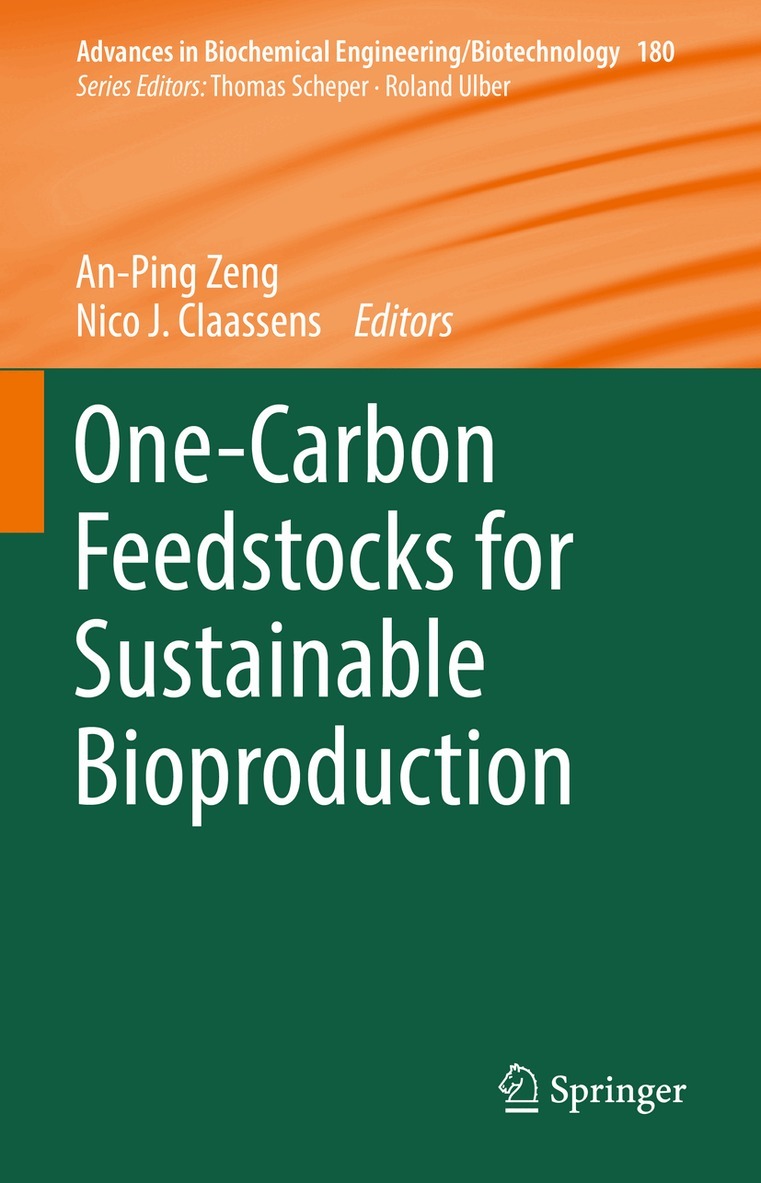
    One-Carbon Feedstocks for Sustainable Bioproduction

    AvAn-Ping Zeng,Nico J. Claassens

    Inbunden, Engelska, 2022

    Del i serien Advances in Biochemical Engineering/Biotechnology

    3 784 kr

    Beställningsvara. Skickas inom 10-15 vardagar. Fri frakt över 249 kr.

    Beskrivning

    This book offers a comprehensive review of the latest developments, challenges and trends in C1-based (one-carbon based) bioproduction, and it presents an authoritative account of one-carbon compounds as promising alternative microbial feedstocks. The book starts with a perspective on the future of C1 compounds as alternative feedstocks for microbial growth, and their vital role in the establishment of a sustainable circular carbon economy, followed by several chapters in which expert contributors discuss about the recent strategies and address key challenges regarding one or more C1 feedstocks. The book covers topics such as acetogenic production from C1 feedstocks, aerobic carboxydotrophic bacteria potential in industrial biotechnology, bioconversion of methane to value-added compounds, combination of electrochemistry and biology to convert C1 compounds, and bioprocesses based on C1-mixotrophy. Particular attention is given to the current metabolic engineering, systems biology, and synthetic biology strategies applied in this field.

    Produktinformation

    • Utgivningsdatum:2022-06-02
    • Mått:155 x 235 x 29 mm
    • Vikt:793 g
    • Format:Inbunden
    • Språk:Engelska
    • Serie:Advances in Biochemical Engineering/Biotechnology
    • Antal sidor:407
    • Förlag:Springer International Publishing AG
    • ISBN:9783031068539

    Utforska kategorier

    • Fysikalisk kemi inom Naturvetenskap och teknik
    • Biokemisk teknik inom Naturvetenskap och teknik
    • Biologi inom Naturvetenskap och teknik

    Mer om författaren

    Prof. An-Ping Zeng was Director of the Institute of Bioprocess and Biosystems Engineering at the Hamburg University of Technology, Germany from April 2006 to March 2022 and recently joined Westlake University in China as Chair Professor for Synthetic Biology and Bioengineering. He got a PhD degree in Biochemical Engineering from Technical University of Braunschweig, Germany. He has extensive research experience in Australia, China, Germany and USA for more than 36 years, among others as research scientist in the former German Research Center for Biotechnology (GBF, now Helmholtz Center for Infection Research), CSIRO and University of Minnesota and as Professor at TU Braunschweig. His recent research covers (1) Industrial biotechnology; (2) Cell culture for proteins and biomaterials; (3) Metabolic engineering and synthetic biology for new enzymes, pathways and microbes using rational and evolutionary approaches; (4) New bioelectrochemical and hybrid systems, especially for useof CO2 and other C1-feedstocks. He has published 300+ papers (Google H-Index 70), edited 5 books and filed 30+ patents. He is Editor-in-Chief of “Engineering in Life Sciences”, and associated editor/editorial board member of seven other journals and book series. He has coordinated several national and international collaborative research projects including the German Research Foundation (DFG) Priority Program 2240 eBiotech. He is member of the German National Academy of Science and Engineering (acatech).Dr. Nico J. Claassens is an Assistant Professor at the Laboratory of Microbiology at Wageningen University (The Netherlands). A core activity of his group is to perform systems-wide metabolic engineering using novel high-throughput genome editing techniques (including recombineering and CRISPR-Cas) in bacteria. Specifically, his work focuses on engineering synthetic pathways to support the efficient use of next-generation, sustainable feedstocks, including CO2 and one-carbon-substrates, such as formate and methanol. After obtaining his Ph.D. with Prof. John van der Oost at Wageningen University, Nico worked as postdoctoral fellow at the Max Planck Institute Potsdam, Germany with Dr. Arren  Bar-Even, supported by a Rubicon fellowship of the Dutch Science Organisation (NWO). During this postdoc in Arren’s lab, Nico and his students demonstrated formatotrophic growth in Cupriavidus necator after the full replacement of the native Calvin cycle by the more ATP-efficient reductive glycine pathway. Furthermore, he characterized the wasteful phosphoglycolate metabolism when C. necator grows via the Calvin cycle on ambient CO2 hydrogen. Together with  Arren and other colleagues, he also performed systematic analyses of various biotechnological production strategies using electricity and CO2 as ultimate energy and carbon sources. They considered several mediator molecules to connect the (electro)chemical and biological processes, and identified formate and methanol as highly promising C1-mediators for efficient electromicrobial production. In 2019 he obtained a prestigious NWO-Veni grant for talented junior researchers to continue his research in C1 metabolic engineering at Wageningen University.

    Innehållsförteckning

    • Obituary: In memory of Dr. Arren Bar-Even.- Introduction: The future belongs to the one-carbons.- Exploiting aerobic carboxydotrophic bacteria for industrial biotechnology.- Process engineering aspects of C1-conversion.- Systems biology on acetogenic bacteria for utilizing C1 feedstocks.- Systems metabolic engineering of methanotrophic bacteria for biological conversion of methane to value-added compounds.- Engineering synthetic methylotrophs by harnessing the power of metabolic engineering-guided adaptive laboratory evolution.- Bioconversion of methanol by synthetic methylotrophy.- Aerobic growth on methanol using the RuMP cycle.- Empower C1 – Combination of electrochemistry and biology to convert C1 compounds.- Extracellular electron powered microbial CO2 upgrading.- Understanding and engineering glycine cleavage system and its reversion for C1 biosynthesis.- Engineering the reductive glycine pathway - A promising synthetic metabolism approach for C1-assimilation.- Biosynthesisbased on one-carbon mixotrophy.- Conversion of carbon monoxide to chemicals by mixed culture approaches.