• Fri frakt över 249 kr
  • •
  • Snabba leveranser
  • •
  • Billiga böcker
Kundservice

Du är på sajten för privatpersoner.

Företag, bibliotek eller offentlig verksamhet?

Du handlar på classic.bokus.com, där alla dina funktioner finns intakta.
Till classic.bokus.com
Bokus logotyp. Gå till startsidan.
  • Erbjudanden
  • Nyheter
  • Student
  • Topplistor
  • Barn & ungdom
  • Bokus Play
  • E-böcker
  • Pocketböcker
  • Spel & pussel

10% rabatt på allt med kod: NYSTART10 →

Sidfot

Mina sidor

    Hjälp

    • Kundservice
    • Vanliga frågor och svar
    • Frakt och leverans
    • Retur vid ångerrätt
    • Reklamera vara
    • Betalning
    • Köpvillkor
    • Allmänna villkor
    • Information om webbplatsens tillgänglighet

    Om Bokus

    • Om oss
    • Pressrum
    • För studenter
    • För företag
    • För bibliotek och offentlig verksamhet
    • För leverantörer
    • Hållbarhet

    Populärt

    • Aktuella erbjudanden
    • Presentkort
    • Studentlitteratur
    • Nya böcker
    • Topplistor
    • Signerade böcker
    • Engelska böcker

    Inspiration

    • Boktips
    • BookTok
    • Populära bokserier
    • Barnbokskaraktärer
    • Populära författare
    Logotyp för Bokus
    Följ oss på Facebook (extern länk)Följ oss på Instagram (extern länk)Följ oss på YouTube (extern länk)Följ oss på TikTok (extern länk)
    bokus @ CookiesAnpassa cookiesIntegritetspolicyKöpvillkor
    Till Citymail hemsida (extern länk)Till Budbee hemsida (extern länk)Till Postnord hemsida (extern länk)Till Schenker hemsida (extern länk)Till Early Bird hemsida (extern länk)Till Walleys hemsida (extern länk)
    1. Samhälle och politik
    2. Samhälle och kultur
    3. Kultur och medier
    4. Referensverk och tvärvetenskap

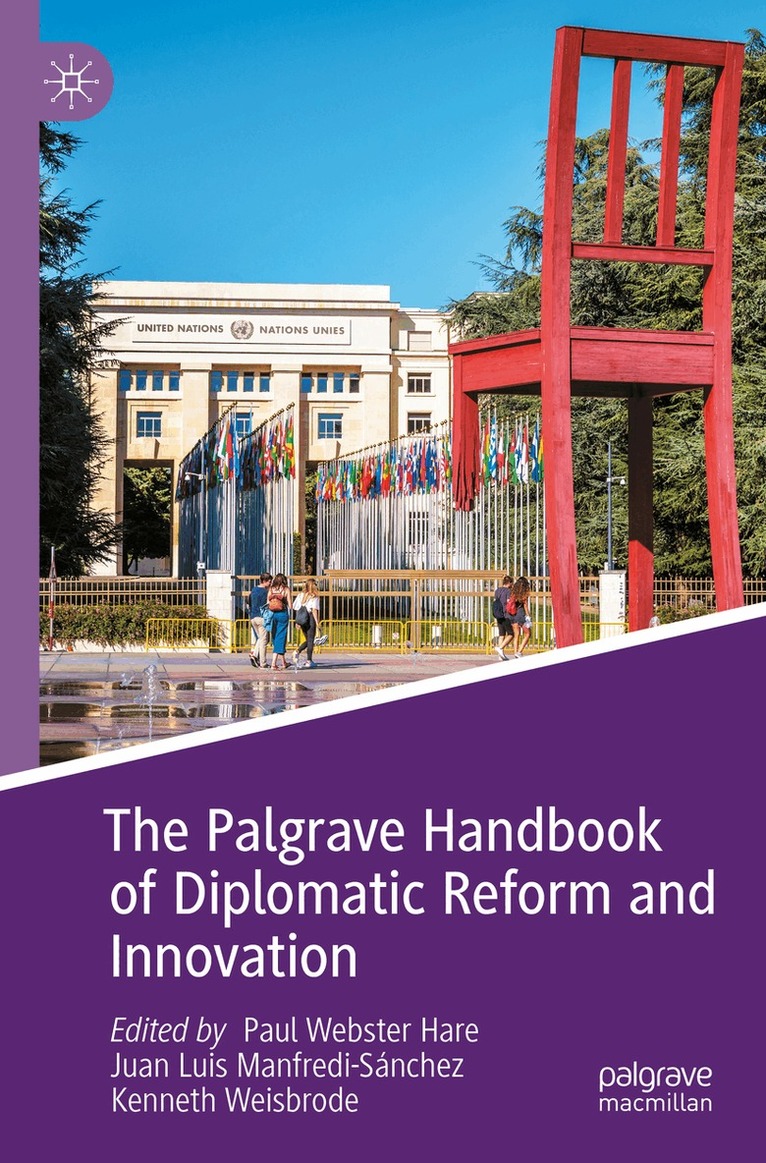
    Palgrave Handbook of Diplomatic Reform and Innovation

    AvPaul Webster Hare,Juan Luis Manfredi-Sánchez

    Häftad, Engelska, 2024

    Del i serien Studies in Diplomacy and International Relations

    2 381 kr

    Beställningsvara. Skickas inom 10-15 vardagar. Fri frakt över 249 kr.

    Beskrivning

    In this handbook, a group of 40 scholars and practitioners from some 30 countries takes a critical look at the contemporary practice of diplomacy. Many assume diplomacy evolves naturally, and that state- and non-state actors are powerless to make significant changes. But Diplomacy’s methods, its key institutions and conventions were agreed more than six decades ago. None take account of the opportunities and vulnerabilities presented by the Internet. Diplomacy is now a neglected global issue.The COVID pandemic and the invasion of Ukraine have highlighted some of the problems of diplomatic dysfunction. Beyond identifying current problems diplomacy is facing, the book also seeks to identify some practical options for reform and innovation. How might a process of reform be agreed and implemented? What role might the United Nations, regional organizations and Big Tech play? How can new norms of diplomatic behavior and methods be established in a multipolar, digital world where diplomacy is seen as less and less effective?

    Produktinformation

    • Utgivningsdatum:2024-02-05
    • Mått:155 x 235 x 42 mm
    • Vikt:1 153 g
    • Format:Häftad
    • Språk:Engelska
    • Serie:Studies in Diplomacy and International Relations
    • Antal sidor:752
    • Förlag:Springer International Publishing AG
    • ISBN:9783031109737

    Utforska kategorier

    • Referensverk och tvärvetenskap inom Samhälle och politik
    • Statsvetenskap och politisk teori inom Samhälle och politik
    • Internationella relationer inom Samhälle och politik

    Mer om författaren

    Paul Webster Hare is Senior Lecturer in International Relations at the Frederick S. Pardee School of Global Studies, Boston University, USA. He was a diplomat for 30 years and British ambassador to Cuba from 2001 to 2004.Juan Luis Manfredi-Sánchez is Prince of Asturias Distinguished Visiting Professor at the School of Foreign Service, Georgetown University, USA, and Professor at the University of Castilla-La Mancha, Spain. Kenneth Weisbrode is Assistant Professor of History at Bilkent University, Turkey.

    Innehållsförteckning

    • Part I. Introduction.- 1. Diplomacy the Neglected Global Issue. Why Diplomacy Needs to Catch Up with the World (Paul Webster Hare).- Part II. State of Diplomacy.- 2. The Closing of the Diplomatic Mind (Kenneth Weisbrode).- 3. A Diplomatic Taxonomy for the New World Disorder (Chas W. Freeman Jr.).- 4. Knowledge Diplomacy – A Conceptual Analysis (Jane Knight).- 5. Why Reforms Are Needed for Bilateral Diplomacy? A Global South Perspective (Kishan S. Rana).- 6. The 21st Century Toolbox for a Modern Diplomat (Seppe Verheyen).- Part III. Politicization of Diplomacy.- 7. Diplomats and Politicization (Pauline Kerr).- 8. Digital Diplomacy and International Society in the Age of Populism (Onur Erpul).- 9. Declining Ministry of Foreign Affairs: Evidence from China (Qingmin Zhang and Lize Yang).- 10. South Africa and its Foreign Alignment and Practice: From Hope to Dashed Expectations (Tony Leon).- Part IV. Reforming Institutions.- 11. From Great Expectations to Dwindling Status: Brazilian Diplomacy’s Response to Post-Cold War Upheavals (Antônio Carlos Lessa and Rogério de Souza Farias).- 12. Crisis Prevention and Stabilization Made in Germany: Meeting the Demands of Modern Diplomacy? (Sarah Bressan).- 13. Integrated Statecraft and Australia’s Diplomacy (Tom Barber and Melissa Conley Tyler).- 14. What Motivates South Korea’s Diplomatic Reform and Innovation? (HwaJung Kim).- 15. The Transformations of French Diplomacy (Maxime Lefebvre).- Part V. Digital Revolution and Diplomatic Reform.- 16. Digital Diplomacy in the Time of the Coronavirus Pandemic: Lessons and Recommendations (Corneliu Bjola and Michaela Coplen).- 17. Exploring the Usefulness of Artificial Intelligence for Diplomatic Negotiations: Two Case Studies (Volker Stanzel).- 18. Beyond Meeting and Tweeting: The Next Challenges for Innovation in Diplomacy (Tom Fletcher).- 19. Disinformation and Diplomacy (Juan Luis Manfredi-Sánchez and Zhao Alexandre Huang).- 20. Digitalizing South American MFAs: Reform and Resistance (Jorge Heine and Daniel Aguirre).- Part VI. Multilateral Diplomacy and Innovation.- 21. Toward a More Credible Multilateralism at the United Nations. A Few Practical Steps (Bénédicte Frankinet).- 22. A New Logic of Multilateralism on Demand (Akiko Fukushima).- 23. About Spheres of Influence (Chas W. Freeman Jr.).- 24. Regional Diplomacy and its Variations: Change and Innovation (Rajiv Bhatia and Kishan S. Rana).- 25. African Union Reform (Emmanuel Balogun and Anna Mwaba).- 26. Why Collective Diplomacy Needs to Embrace Innovation (Martin Wählisch).- 27. Innovating International Cooperation for Development: a New Model for Partnerships between Developed and Middle Income Countries (José Antonio Zabalgoitia and Antonio Tenorio).- 28. The UAE’s Innovative Diplomacy: How the Abraham Accords Changed (or Did Not Change) Emirati Foreign Policy (William Guéraiche).- 29. Small States: From Intuitive To Smart Diplomacy (Vesko Garčević).- 30. Urban Diplomacy: How Cities Will Leverage Multilateralism (Juan Luis Manfredi-Sánchez).- Part VII. Diplomatic Agenda.- 31. Reforming Global Health Diplomacy in the Wake of COVID-19 (Mark C. Storella).- 32. The Reform of Humanitarian Diplomacy (Gregory Simons and Anna A. Velikaya).- 33. Geoeconomic Diplomacy: Reforming the Instrumentalization of Economic Interdependencies and Power (Kim B. Olsen).- 34. Science Diplomacy with Diplomatic Relations to Facilitate Common-Interest Building (Paul Arthur Berkman).- 35. Multi-stakeholderism and the 2030 Agenda: Does the Promise Hold? (Karin Bäckstrand and Felicitas Fritzsche).- 36. The Reform of Climate Diplomacy (Andrew Gilder and Olivia Trumble).- Part VIII. Conclusions.- 37. Conclusions (Paul Webster Hare).