• Fri frakt över 249 kr
  • •
  • Snabba leveranser
  • •
  • Billiga böcker
Kundservice

Du är på sajten för privatpersoner.

Företag, bibliotek eller offentlig verksamhet?

Du handlar på classic.bokus.com, där alla dina funktioner finns intakta.
Till classic.bokus.com
Bokus logotyp. Gå till startsidan.
  • Erbjudanden
  • Nyheter
  • Student
  • Topplistor
  • Barn & ungdom
  • Bokus Play
  • E-böcker
  • Pocketböcker
  • Spel & pussel

10% rabatt på allt med kod: NYSTART10 →

Sidfot

Mina sidor

    Hjälp

    • Kundservice
    • Vanliga frågor och svar
    • Frakt och leverans
    • Retur vid ångerrätt
    • Reklamera vara
    • Betalning
    • Köpvillkor
    • Allmänna villkor
    • Information om webbplatsens tillgänglighet

    Om Bokus

    • Om oss
    • Pressrum
    • För studenter
    • För företag
    • För bibliotek och offentlig verksamhet
    • För leverantörer
    • Hållbarhet

    Populärt

    • Aktuella erbjudanden
    • Presentkort
    • Studentlitteratur
    • Nya böcker
    • Topplistor
    • Signerade böcker
    • Engelska böcker

    Inspiration

    • Boktips
    • BookTok
    • Populära bokserier
    • Barnbokskaraktärer
    • Populära författare
    Logotyp för Bokus
    Följ oss på Facebook (extern länk)Följ oss på Instagram (extern länk)Följ oss på YouTube (extern länk)Följ oss på TikTok (extern länk)
    bokus @ CookiesAnpassa cookiesIntegritetspolicyKöpvillkor
    Till Citymail hemsida (extern länk)Till Budbee hemsida (extern länk)Till Postnord hemsida (extern länk)Till Schenker hemsida (extern länk)Till Early Bird hemsida (extern länk)Till Walleys hemsida (extern länk)
    1. Naturvetenskap och teknik
    2. Teknik och industri
    3. Biokemisk teknik

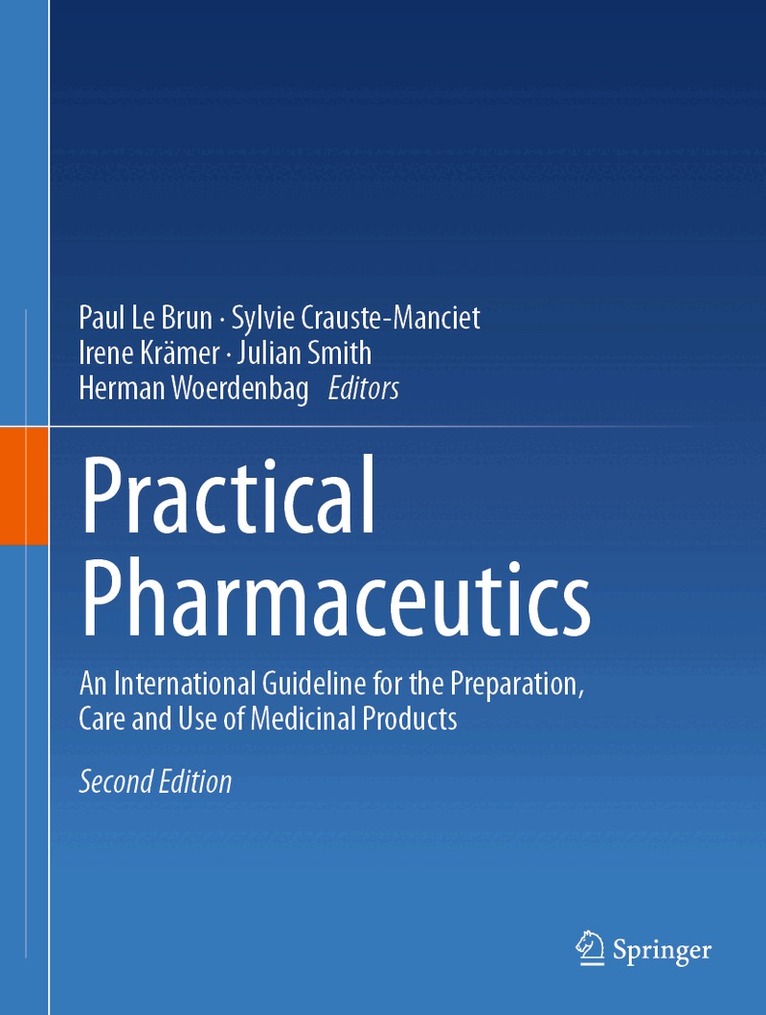
    Practical Pharmaceutics

    An International Guideline for the Preparation, Care and Use of Medicinal Products

    AvPaul Le Brun,Sylvie Crauste-Manciet

    Inbunden, Engelska, 2023

    2 451 kr

    Beställningsvara. Skickas inom 10-15 vardagar. Fri frakt över 249 kr.

    Beskrivning

    Practical Pharmaceutics contains essential knowledge on the preparation, quality control, logistics, dispensing and use of medicines. It features chapters written by experienced pharmacists and scientists working in hospitals, academia and industry throughout Europe, including practical examples as well as information on current GMP and GMP-based guidelines and EU-legislation. In this second edition all chapters have been updated with numerous new as well as didactically revised illustrations and tables. A completely new chapter about therapeutic proteins and Advanced Therapy Medicinal Products was added.From prescription to production, from usage instructions to procurement and the impact of medicines on the environment, the book provides step-by-step coverage that will help a wide range of readers, students as well as professionals. It offers product knowledge for all pharmacists working directly with patients and it will enable them to make the required medicine available, to store medicines properly, to adapt medicines if necessary and to dispense medicines with the appropriate information for patients as well as caregivers about product care and how to maintain the quality of the product. The basic knowledge presented in the book will also be valuable for industrial pharmacists to remind and focus them on the application of the medicines manufactured.The basic and practical knowledge on the design, preparation and quality management of medicines can directly be applied by the pharmacists whose main duty is production in community and hospital pharmacies and in industry. Undergraduate as well as graduate pharmacy students will find knowledge presented in a coherent way and fully supported with relevant examples.Practical Pharmaceutics has become a reliable and recognised source for the acquisition of pharmaceutical-technological knowledge. The book is used in the curriculum of a number of international universities and schools of Pharmacy.

    Produktinformation

    • Utgivningsdatum:2023-06-16
    • Mått:210 x 279 x 55 mm
    • Vikt:2 890 g
    • Format:Inbunden
    • Språk:Engelska
    • Antal sidor:986
    • Upplaga:2
    • Förlag:Springer International Publishing AG
    • ISBN:9783031202971

    Utforska kategorier

    • Biokemisk teknik inom Naturvetenskap och teknik
    • Klinisk medicin och internmedicin inom Medicin
    • Biologi inom Naturvetenskap och teknik

    Mer om författaren

    Paul Le Brun, PharmD, PhD, is hospital pharmacist and clinical pharmacologist of the Department of Clinical Pharmacy and Toxicology of Leiden University Medical Center, The Netherlands since 2017. He also teaches pharmacy students in quality, preparation and innovative medicines as associate professor at the university of Leiden.Paul obtained his degree in pharmacy from the Groningen University in 1982. He started his career at the Dutch Laboratory of Pharmacists (LNA), department of the Royal Dutch Association of Pharmacists (KNMP). From 1985 until 1988 he was trained and worked as a hospital pharmacist in the Central Hospital Pharmacy of The Hague. He joined Merck Sharp&Dohme as production pharmacist from 1989 to 1992. From 1992 until 2017 he was director of production of the Central Hospital Pharmacy in The Hague combined with clinical tasks in Haga teaching hospital.In 2001 he obtained his PhD: "Optimization of antibiotic inhalation therapy in Cystic Fibrosis.Studies on nebulized tobramycin. Development of a colistin dry powder inhaler system. The research was valued in 2000 with the KNMP Innovation Award. To date, his main research themes are Aseptic preparation and Medicinal product development.Paul published numerous scientific papers and was author/editor of the first edition of Practical Pharmaceutics.Sylvie Crauste-Manciet obtained her degree in Pharmacy (PharmD) in 1993, her PhD in 1997 and accreditation to supervise research (HDR) in 2013 from the University of Paris Descartes, France. Until 1999, she combines hospital pharmacy and academic activities as specialist in pharmaceutical technologies for preparation of sterile and not sterile drugs for hospitalized patients e.g. cytotoxic drugs, parenteral nutrition, paediatric capsules in Paris, Bordeaux and she recently moved to Angers. As professor of pharmaceutical technologies, she developed specific research in nanosytems design and characterization firstly at UPCGI Laboratory, UMR 8151 CNRS- U1022 INSERM at Paris Descartes University then at ARNA, ChemBioPharm team, INSERM U1212 UMR 5320 CNRS at Bordeaux University and since September 2022 at MINT laboratory UMR INSERM 1066 /CNRS 6021 at Angers University. She created in 2016 a master’s program dedicated for research on hospital pharmaceutical technology. Since 1998, she is the president of the European society of Hospital Pharmaceutical Technology (GERPAC) which is an association of European hospital pharmacists involved in the research and development of hospital preparations.Sylvie Crauste-Manciet obtained her degree in Pharmacy (PharmD) in 1993, her PhD in 1997 and accreditation to supervise research (HDR) in 2013 from the University of Paris Descartes, France. Until 1999, she combines hospital pharmacy and academic activities as specialist in pharmaceutical technologies for preparation of sterile and not sterile drugs for hospitalized patients e.g. cytotoxic drugs, parenteral nutrition, paediatric capsules in Paris, Bordeaux and she recently moved to Angers. As professor of pharmaceutical technologies, she developed specific research in nanosytems design and characterization firstly at UPCGI Laboratory, UMR 8151 CNRS- U1022 INSERM at Paris Descartes University then at ARNA, ChemBioPharm team, INSERM U1212 UMR 5320 CNRS at Bordeaux University and since September 2022 at MINT laboratory UMR INSERM 1066 /CNRS 6021 at Angers University. She created in 2016 a master’s program dedicated for research on hospital pharmaceutical technology. Since 1998, she is the president of the European society of Hospital Pharmaceutical Technology (GERPAC) which is an association of European hospital pharmacists involved in the research and development of hospital preparations.Irene Krämer, PharmD, PhD, is Director of the Pharmacy Department of the University Medical Center at the Johannes Gutenberg-University Mainz (Germany) and Professor of Clinical Pharmacy at the faculty of pharmacy at the same university.She obtained her doctorate in pharmaceutical chemistry and continued her postgraduate education at the Pharmacy Department of the Johannes Gutenberg-University and went on to complete her postdoctoral thesis in Pharmaceutical Technology, entitled Development, Quality Assurance, and Optimization of Ready-to-Use Parenteral Solutions in the Integrated Cancer Care Concept. The research projects of Prof. Kraemer focus on experimental studies of the physicochemical and microbiological stability of ready-to-administer parenteral preparations mainly used in oncology and intensive care patients. Other research projects deal with the development and evaluation of clinical pharmacy services and the improvement of medication safety by digitalization and automation of the medication process. She also performed numerous studies regarding medication adherence of special patient groups.Prof. Krämer published numerous scientific papers and isauthor/editor of several clinical pharmacy and pharmaceutical technology textbooks. She received the German Federal Cross of Merit for her dedication to hospital pharmacy and patient care.Julian Smith is a registered pharmacist, and a Qualified Person (QP) responsible for assuring the quality of medicines. He has been a hospital pharmacist for much of his professional career. His time in hospital was spent in “technical services”, mainly in Quality Assurance, where he was involved in the manufacture of Pharmaceutical “Specials” in licensed Production Units. His final role in the NHS was as the All-Wales Quality Assurance Pharmacist. During his career he has taken brief detours into both community pharmacy and academia. He was a lecturer in Pharmaceutics at Aston University in the UK. His PhD is in transdermal drug delivery, and this was where he developed a passion for formulation development which has driven his career. He became a director at Viridian Pharma where he wasinvolved in developing and applying for licensed pharmaceutical products. He is now a Director of JCS Pharma Consulting where he provides advice on product development, lectures in Quality Assurance, and acts as a contract Qualified Person.Dr. H.J. (Herman) Woerdenbag is associate professor of pharmaceutical product care at the University of Groningen, Department of Pharmaceutical Technology and Biopharmacy. He is responsible for teaching activities (theory and practical) in pharmaceutical compounding and dispensing (small and medium scale, including quality management) and product care in the Pharmacy curriculum (BSc and MSc). He is teacher, coordinator and innovator of various compulsory and elective courses. He contributes to quality assurance in pharmacy education and curriculum renewal. Current research is mainly practice-oriented, in collaboration with (hospital) pharmacists in the Netherlands, and often linked with pharmacy education in galenics and compounding. His scientific and societal work covers publications on medicinal plants and herbal medicine, pharmaceutics and pharmaceutical product care.

    Innehållsförteckning

    • Chapter 1. Introduction (Paul Le Brun).- Chapter 2. Prescription Assessment (Andrew Loweya).- Chapter 3. Availability of medicines (Helena Jenzer).- Chapter 4. Product Design (Christien Oussoren).- Chapter 5. Biopharmaceutics (Henderik Frijlink).- Chapter 6.Physical Chemistry (Wouter Hinrichs).- Chapter 7. Raw Materials (Richard Lantink).- Chapter 8. Containers (Julian Smith).- Chapter 9. Microbiology (David Roesti).- Chapter 10. Impact on the environment (Bengt Mattson).- Chapter 11. Information Sources (Sin Ying Chuah).- Chapter 12. Oral solids (Boy van Basten).- Chapter 13. Oral Liquids (Antje  Lein).- Chapter 14. Pulmonary (A.H. de Boer).- Chapter 15. Oropharynx (Craig Russell).- Chapter 16. Nose (Anita Hafner).- Chapter 17. Ear (Monja Gantumur).- Chapter 18. Eye (Jens Boventer).- Chapter 19. Rectal and Vaginal (Herman Woerdenbag).- Chapter 20. Dermal (Antje  Lein).- Chapter 21. Parenterals (Marija Tubic-Grozdanis).- Chapter 22. Irrigations and Dialysis Solutions (Daan  Touw).- Chapter 23. Radiopharmaceuticals (Rogier Lange).- Chapter 24. Therapeutic Proteins and ATMPs (Michel Eppink).- Chapter 25. Human Resources (Elfriede Nusser-Rothermundt).- Chapter 26. Occupational safety (Johannes Gerding).- Chapter 27. Premises (Farshid Sadeghipour).- Chapter 28. Equipment (Derk Allersma).- Chapter 29. Basic Operations (Herman  Woerdenbag).- Chapter 30. Sterilisation Methods (Craig Russell).- Chapter 31. Aseptic Handling (Frits Boom).- Chapter 32. Production Quality Control and validation (Rogier Lange).- Chapter 33. Quality Requirements and Analysis (Mark Santillo).- Chapter 34. Stability (Daan Touw).- Chapter 35 Pharmaceutical Quality System (Reinout C.A. Schellekens).- Chapter 36. Risk management in pharmacy production (Elfriede Nusser Rothermundt).- Chapter 37. Documentation (Rik Wagenaar).-Chapter 38. Statistics (Pascal Odou).- Chapter 39. Logistics (Martin J. Hug).- Chapter 40. Product care and daily practice (Diana van Riet-Nales).