• Fri frakt över 249 kr
  • •
  • Snabba leveranser
  • •
  • Billiga böcker
Kundservice

Du är på sajten för privatpersoner.

Företag, bibliotek eller offentlig verksamhet?

Du handlar på classic.bokus.com, där alla dina funktioner finns intakta.
Till classic.bokus.com
Bokus logotyp. Gå till startsidan.
  • Erbjudanden
  • Nyheter
  • Student
  • Topplistor
  • Barn & ungdom
  • Bokus Play
  • E-böcker
  • Pocketböcker
  • Spel & pussel

10% rabatt på allt med kod: NYSTART10 →

Sidfot

Mina sidor

    Hjälp

    • Kundservice
    • Vanliga frågor och svar
    • Frakt och leverans
    • Retur vid ångerrätt
    • Reklamera vara
    • Betalning
    • Köpvillkor
    • Allmänna villkor
    • Information om webbplatsens tillgänglighet

    Om Bokus

    • Om oss
    • Pressrum
    • För studenter
    • För företag
    • För bibliotek och offentlig verksamhet
    • För leverantörer
    • Hållbarhet

    Populärt

    • Aktuella erbjudanden
    • Presentkort
    • Studentlitteratur
    • Nya böcker
    • Topplistor
    • Signerade böcker
    • Engelska böcker

    Inspiration

    • Boktips
    • BookTok
    • Populära bokserier
    • Barnbokskaraktärer
    • Populära författare
    Logotyp för Bokus
    Följ oss på Facebook (extern länk)Följ oss på Instagram (extern länk)Följ oss på YouTube (extern länk)Följ oss på TikTok (extern länk)
    bokus @ CookiesAnpassa cookiesIntegritetspolicyKöpvillkor
    Till Citymail hemsida (extern länk)Till Budbee hemsida (extern länk)Till Postnord hemsida (extern länk)Till Schenker hemsida (extern länk)Till Early Bird hemsida (extern länk)Till Walleys hemsida (extern länk)
    1. Data och IT
    2. Systemvetenskap och AI

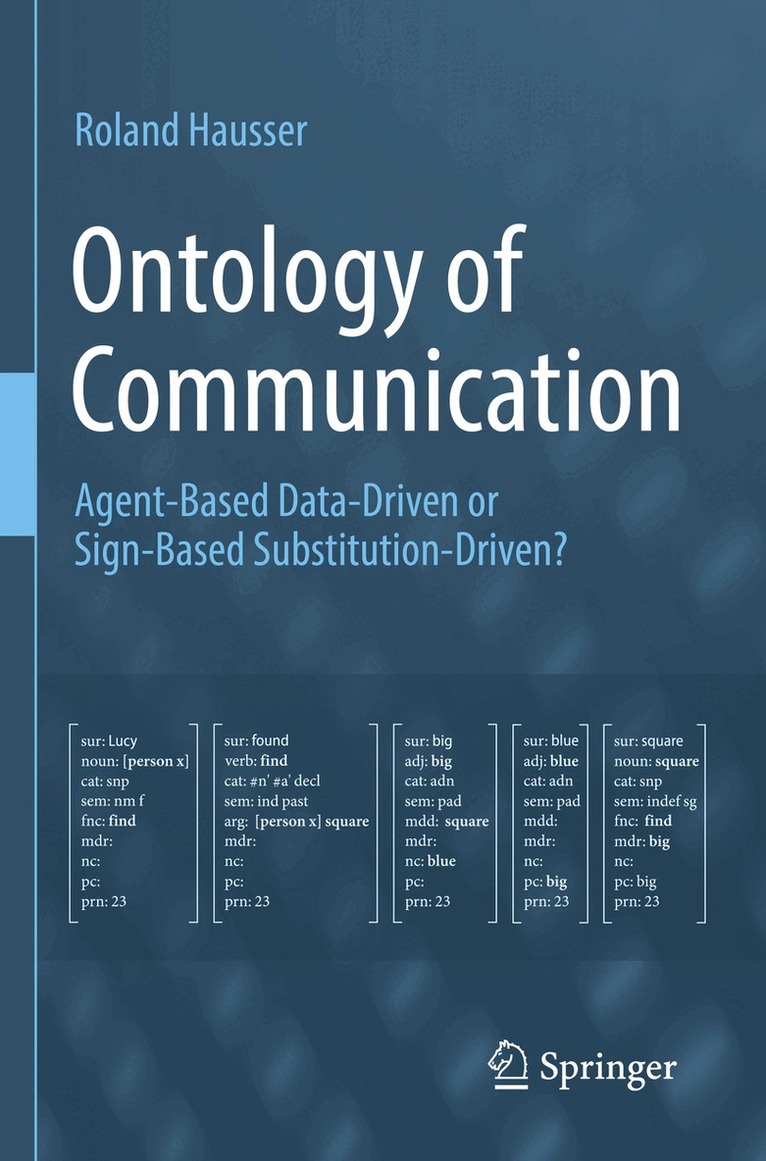
    Ontology of Communication

    Agent-Based Data-Driven or Sign-Based Substitution-Driven?

    AvRoland Hausser

    Häftad, Engelska, 2024

    1 785 kr

    Beställningsvara. Skickas inom 10-15 vardagar. Fri frakt över 249 kr.

    Fler format och utgåvor

    Inbunden

    1 785 kr

    E-bok

    2 267 kr

    Häftad

    665 kr

    Beskrivning

    The book gives a comprehensive discussion of Database Semantics (DBS) as an agent-based data-driven theory of how natural language communication essentially works. In language communication, agents switch between speak mode, driven by cognition-internal content (input) resulting in cognition-external raw data (e.g. sound waves or pixels, which have no meaning or grammatical properties but can be measured by natural science), and hear mode, driven by the raw data produced by the speaker resulting in cognition-internal content.The motivation is to compare two approaches for an ontology of communication: agent-based data-driven vs. sign-based substitution-driven. Agent-based means: design of a cognitive agent with (i) an interface component for converting raw data into cognitive content (recognition) and converting cognitive content into raw data (action), (ii) an on-board, content-addressable memory (database) for the storage and content retrieval, (iii) separate treatments of the speak and the hear mode. Data-driven means: (a) mapping a cognitive content as input to the speak-mode into a language-dependent surface as output, (b) mapping a surface as input to the hear-mode into a cognitive content as output. Oppositely, sign-based means: no distinction between speak and hear mode, whereas substitution-driven means: using a single start symbol as input for generating infinitely many outputs, based on substitutions by rewrite rules.Collecting recent research of the author, this beautiful, novel and original exposition begins with an introduction to DBS, makes a linguistic detour on subject/predicate gapping and slot-filler repetition, and moves on to discuss computational pragmatics, inference and cognition, grammatical disambiguation and other related topics. The book is mostly addressed to experts working in the field of computational linguistics, as well as toenthusiasts interested in the history and early development of this subject, starting with the pre-computational foundations of theoretical computer science and symbolic logic in the 30s.

    Produktinformation

    • Utgivningsdatum:2024-01-05
    • Mått:155 x 235 x undefined mm
    • Format:Häftad
    • Språk:Engelska
    • Antal sidor:258
    • Förlag:Springer International Publishing AG
    • ISBN:9783031227417

    Utforska kategorier

    • Systemvetenskap och AI inom Data och IT
    • Artificiell intelligens inom Data och IT

    Mer om författaren

    Roland Hausser is Professor Emeritus for Theoretical and Computational Linguistics at the University Erlangen-Nürnberg and former director of its Laboratory of Computational Linguistics (CLUE), between 1989 and 2011. After obtaining his PhD at the University of Texas at Austin, the author held various positions at Carnegie Mellon, Stanford University or Ludwig-Maximilians-Universität München. Prof. Hausser has been active and made significant contributions in the fields of Theoretical and Computational Linguistics, Human-Computer Interaction, Formal Grammars and Database Semantics. His research resulted in around 40 journal papers and conference proceedings, and he is the author of the Springer books “Foundations of Computational Linguistics”, “A Computational Model of Natural Language Communication” and “Computational Linguistics and Talking Robots”.

    Innehållsförteckning

    • Preface.- Background. - 1. Introduction.- 2. Laboratory Set-up of Database Semantics.- 3. Outline of DBS.- 4. Software Mechanisms of the Content Kinds.- 5. Comparison of Coordination and Gapping.- 6. Are Iterating Slot-Filler Structures Universal? - 7. Computational Pragmatics.- 8. Discontinuous Structures in DBS and PSG.- 9. Classical Syllogisms as Computational Inferences.- 10. Grounding of Concepts in Science.- 11. Function Words.- 12. Language vs. Nonlanguage Cognition.- 13. Grammatical Disambiguation.- 14. Database Semantics vs. Predicate Calculus.- 15. Agent-Based Memory as an On-Board Database.- 16. David Hume’s ‘Causation’ in Database Semantics.- 17. Concepts in Computational Cognition.- 18. Paraphrase and Ambiguity.- 19. Recursion and Grammatical Disambiguation.- Name Index - Bibliography.