Roland Hausser – författare
1 774 kr
Skickas inom 10-15 vardagar
2 194 kr
Läs direkt efter köp
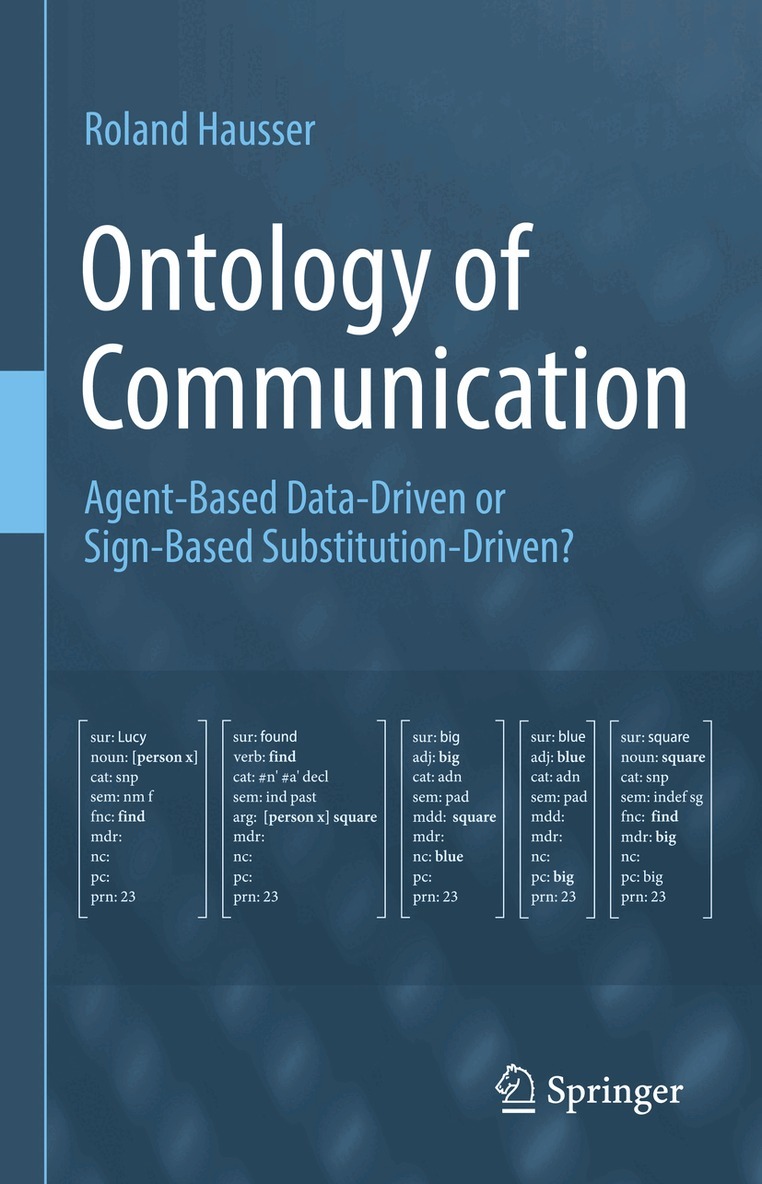
Collecting recent research of the author, this beautiful, novel and original exposition begins with an introduction to DBS, makes a linguistic detour on subject/predicate gapping and slot-filler repetition, and moves on to discuss computational pragmatics, inference and cognition, grammatical disambiguation and other related topics. The book is mostly addressed to experts working in the field of computational linguistics, as well as toenthusiasts interested in the history and early development of this subject, starting with the pre-computational foundations of theoretical computer science and symbolic logic in the 30s.
667 kr
Skickas inom 5-8 vardagar
1 774 kr
Skickas inom 10-15 vardagar
1 938 kr
Skickas inom 10-15 vardagar
2 524 kr
Läs direkt efter köp
Modern science is divided into three parts: natural sciences, engineering sciences and humanities. Over the last millennia, natural and engineering sciences evolved a symbiotic relationship, but humanities still stand apart. Today, however, designing and building a talking robot is a comparatively new challenge for which all three branches are needed. Starting from the idea that designing a theory of computational cognition should be as complete as possible, and trying to answer questions such as “Which ontology is required for building a computational cognition?”, the current book integrates interfaces, components, functional flows, data structure, database schema, and algorithms into a coherent system with an extensive range of cognitive functions, and constitutes the background to the book “Ontology of Communication” recently published by the author (Springer, 2023).
Part I discusses ontological distinctions between a sign-based and an agent-based approach, and continues with explanations of the data structure, the content-addressable database schema; the time-linear derivations of the speak and the hear mode; resonating content; induction, deduction, and abduction in inferencing, and concludes with a reconstruction of eight classical syllogisms as a test suite for DBS inferencing in the think mode.
Part II complements the literal use of language in the speak and hear mode with a reconstruction of syntactic mood adaptations and figurative use. The database schema of DBS is shown to lend itself not only to the tasks of traditional storage and retrieval, but also of reference, coreference, shadowing, coactivation of resonating content, and selective activation.
Part III complements the treatment of individual topics in linguistics, philosophy, and cognitive psychology with an overall software structure in the form of three interacting main components, called the interface, the memory, and the production component.
1 938 kr
Skickas inom 10-15 vardagar
753 kr
Kommande
559 kr
Skickas inom 10-15 vardagar
1 187 kr
Skickas inom 10-15 vardagar
1 519 kr
Läs direkt efter köp
The practical task of building a talking robot requires a theory of how natural language communication works. Conversely, the best way to computationally verify a theory of natural language communication is to demonstrate its functioning concretely in the form of a talking robot, the epitome of human–machine communication. To build an actual robot requires hardware that provides appropriate recognition and action interfaces, and because such hardware is hard to develop the approach in this book is theoretical: the author presents an artificial cognitive agent with language as a software system called database semantics (DBS). Because a theoretical approach does not have to deal with the technical difficulties of hardware engineering there is no reason to simplify the system – instead the software components of DBS aim at completeness of function and of data coverage in word form recognition, syntactic–semantic interpretation and inferencing, leaving the procedural implementation of elementary concepts for later.
In this book the author first examines the universals of natural language and explains the Database Semantics approach. Then in Part I he examines the following natural language communication issues: using external surfaces; the cycle of natural language communication; memory structure; autonomous control; and learning. In Part II he analyzes the coding of content according to the aspects: semantic relations of structure; simultaneous amalgamation of content; graph-theoretical considerations; computing perspective in dialogue; and computing perspective in text. The book ends with a concluding chapter, a bibliography and an index.
The book will be of value to researchers, graduate students and engineers in the areas of artificial intelligence and robotics, in particular those who deal with natural language processing.
1 333 kr
Skickas inom 10-15 vardagar
1 172 kr
Läs direkt efter köp
The content of this textbook is organized as a theory of language for the construction of talking robots. The main topic is the mechanism of natural language communication in both the speaker and the hearer.
In the third edition the author has modernized the text, leaving the overview of traditional, theoretical, and computational linguistics, analytic philosophy of language, and mathematical complexity theory with their historical backgrounds intact. The format of the empirical analyses of English and German syntax and semantics has been adapted to current practice; and Chaps. 22–24 have been rewritten to focus more sharply on the construction of a talking robot.
1 222 kr
Skickas inom 10-15 vardagar
734 kr
Läs direkt efter köp
559 kr
Skickas inom 10-15 vardagar
1 132 kr
Läs direkt efter köp
1 174 kr
Läs direkt efter köp
946 kr
Skickas inom 10-15 vardagar