• Fri frakt över 249 kr
  • •
  • Snabba leveranser
  • •
  • Billiga böcker
Kundservice

Du är på sajten för privatpersoner.

Företag, bibliotek eller offentlig verksamhet?

Du handlar på classic.bokus.com, där alla dina funktioner finns intakta.
Till classic.bokus.com
Bokus logotyp. Gå till startsidan.
  • Erbjudanden
  • Nyheter
  • Student
  • Topplistor
  • Barn & ungdom
  • Bokus Play
  • E-böcker
  • Pocketböcker
  • Spel & pussel

10% rabatt på allt med kod: NYSTART10 →

Sidfot

Mina sidor

    Hjälp

    • Kundservice
    • Vanliga frågor och svar
    • Frakt och leverans
    • Retur vid ångerrätt
    • Reklamera vara
    • Betalning
    • Köpvillkor
    • Allmänna villkor
    • Information om webbplatsens tillgänglighet

    Om Bokus

    • Om oss
    • Pressrum
    • För studenter
    • För företag
    • För bibliotek och offentlig verksamhet
    • För leverantörer
    • Hållbarhet

    Populärt

    • Aktuella erbjudanden
    • Presentkort
    • Studentlitteratur
    • Nya böcker
    • Topplistor
    • Signerade böcker
    • Engelska böcker

    Inspiration

    • Boktips
    • BookTok
    • Populära bokserier
    • Barnbokskaraktärer
    • Populära författare
    Logotyp för Bokus
    Följ oss på Facebook (extern länk)Följ oss på Instagram (extern länk)Följ oss på YouTube (extern länk)Följ oss på TikTok (extern länk)
    bokus @ CookiesAnpassa cookiesIntegritetspolicyKöpvillkor
    Till Citymail hemsida (extern länk)Till Budbee hemsida (extern länk)Till Postnord hemsida (extern länk)Till Schenker hemsida (extern länk)Till Early Bird hemsida (extern länk)Till Walleys hemsida (extern länk)
    1. Historia och arkeologi
    2. Arkeologi

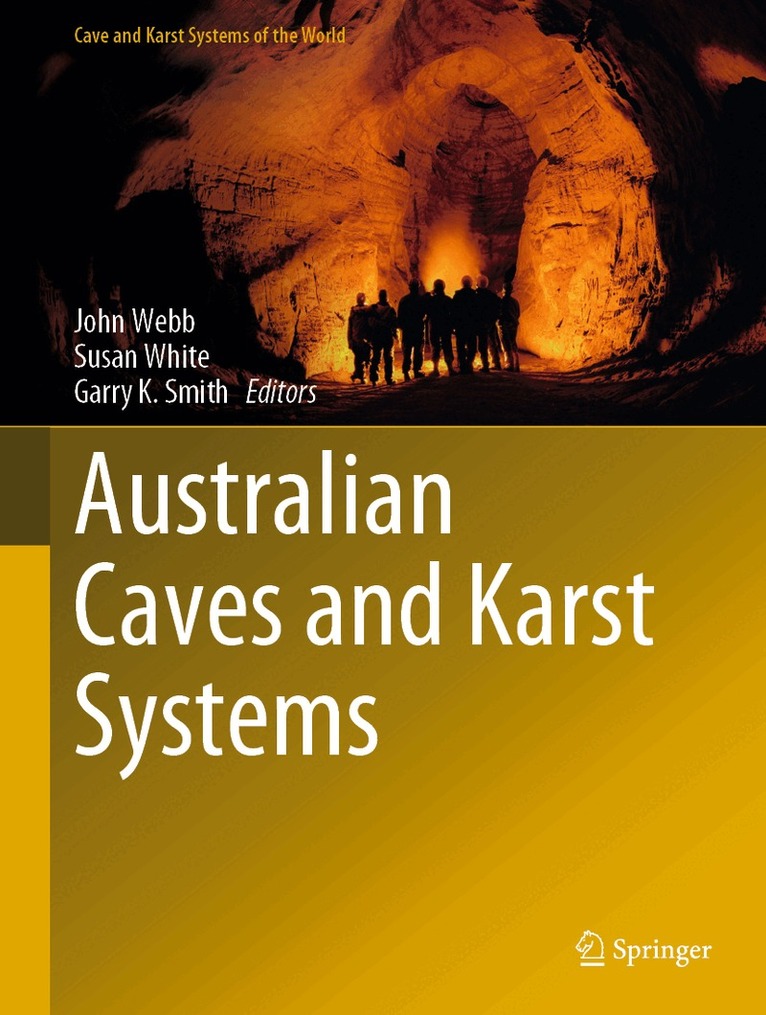
    Australian Caves and Karst Systems

    AvJohn Webb,Susan White

    Inbunden, Engelska, 2023

    Del i serien Cave and Karst Systems of the World

    2 007 kr

    Beställningsvara. Skickas inom 10-15 vardagar. Fri frakt över 249 kr.

    Beskrivning

    This book, part of the series Cave and Karst Systems of the World, begins with a review of the interaction between people and caves in Australia (including conservation), followed by descriptions of the spectacular cave diving sites, before comprehensively covering all the major carbonate and noncarbonate karst areas, subdivided by rock type and region, and including the origin of the caves. This is followed by broad overviews of cave minerals and speleothems, cave biology and cave fossils. Each section was written by one or more specialists in the topic and is illustrated by clear diagrams and superb colour photos. The book emphasises the unique aspects of the Australian karst, including the variability in the age of the caves (very old to very young) and the impact of isolation on the stygofauna, as well as the vertebrate fossils preserved in the caves. Written in an easy-to-read style, the book is a primary reference guide to Australian karst and represents a valuable asset for anyone interested in the topic, not only cavers and academics.

    Produktinformation

    • Utgivningsdatum:2023-09-01
    • Mått:210 x 279 x 22 mm
    • Vikt:1 373 g
    • Format:Inbunden
    • Språk:Engelska
    • Serie:Cave and Karst Systems of the World
    • Antal sidor:398
    • Förlag:Springer International Publishing AG
    • ISBN:9783031242663

    Utforska kategorier

    • Arkeologi inom Historia och arkeologi
    • Miljövetenskap och miljöpolitik inom Naturvetenskap och teknik
    • Geografi inom Naturvetenskap och teknik

    Mer om författaren

    John A. Webb is Emeritus Professor of Environmental Geoscience at La Trobe University, Melbourne. He has published extensively on Australian karst, particularly the Nullarbor and southeastern Australia, and has caved throughout Australia and overseas (although not so much recently). In 2013 the Australian Speleological Federation awarded him the Edie Smith Award for outstanding service to Australian speleology, and he gave an invited plenary speech on Australian karst at the 2017 International Congress of Speleology. His interests extend to geoarchaeology, including artefact and ochre sourcing, as well as the landscape evolution of archaeological sites. He also works on groundwater and contaminated site management, with an on-going research project on improving treatment procedures for acid mine drainage. He has supervised over 30 PhD and 100 honours students in a variety of geomorphological, ^5000 citations in total.Susan Q. White is akarst geomorphologist at La Trobe University Melbourne. She has published on Australian karst developed on Cenozoic limestones (including the Nullarbor) and Proterozoic dolomites (Bullita/Judburra). She has caved extensively in Australia and overseas. In 2015 she was awarded the Order of Australia Medal (OAM) for service to science (especially speleology) and youth (Girl Guides). She chaired the ASF Publications commission from 2005 to 2019, has been involved in the Speleo2017 Congress, Conservation and Library Commissions, and was an Editor of Helictite (1998-2016). She was made a Fellow of the Australian Speleological Federation in 2015 for her service to ASF and is an Honorary Life Member of the Victorian Speleological Association. She has worked at several tertiary institutions in Melbourne where she has co-supervised Honours and post-graduate students. Her interests also include Geological Heritage and Significance, and she chaired the Geological Society of Australia’s Standing Committee on Geological Heritage (1994-2010) and GSA (Victoria)’s Geological Heritage subcommittee (1993 - present).Garry K. Smith is an active speleologist, with more than 50 years’ experience in Australia and overseas. He has held various qualifications as a Scouts caving instructor and examiner as well as 36 years membership of the Newcastle & Hunter Valley Speleological Society, serving in various executive positions including the current president. He has published numerous articles and chapters in magazines and books, covering subjects about cave atmospheres, caving techniques, histoplasmosis, mineralogy, geomorphology and photography. Garry enjoys underground photography and has received numerous photographic awards.

    Innehållsförteckning

    • Introduction.- Part 1- People and Caves in Australia.- Part 2 - ‘Hard’ rock karst developed in Neoproterozoic and Palaeozoic carbonates.- Part 3 - ‘Soft’ rock karst developed in Tertiary and Quaternary limestones.- Part 4 – Pseudokarst.- Part 5 – Cave contents.