• Fri frakt över 249 kr
  • •
  • Snabba leveranser
  • •
  • Billiga böcker
Kundservice

Du är på sajten för privatpersoner.

Företag, bibliotek eller offentlig verksamhet?

Du handlar på classic.bokus.com, där alla dina funktioner finns intakta.
Till classic.bokus.com
Bokus logotyp. Gå till startsidan.
  • Erbjudanden
  • Nyheter
  • Student
  • Topplistor
  • Barn & ungdom
  • Bokus Play
  • E-böcker
  • Pocketböcker
  • Spel & pussel

10% studentrabatt med kod TERM26

Sidfot

Mina sidor

    Hjälp

    • Kundservice
    • Vanliga frågor och svar
    • Frakt och leverans
    • Retur vid ångerrätt
    • Reklamera vara
    • Betalning
    • Köpvillkor
    • Allmänna villkor
    • Information om webbplatsens tillgänglighet

    Om Bokus

    • Om oss
    • Pressrum
    • För studenter
    • För företag
    • För bibliotek och offentlig verksamhet
    • För leverantörer
    • Hållbarhet

    Populärt

    • Aktuella erbjudanden
    • Presentkort
    • Studentlitteratur
    • Nya böcker
    • Topplistor
    • Signerade böcker
    • Engelska böcker

    Inspiration

    • Boktips
    • BookTok
    • Populära bokserier
    • Barnbokskaraktärer
    • Populära författare
    Logotyp för Bokus
    Följ oss på Facebook (extern länk)Följ oss på Instagram (extern länk)Följ oss på YouTube (extern länk)Följ oss på TikTok (extern länk)
    bokus @ CookiesAnpassa cookiesIntegritetspolicyKöpvillkor
    Till Citymail hemsida (extern länk)Till Budbee hemsida (extern länk)Till Postnord hemsida (extern länk)Till Schenker hemsida (extern länk)Till Early Bird hemsida (extern länk)Till Walleys hemsida (extern länk)
    1. Psykologi och pedagogik
    2. Psykologi
    3. Socialpsykologi och gruppsykologi

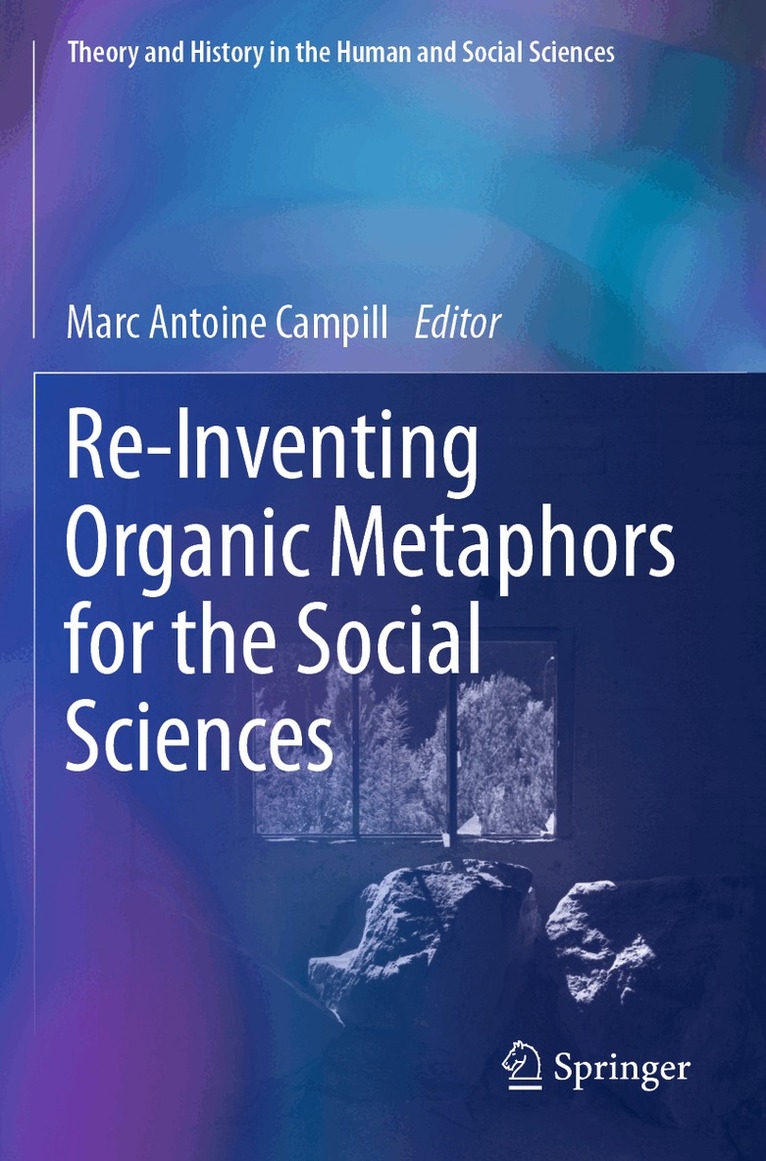
    Re-Inventing Organic Metaphors for the Social Sciences

    AvMarc Antoine Campill

    Häftad, Engelska, 2024

    Del i serien Theory and History in the Human and Social Sciences

    1 272 kr

    Beställningsvara. Skickas inom 10-15 vardagar. Fri frakt över 249 kr.

    Beskrivning

    The “Re-Inventing Organic Metaphors for the Social Sciences” is a volume with the specific goal: to challenge psychological understandings by connecting psychological approaches with  multidimensional perspectives of various other scientific streams, meanwhile imbedding the generated knowledge in metaphors that allows researchers to follow  phenomena into a deeper and more (w)holistic understanding of its appearance. This is particularly important when the humankind faces challenges due to systemic biological changes, as the phenomenological dynamics bonded to those challenges can be conserved in appropriated context. For this purpose, the organic metaphors  are introduced. A tool that has central advantage over mechanical metaphors as it can capture the complex and open-systemic nature of biological, psychological, and social phenomena.  For example—the widely used notion “mind as a computer” may be more productively replaced by “mind as a membrane”—with implications (e.g. focus on borders in-between, or in systems in themselves- exosystemic realities in our world). There are many other fertile opportunities not yet explored in the realms of psychology and other sciences.  Furthermore, the contributors  operated also as cross-reviewers for each other’s. In this occasion a new dimension, in chapter construction, will be introduced. Beside the traditional reviewing of another paper the reviewer has been asked to add a small list of extending questions toward the reviewed paper. These added questions have been introduced as potential questions that the authors were demanded to add into a final sub-chapter of their contribution. The subchapter has been titled as “Dialogue” (the author was free to select between the questions and ideas on those they believe could inhabit an especially worth for the future readers).

    Produktinformation

    • Utgivningsdatum:2024-04-27
    • Mått:155 x 235 x 16 mm
    • Vikt:435 g
    • Format:Häftad
    • Språk:Engelska
    • Serie:Theory and History in the Human and Social Sciences
    • Antal sidor:263
    • Förlag:Springer International Publishing AG
    • ISBN:9783031266799

    Utforska kategorier

    • Socialpsykologi och gruppsykologi inom Psykologi och pedagogik
    • Psykologi inom Psykologi och pedagogik
    • Kognitiv psykologi inom Psykologi och pedagogik

    Mer om författaren

    Marc Antoine Campill, accomplished his master’s degree (MSc.) in cultural psychology at the Sigmund Freud (Private) University Vienna and his bachelor’s degree in psychology (BSc.) from the University of Luxembourg. The current field interest is determinate toward the cultural psychological understanding of the individuum, in his identification process. As his current publications imply, his interests are set on generating a new psychological perspective by integrating the social construction of common knowledge and the scientifical meaning of other “Naturwissenschaften” into the psychological field.  His collaborative work with Japan dedicated to the hihkikomori phenomena serves as the basis for the theoretical efforts made collectively in this volume.  The creation of dynamic models, that can surpass the mechanical restrictions of current theoretical models in psychology, is a central aim of his current construct as a researcher.

    Innehållsförteckning

    • 1. Prelude: Psychology in metamorphosis.- 2. Time as an organic metaphor.- 3. The regeneration of the space of landscape - where experiencing is fundamentally sustained.- 4. Ohh-- Guovssahas above my meadow: Introducing the Gestalt-explosion as the core factor of meaning-generation.- 5. Everything Is Bound to Transform: On Knowledge’s Flow .- 6. Allegory Analysis:A Methodological Framework For A Tool For Psychology.- 7. The knot and the psyche. A study on the dynamism of the psyche by means of the knotting praxis.- 8. Exploring the “garden metaphor”: An inter-modal autoethnography.- 9. The Role Of Metaphors In Model-Building Within The Sciences Of Meaning.- 10. Ice cream: An exploration of outsiders by parasitological insights.- 11. Biocenosis of the Self: The dynamic of relationships.- 12. The Story of Isepal – A Case Study Allegory Analysis –.- 13. Dialogue: How to use the wasted potential of thoughts and efforts.- 14. Conclusion: Following innovation into the wasteland: Re-inventing organic metaphors.