• Fri frakt över 249 kr
  • •
  • Snabba leveranser
  • •
  • Billiga böcker
Kundservice

Du är på sajten för privatpersoner.

Företag, bibliotek eller offentlig verksamhet?

Du handlar på classic.bokus.com, där alla dina funktioner finns intakta.
Till classic.bokus.com
Bokus logotyp. Gå till startsidan.
  • Erbjudanden
  • Nyheter
  • Student
  • Topplistor
  • Barn & ungdom
  • Bokus Play
  • E-böcker
  • Pocketböcker
  • Spel & pussel

10% rabatt på allt med kod: NYSTART10 →

Sidfot

Mina sidor

    Hjälp

    • Kundservice
    • Vanliga frågor och svar
    • Frakt och leverans
    • Retur vid ångerrätt
    • Reklamera vara
    • Betalning
    • Köpvillkor
    • Allmänna villkor
    • Information om webbplatsens tillgänglighet

    Om Bokus

    • Om oss
    • Pressrum
    • För studenter
    • För företag
    • För bibliotek och offentlig verksamhet
    • För leverantörer
    • Hållbarhet

    Populärt

    • Aktuella erbjudanden
    • Presentkort
    • Studentlitteratur
    • Nya böcker
    • Topplistor
    • Signerade böcker
    • Engelska böcker

    Inspiration

    • Boktips
    • BookTok
    • Populära bokserier
    • Barnbokskaraktärer
    • Populära författare
    Logotyp för Bokus
    Följ oss på Facebook (extern länk)Följ oss på Instagram (extern länk)Följ oss på YouTube (extern länk)Följ oss på TikTok (extern länk)
    bokus @ CookiesAnpassa cookiesIntegritetspolicyKöpvillkor
    Till Citymail hemsida (extern länk)Till Budbee hemsida (extern länk)Till Postnord hemsida (extern länk)Till Schenker hemsida (extern länk)Till Early Bird hemsida (extern länk)Till Walleys hemsida (extern länk)
    1. Naturvetenskap och teknik
    2. Geovetenskap

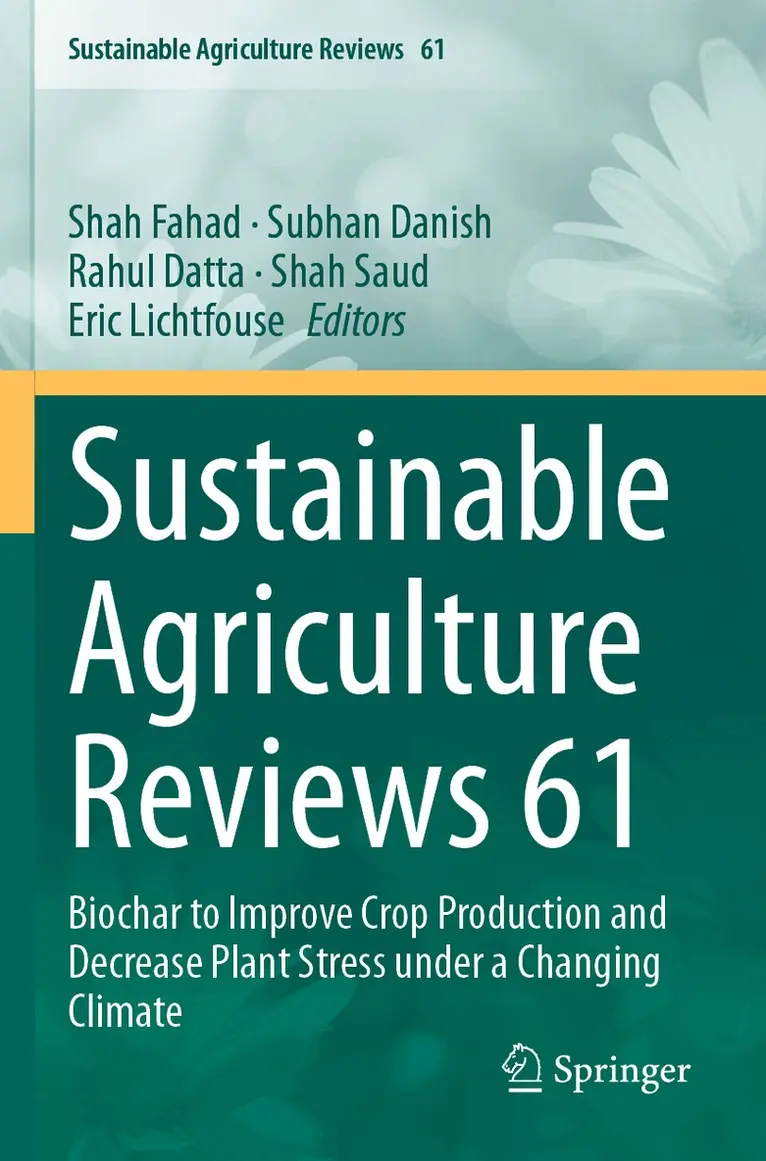
    Sustainable Agriculture Reviews 61

    Biochar to Improve Crop Production and Decrease Plant Stress under a Changing Climate

    AvShah Fahad,Subhan Danish

    Häftad, Engelska, 2024

    Del 61 i serien Sustainable Agriculture Reviews

    1 518 kr

    Beställningsvara. Skickas inom 10-15 vardagar. Fri frakt över 249 kr.

    Beskrivning

    The book aim to contribute the latest understandings of physiological, biochemical and molecular bases of the responses of major crop plants to a range of different biomass produced biochar to introduce climate resilience crop varieties which leads to enhanced crop productivity and quality under stressful conditions and also for better utilization of natural resources to ensure food security through modern breeding. Finally, this book will be a valuable resource for future plant stress related research with biochar, and can be considered as a reference book for front-line researchers working on sustaining crop production under climate change.Adverse effects of climate changes on crops has developed the situation quite critical for sustainable agriculture. Food security has become in danger due to low production of agricultural crops by resilient climate and ever increasing human population. Heat, drought, salinity, soil compaction, flooding and poor soil organic carbon induced stress in crops by climate adverse conditions are major concerns in this regard. A mechanistic understanding of the interactions between abiotic stresses response of crops is needed to identify and take advantage of acclimation traits in major crop species as a prerequisite for securing robust yield and good quality. This underpins a need for crops with inherent yield increase, yield stability against multiple abiotic stresses and improved quality. Individual stress tolerance mechanisms have been well documented so far. However, mechanisms behind plants’ tolerance by application of biochar and its interactions with soil and plant roots towards multiple abiotic stresses are not fully understood. In addition, there will always be some uncertainty associated with modelling the complex relationships between agricultural yields, product quality with biochar under future climate scenarios. Prediction of yield and quality stability, one of mostcomplex agronomic traits, must integrate aspects of plant development, physiology, biochemistry and genetics. Furthermore, the GxExM interactions will complicate the model predications, thus the responses of a given genotype to a defined environment under certain management strategy need to be determined empirically and used to parameterise and refine crop models.

    Produktinformation

    • Utgivningsdatum:2024-04-16
    • Mått:155 x 235 x 20 mm
    • Vikt:670 g
    • Format:Häftad
    • Språk:Engelska
    • Serie:Sustainable Agriculture Reviews
    • Antal sidor:376
    • Förlag:Springer International Publishing AG
    • ISBN:9783031269851

    Utforska kategorier

    • Geovetenskap inom Naturvetenskap och teknik
    • Agronomi inom Naturvetenskap och teknik

    Mer om författaren

    Dr Shah Fahad is working as Assistant Professor in the Department of Agronomy, Abdul Wali Khan University Mardan, Khyber Pakhtunkhwa, Pakistan. He has obtained his PhD in Agronomy from Huazhong Agriculture University, China, in 2015. After doing his postdoctoral research in Agronomy at the Huazhong Agriculture University from 2015 to 2017, he was Assistant Professor at the University of Haripur. He has published over 440 peer-reviewed papers with more than 380 research and 60 review articles, on climate change, plant physiology and breeding, plant nutrition, plant stress responses and tolerance mechanisms, and exogenous chemical priming-induced abiotic stress tolerance. He has also contributed 80 book chapters and edited twenty book volumes. He has won the Young Rice International Scientist award and distinguish scholar award in 2014 and 2015 respectively. He got 17 projects from international and national donor agencies. Dr Shah Fahad figured in the Clarivate's 2021and 2022 lists of Highly Cited Researchers in the field of Plant and Agriculture sciences. His is among the top two percent scientists in a global list compiled by the Stanford University, USA. He has worked and is presently continuing on a wide range of topics, including climate change, greenhouse emission gasses, abiotic stresses tolerance, roles of phytohormones and their interactions in abiotic stress responses, heavy metals, regulation of nutrient transport processes.Dr. Subhan Danish has completed a PhD in Agriculture Soil Science from the Bahauddin Zakariya University in Pakistan. His has expertise in soil microbiology, phytoremediation of heavy metals, biochar use as an amendment and plant nutrition. He has published 72 research articles. He is guest editor of the Sustainability Journal. He got a Gold Medal in M.Sc. Hons. and was awarded Role of Honor for Best Debater at provincial level and interdepartmental university level.Dr. Rahul Datta is a soil microbiologist and enzymologist holding an MSc and PhD from the Department of Geology and Pedology at Mendel University in Brno, Czech Republic, where he is currently a researcher. He has acquired global experience in soil science research by working at the Ohio State University, USA, and at the University of Florence, Italy. He has published numerous research articles and a book. He is editorial board member of the Journal of Open Agriculture.Dr. Shah Saud received his Ph.D. and post doctorate in turf grasses, horticulture, from the Northeast Agricultural University, Harbin, China. He is currently working as Assistant Professor in the College of Life Science, Linyi University, China. He has published over 200 articles, edited 8 books and written 60 book chapters plant physiology, plant stress responses, and environmental problems in relation to agricultural plants.Dr. Eric Lichtfouse is Professor at Xi'an Jiaotong University, China, and Chief Editor founder of thejournal Environmental Chemistry Letters and the series Sustainable Agriculture Reviews. He has invented carbon-13 dating, a method allowing to measure the relative age of organic molecules in complex media, and has discovered temporal pools of individual substances in soils. He has written about 400 publications and has awards in analytical chemistry and scientific editing. He is teaching scientific writing and communication, and has written the book Scientific Writing for Impact Factor Journals. He is XTerra Vice-Champion in his age category.

    Innehållsförteckning

    • Part 1: Improvement of Crop Yield. 1. Biochar application for improving the yield and quality of crops under climate change (Akbar Hossain).- 2. Biochar to improve crops yield and quality under a changing climate (Shah Fahad).- 3. Biochar for improving crop productivity and soil fertility (Fazal Jalal).- 4. Biochar application to soil to improve fertility (Sadia Zafar).- Part 2: Alleviation of Plant Stress. 5. Biochar as soil amendment for mitigating nutrients stress in crops (Shah Fahad).- 6. Biochar to mitigate crop exposure to soil compaction stress (Anis Ali Shah).- 7. Biochar for mitigation of heat stress in crop plants (Zhixiang Zhang).- 8. Biochar application to soil for mitigation of nutrients stress in plants (Hafiz Muhammad Rashad Javeed).- Part 3: Improvement of soil health9. Biochar from on-farm feedstocks for sustainable potassium management in soils (Hafeez Ur Rahim).- 10. Biochar for crop protection from soil borne diseases (Rabia Naz).- 11. Biofertilizers to improve soil health and crop yields (Ligeng Jiang).- 12. Biochar application to soils to improve the management of irrigation water (Jackson Nkoh Nkoh).- 13. Role of biochar in the adsorption of heavy metals (Osman Sonmez).- Part 4: Microbial interactions. 14. Positive and negative impacts of biochar on microbial diversity (Muhammad Nauman Khan).- 15. Biochar and arbuscular mycorrhizae fungi to improve soil organic matter and fertility (Hafiz Muhammad Rashad Javeed).- 16.Biochar feedstocks, synthesis and interaction with soil microorganisms (Sammina Mahmood).- Index.