• Fri frakt över 249 kr
  • •
  • Snabba leveranser
  • •
  • Billiga böcker
Kundservice

Du är på sajten för privatpersoner.

Företag, bibliotek eller offentlig verksamhet?

Du handlar på classic.bokus.com, där alla dina funktioner finns intakta.
Till classic.bokus.com
Bokus logotyp. Gå till startsidan.
  • Erbjudanden
  • Nyheter
  • Student
  • Topplistor
  • Barn & ungdom
  • Bokus Play
  • E-böcker
  • Pocketböcker
  • Spel & pussel

10% rabatt på allt med kod: NYSTART10 →

Sidfot

Mina sidor

    Hjälp

    • Kundservice
    • Vanliga frågor och svar
    • Frakt och leverans
    • Retur vid ångerrätt
    • Reklamera vara
    • Betalning
    • Köpvillkor
    • Allmänna villkor
    • Information om webbplatsens tillgänglighet

    Om Bokus

    • Om oss
    • Pressrum
    • För studenter
    • För företag
    • För bibliotek och offentlig verksamhet
    • För leverantörer
    • Hållbarhet

    Populärt

    • Aktuella erbjudanden
    • Presentkort
    • Studentlitteratur
    • Nya böcker
    • Topplistor
    • Signerade böcker
    • Engelska böcker

    Inspiration

    • Boktips
    • BookTok
    • Populära bokserier
    • Barnbokskaraktärer
    • Populära författare
    Logotyp för Bokus
    Följ oss på Facebook (extern länk)Följ oss på Instagram (extern länk)Följ oss på YouTube (extern länk)Följ oss på TikTok (extern länk)
    bokus @ CookiesAnpassa cookiesIntegritetspolicyKöpvillkor
    Till Citymail hemsida (extern länk)Till Budbee hemsida (extern länk)Till Postnord hemsida (extern länk)Till Schenker hemsida (extern länk)Till Early Bird hemsida (extern länk)Till Walleys hemsida (extern länk)
    1. Naturvetenskap och teknik
    2. Teknik och industri
    3. Biokemisk teknik

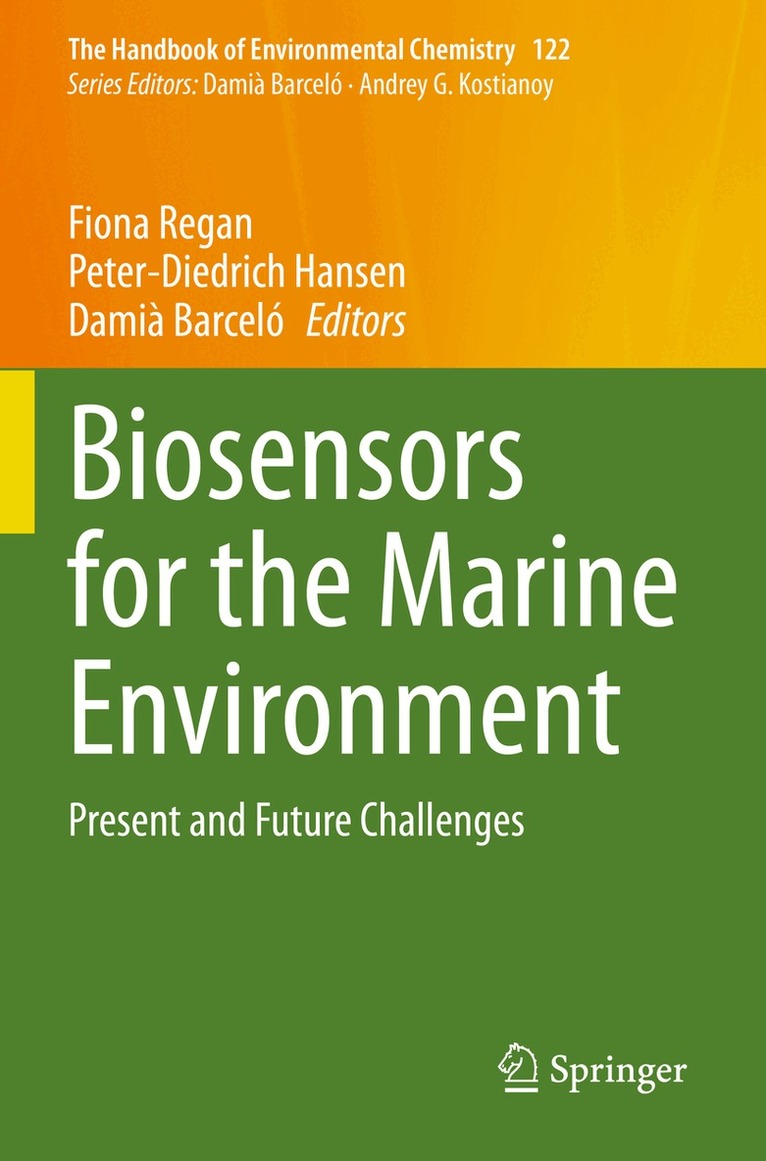
    Biosensors for the Marine Environment

    Present and Future Challenges

    AvFiona Regan,Peter-Diedrich Hansen

    Häftad, Engelska, 2024

    Del 122 i serien Handbook of Environmental Chemistry

    3 243 kr

    Beställningsvara. Skickas inom 10-15 vardagar. Fri frakt över 249 kr.

    Beskrivning

    This book is devoted to the exploration of innovative sensing technologies for marine applications. The book focuses on various novel biosensor designs from nano-biosensors to molecularly imprinted polymers offering a broad perspective for marine biosensors development to deployment challenges.The book aims to target researchers in the area of marine monitoring, sensor developments and deployment of devices in the marine environment.

    Produktinformation

    • Utgivningsdatum:2024-06-04
    • Mått:155 x 235 x 14 mm
    • Vikt:460 g
    • Format:Häftad
    • Språk:Engelska
    • Serie:Handbook of Environmental Chemistry
    • Antal sidor:255
    • Förlag:Springer International Publishing AG
    • ISBN:9783031320033

    Utforska kategorier

    • Biokemisk teknik inom Naturvetenskap och teknik
    • Kemi inom Naturvetenskap och teknik
    • Biovetenskap inom Naturvetenskap och teknik

    Mer om författaren

    Fiona Regan is founder and Director of the DCU Water Institute and is Full professor in Chemistry at the School of Chemical Sciences in Dublin City University. Fiona’s research focuses on analytical chemistry in the field of environmental monitoring and she has special interest in priority and emerging chemicals as well as the establishment of decision support tools for environmental monitoring using novel technologies and data management tools. Her work includes the areas of separations and sensors (including microfluidics, Lab-on-a-disc), materials for sensing and antifouling applications on aquatic deployed systems. Fiona was coordinator of SmartBay Ireland (2010–2016), she is an associate editor with Royal Society of Chemistry’s Analytical Methods, a member of the Water4All Scientific and Technological Board, a Chair of the Royal Irish Academy (RIA) Climate Change and Environment committee and Scientific Advisor to AquaWatch, Australia.Peter-Diedrich Hansen is a Full Professor and Departmental Director Technische Universität Berlin, 1990–2009. Head of the chair Ecotoxicology. Director and Professor 1980–1990 in the Institute of Water, Soil and Air Hygiene at the former Federal Health Office (Scientific Director of the Test Site for Environmental Hygiene), Berlin. Dissertation Dr. rer. nat. at the University of Hamburg (1976) and Habilitation (Dr. habil.) at the Technische Universität Berlin (1988). His expertise is in the areas of Ecotoxicology, Bioanalytical and Chemical Methods: Chairman of DIN UA 7 “Subanimal Testing = alternative testing strategies” with 6 subcommittees, Genotoxicity, Immunoassays, Enzymatic Activity and whole cell biosensors, Fish Eggs and Embryos and Endocrine Effects. Effects monitoring (coastal areas and freshwater – artificial streams) and research under microgravity in orbit (ISS). Risk analysis and steering mechanisms. He has published more than 150 peer reviewed publications.Damià Barceló is a Full Professor IDAEA-CSIC, Spain since 2008 and Director of the Catalan Institute for Water Research (ICRA), Girona, Spain, 2016–2020. Full Professor Chair in Biology, College of Science, King Saud University, Riyadh, Saudi Arabia. Distinguished Scientist Fellowship Program (DSFP). Doctor Honoris Causa by the Universities of Ioannina, Greece, in 2014 and more than 1400 publications (source Google Scholar on  May 2021, Scopus in parenthesis).

    Innehållsförteckning

    • Biosensors for the Marine Environment: Introduction.- Microgravity Changes Membrane Properties and Triggers Bioluminescence in Pyrocystis noctiluca as an Approach for New Biosensor Concepts.- Addressing Ciguatera Risk Using Biosensors for the Detection of Gambierdiscus and Ciguatoxins.- Antibody, Aptamer and Affimer-Based Affinity Tools for Marine Toxin Biosensing.- Environmental DNA as a Tool for Single Species Detection.- Paper-Based Devices for Virus Detection in Water.- Electrochemical MIP Sensors for Environmental Analysis.- Whole-Cell Biosensors and Phagocytosis with Cryo-Conserved Cells in Coastal Areas and in Orbit (ISS) Under Microgravity.- Marine Whole-Cell Biosensing for “Real-Time” Determination of the Ballast Water Treatment Efficiency.- Sensors for Monitoring Faecal Indicator Bacteria in Bathing Waters.- Electrochemical (Bio)sensors for Toxins Control in the Marine Environment.