• Fri frakt över 249 kr
  • •
  • Snabba leveranser
  • •
  • Billiga böcker
Kundservice

Du är på sajten för privatpersoner.

Företag, bibliotek eller offentlig verksamhet?

Du handlar på classic.bokus.com, där alla dina funktioner finns intakta.
Till classic.bokus.com
Bokus logotyp. Gå till startsidan.
  • Erbjudanden
  • Nyheter
  • Student
  • Topplistor
  • Barn & ungdom
  • Bokus Play
  • E-böcker
  • Pocketböcker
  • Spel & pussel

10% rabatt på allt med kod: NYSTART10 →

Sidfot

Mina sidor

    Hjälp

    • Kundservice
    • Vanliga frågor och svar
    • Frakt och leverans
    • Retur vid ångerrätt
    • Reklamera vara
    • Betalning
    • Köpvillkor
    • Allmänna villkor
    • Information om webbplatsens tillgänglighet

    Om Bokus

    • Om oss
    • Pressrum
    • För studenter
    • För företag
    • För bibliotek och offentlig verksamhet
    • För leverantörer
    • Hållbarhet

    Populärt

    • Aktuella erbjudanden
    • Presentkort
    • Studentlitteratur
    • Nya böcker
    • Topplistor
    • Signerade böcker
    • Engelska böcker

    Inspiration

    • Boktips
    • BookTok
    • Populära bokserier
    • Barnbokskaraktärer
    • Populära författare
    Logotyp för Bokus
    Följ oss på Facebook (extern länk)Följ oss på Instagram (extern länk)Följ oss på YouTube (extern länk)Följ oss på TikTok (extern länk)
    bokus @ CookiesAnpassa cookiesIntegritetspolicyKöpvillkor
    Till Citymail hemsida (extern länk)Till Budbee hemsida (extern länk)Till Postnord hemsida (extern länk)Till Schenker hemsida (extern länk)Till Early Bird hemsida (extern länk)Till Walleys hemsida (extern länk)
    1. Djur och Natur
    2. Naturböcker
    3. Växtböcker

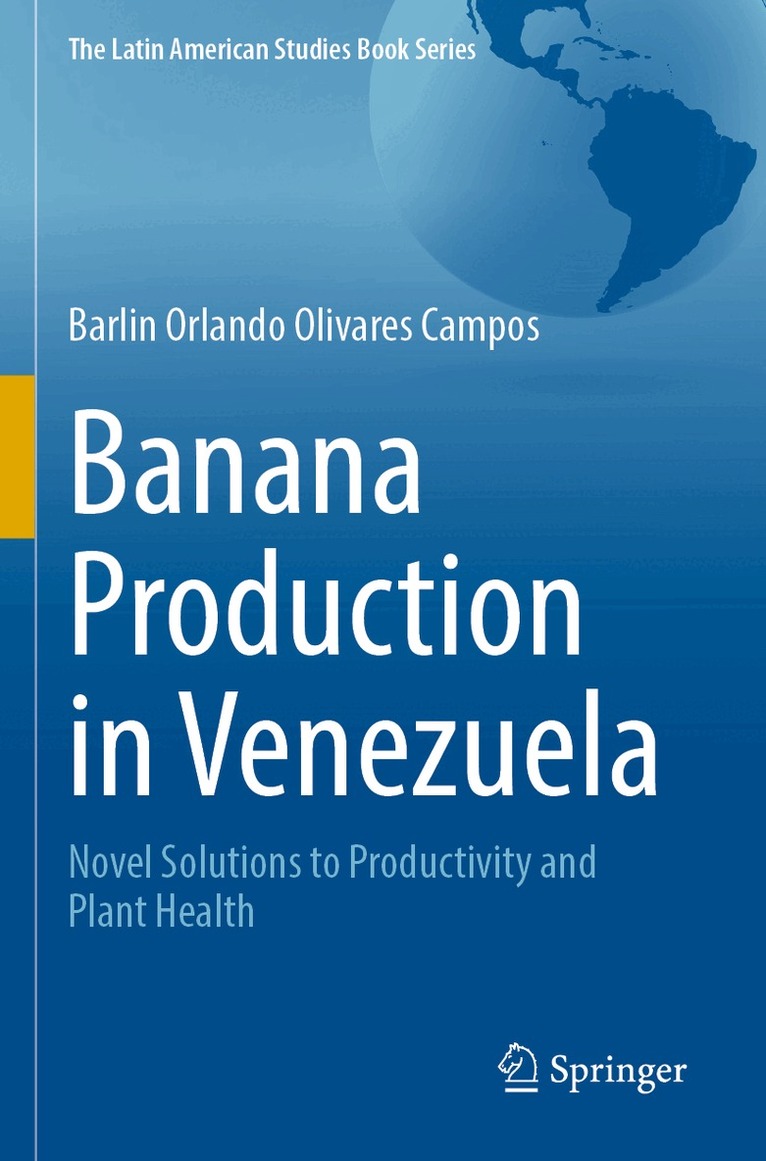
    Banana Production in Venezuela

    Novel Solutions to Productivity and Plant Health

    AvBarlin Orlando Olivares Campos

    Häftad, Engelska, 2024

    Del i serien Latin American Studies Book Series

    1 626 kr

    Beställningsvara. Skickas inom 10-15 vardagar. Fri frakt över 249 kr.

    Fler format och utgåvor

    Inbunden

    1 626 kr

    E-bok

    2 044 kr

    Beskrivning

    This book presents an important contribution to the knowledge of the banana soils of Venezuela. Banana, the edible fruit of Musaceae, is a staple food for more than 400 million people worldwide due to their nutritional and energy attributes. This makes Musaceae a crop of worldwide relevance, particularly in tropical regions, highlighting the impact of improved Musaceae cropping systems in the current efforts worldwide oriented towards a new agricultural revolution based on sustainable intensification. To achieve this, better practices for food production based on scientific and technical research capable to consider the complexity and variability within the agri-food sector are necessary. The research presented in this book is oriented towards providing answers to the causes of two aspects considered of high relevance for banana production, both affecting productivity and sustainability, always addressed for the Venezuelan conditions, one of the world’s largest producing countries: 1- The impact of phytosanitary risks related to Fusarium Wilt (FW) and the influence of the soil on the incidence of Banana Wilt (BW); and 2- An observed trend towards loss of productivity and decline of soil quality in some commercial farms of Aragua and Trujillo states in Venezuela. The book presents a pioneering study in the application of categorical regression (CATREG) in the characterization of banana soils and analyses soil morphological variables, such as texture, dry consistency, biological activity, reaction to HCl, and type of structure to characterize soil productivity for growing healthy bananas. It develops, for the first time in Venezuela, risk analysis and climatic suitability maps for lethal wilt disease in bananas caused by Fusarium oxysporum f. sp. cubense (Foc) Tropical Race 4 (TR4) (syn. Fusarium odoratissimum). Innovative machine learning techniques are used to predict BW so that future crop development can be done more efficiently and sustainably.

    Produktinformation

    • Utgivningsdatum:2024-07-15
    • Mått:155 x 235 x 12 mm
    • Vikt:312 g
    • Format:Häftad
    • Språk:Engelska
    • Serie:Latin American Studies Book Series
    • Antal sidor:176
    • Upplaga:2023
    • Förlag:Springer International Publishing AG
    • ISBN:9783031344770

    Utforska kategorier

    • Växtböcker inom Djur och Natur
    • Botanik inom Naturvetenskap och teknik
    • Agronomi inom Naturvetenskap och teknik

    Mer om författaren

    Barlin Orlando Olivares Campos is hired as a researcher in the Biodiversity Management Research Group (GESBIO-UCO) and completed his Ph.D. Cum Laude in Agricultural, Food, Forestry Engineering, and Sustainable Rural Development from the Agrifood Campus of International Excellence (CeiA3) of the University of Cordoba (UCO) Spain (2022) through a scholarship from the Iberoamerican Postgraduate University Association (AUIP), his outstanding scientific activity earned him the UCO Extraordinary Ph.D. Award (2022). He is an Agricultural Engineer from the Central University of Venezuela (2009) and a master’s degree in Environmental Technology from the International University of Andalusia, Spain (2015) through a Carolina Foundation scholarship. He is the author of journal articles, books, and chapters book, he also obtained various fellowships, accreditations, and recognitions, as well as participation in projects for the dissemination of agricultural science. He has carried out six research stays in international universities of Argentina, Chile, Costa Rica, Colombia, Spain, and Panama.

    Innehållsförteckning

    • Chapter1. Research Background .- Chapter2. Methodological framework.- Chapter3. Fusarium Wilt of Bananas: A threat to the banana production systems in Venezuela.- Chapter4. Evaluation of the incidence of banana wilt and its relationship with soil properties.- Chapter5. Identification of the main soil variables correlated with banana productivity.- Chapter6. Potential use of soil morphological properties to differentiate levels of banana productivity.- Chapter7. Discussion and Conclusions.