• Fri frakt över 249 kr
  • •
  • Snabba leveranser
  • •
  • Billiga böcker
Kundservice

Du är på sajten för privatpersoner.

Företag, bibliotek eller offentlig verksamhet?

Du handlar på classic.bokus.com, där alla dina funktioner finns intakta.
Till classic.bokus.com
Bokus logotyp. Gå till startsidan.
  • Erbjudanden
  • Nyheter
  • Student
  • Topplistor
  • Barn & ungdom
  • Bokus Play
  • E-böcker
  • Pocketböcker
  • Spel & pussel

10% rabatt på allt med kod: NYSTART10 →

Sidfot

Mina sidor

    Hjälp

    • Kundservice
    • Vanliga frågor och svar
    • Frakt och leverans
    • Retur vid ångerrätt
    • Reklamera vara
    • Betalning
    • Köpvillkor
    • Allmänna villkor
    • Information om webbplatsens tillgänglighet

    Om Bokus

    • Om oss
    • Pressrum
    • För studenter
    • För företag
    • För bibliotek och offentlig verksamhet
    • För leverantörer
    • Hållbarhet

    Populärt

    • Aktuella erbjudanden
    • Presentkort
    • Studentlitteratur
    • Nya böcker
    • Topplistor
    • Signerade böcker
    • Engelska böcker

    Inspiration

    • Boktips
    • BookTok
    • Populära bokserier
    • Barnbokskaraktärer
    • Populära författare
    Logotyp för Bokus
    Följ oss på Facebook (extern länk)Följ oss på Instagram (extern länk)Följ oss på YouTube (extern länk)Följ oss på TikTok (extern länk)
    bokus @ CookiesAnpassa cookiesIntegritetspolicyKöpvillkor
    Till Citymail hemsida (extern länk)Till Budbee hemsida (extern länk)Till Postnord hemsida (extern länk)Till Schenker hemsida (extern länk)Till Early Bird hemsida (extern länk)Till Walleys hemsida (extern länk)
    1. Data och IT
    2. Systemvetenskap och AI

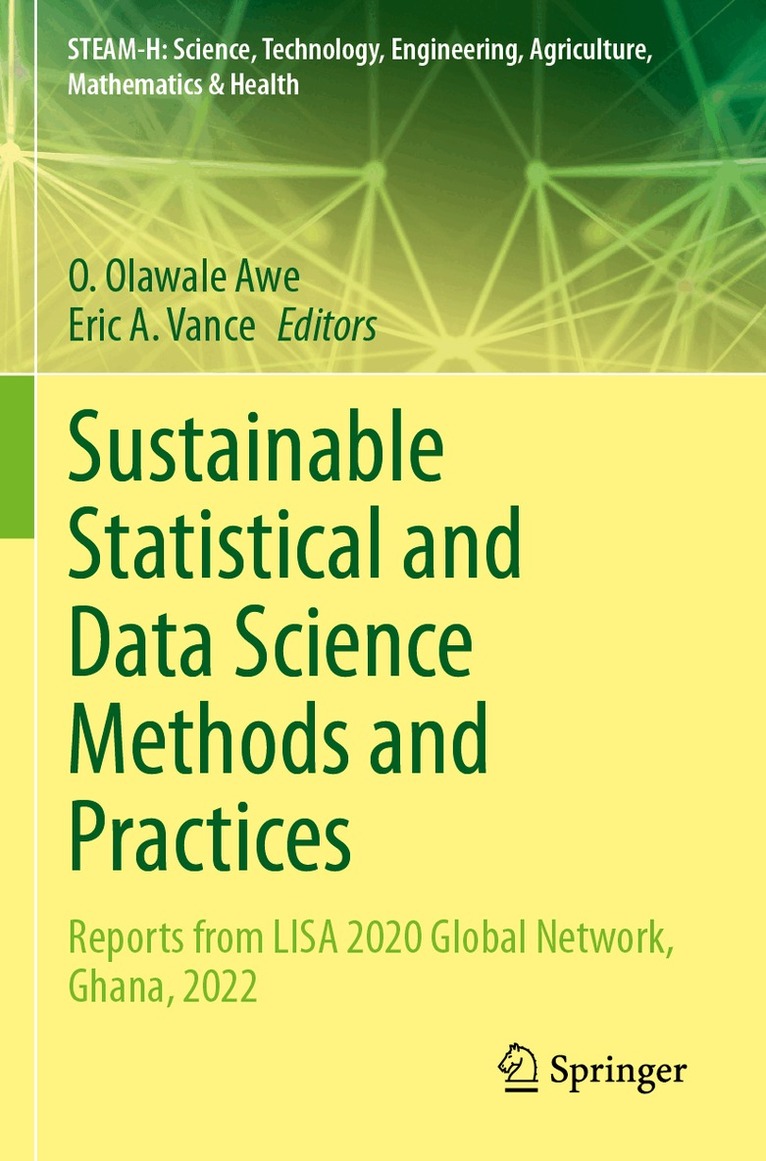
    Sustainable Statistical and Data Science Methods and Practices

    Reports from LISA 2020 Global Network, Ghana, 2022

    AvO. Olawale Awe,Eric A. Vance

    Häftad, Engelska, 2025

    Del i serien STEAM-H: Science, Technology, Engineering, Agriculture, Mathematics & Health

    1 842 kr

    Beställningsvara. Skickas inom 10-15 vardagar. Fri frakt över 249 kr.

    Beskrivning

    This volume gathers papers presented at the LISA 2020 Sustainability Symposium in Kumasi, Ghana, May 2–6, 2022. They focus on sustainable methods and practices of using statistics and data science to address real-world problems. From utilizing social media for statistical collaboration to predicting obesity among rural women, and from analyzing inflation in Nigeria using machine learning to teaching data science in Africa, this book explores the intersection of data, statistics, and sustainability. With practical applications, code snippets, and case studies, this book offers valuable insights for researchers, policymakers, and data enthusiasts alike.The LISA 2020 Global Network aims to enhance statistical and data science capability in developing countries through the creation of a network of collaboration laboratories (also known as “stat labs”). These stat labs are intended to serve as engines for development by training the next generation of collaborative statisticians and data scientists, providing research infrastructure for researchers, data producers, and decision-makers, and enabling evidence-based decision-making that has a positive impact on society. The research conducted at LISA 2020 focuses on practical methods and applications for sustainable growth of statistical capacity in developing nations.

    Produktinformation

    • Utgivningsdatum:2025-01-07
    • Mått:155 x 235 x 24 mm
    • Vikt:663 g
    • Format:Häftad
    • Språk:Engelska
    • Serie:STEAM-H: Science, Technology, Engineering, Agriculture, Mathematics & Health
    • Antal sidor:415
    • Förlag:Springer International Publishing AG
    • ISBN:9783031413544

    Utforska kategorier

    • Systemvetenskap och AI inom Data och IT
    • Matematisk statistik inom Naturvetenskap och teknik
    • Databaser inom Data och IT

    Mer om författaren

    O. Olawale Awe, PhD is a distinguished academic and statistician. He currently serves as the Vice President of the International Association for Statistics Education (IASE). His impressive affiliations include being an elected member of the International Statistics Institute (ISI), Vice President of Global Statistical Engagements of the LISA 2020 Global Network, USA, and a research professor and team leader at the Statistical Learning Laboratory (SaLLy) of the Federal University of Bahia, Brazil. As the pioneering LISA Fellow of the LISA 2020 Global Network at the University of Colorado, Boulder, USA, he has significantly contributed to the global statistical community. Awe's dedication to capacity-building is evident through the numerous workshops and seminars he has facilitated globally. His passion for enhancing the skills of statisticians in Africa and other developing countries drives his work. Holding a Ph.D. in Statistics from the University of Ibadan, Nigeria, and an MBA from Obafemi Awolowo University, Ile-Ife, Nigeria, Awe is an Affiliate Member of the prestigious African Academy of Sciences (AAS). His leadership extends to roles such as a former Council Member of the International Society for Business and Industrial Statistics (ISBIS) (2017-2021) and a country coordinator (Nigeria) for the International Statistical Literacy Program (ISLP) of the ISI. Currently, he serves as a professor and academic director of data science at Anointed University, South Africa, a professor and Ph.D. advisor at the Global Humanistic University (GHU), Curacao, and holds a visiting professorship at the African Institute of Mathematical Sciences (AIMS). Awe's multifaceted contributions underscore his commitment to advancing statistical education and research on a global scale.Eric A. Vance is an Associate Professor of Applied Mathematics and the Director of the Laboratory for InterdisciplinaryStatistical Analysis (LISA) at the University of Colorado Boulder, USA. He is the Global Director of the LISA 2020 Network. He researches the micro- and macro-theory of collaboration, i.e., what individual statisticians and data scientists need to know to become effective interdisciplinary collaborators and what institutions can do to promote interdisciplinary collaboration between domain experts, statisticians, and data scientists. He is an Elected Member of the International Statistical Institute and a member of its Statistical Capacity Building Taskforce. He is a Fellow of the American Statistical Association (ASA) and winner of the 2019 ASA Jackie Dietz Award for best paper in the Journal of Statistics Education for “The ASCCR Frame for Learning Essential Collaboration Skills.” He is a past chair of the ASA Section on Statistical Consulting and the Conference on Statistical Practice. He has traveled through 85 countries and keeps these experiences in mind as he collaboratestoward building capacity for sustainable development.

    Innehållsförteckning

    • Chapter. 1. Using social media and network services to promote statistical collaboration laboratories: A case study of LEA Brazil.- Chapter. 2. Renewable Energy Forecasting Using Deep Learning Models.- Chapter. 3. Exploring feature selection and supervised classification algorithms for predicting Obesity among rural women for policy decisions.- Chapter. 4. Re-examining Inflation and its drivers in Nigeria: A machine learning approach.- Chapter. 5. Estimating Relative Response Rates and Preferential Ranking of Subjects.- Chapter. 6. Wealth Creation and Poverty Alleviation in a Nigerian State: A Recent Evidence-Based Survey.- Chapter. 7. Effect of Statistics on Collaboration for Enhancing Institutional Sustainability: A Case of Mzumbe University-Tanzania.- Chapter. 8. Strategies for the Sustainability of Stat Labs: A Case Study of Laboratory of Interdisciplinary Statistical Analysis, Lahore College for Women University Lahore, Pakistan (LISA-LCWU).- Chapter. 9. Advanced Mathematics and Computations for Innovation and Sustainability of Modern Statistics Laboratory.- Chapter. 10. A New Estimator for the GPD Parameters under the POT Approach.- Chapter. 11. A simple yet Robust Estimation of binned data: Egypt Income distribution and Geographical Inequality.- Chapter. 12. Supervised Machine Learning Classification Algorithms: Some Applications and Code Snippets for Practical Implementations in Python Programming.- Chapter. 13. Exploring the spatial variability and different determinants of co-existence of under-nutritional status among children in India through a Bayesian geo-additive multinomial regression model.- Chapter. 14. Predicting the Nature of Terrorist Attacks in Nigeria Using Bayesian Neural Network Model.- Chapter. 15. Salvage Value from Deterioration (SVD): An Optimal Inventory Model for Chicken Egg Marketing.- Chapter. 16. Structural Equation Modeling with Stata: Illustration using a Population-Based, Nationally-Representative Dataset.- Chapter. 17. Time series forecasting of seasonal non-stationary climate data: A comparative study.- Chapter. 18. Weighted Hard and Soft Voting Ensemble Machine Learning CLASIFIERS: Application to Anaemia Diagnosis.- Chapter 19. Machine Learning Approaches for Handling Imbalances in Health Data Classification.- Chapter. 20. The Intersection of Data and Statistics with Sustainable Development Goals.- Chapter. 21. Teaching Data Science in Africa via Online Team-Based Learning.