• Fri frakt över 249 kr
  • •
  • Snabba leveranser
  • •
  • Billiga böcker
Kundservice

Du är på sajten för privatpersoner.

Företag, bibliotek eller offentlig verksamhet?

Du handlar på classic.bokus.com, där alla dina funktioner finns intakta.
Till classic.bokus.com
Bokus logotyp. Gå till startsidan.
  • Erbjudanden
  • Nyheter
  • Student
  • Topplistor
  • Barn & ungdom
  • Bokus Play
  • E-böcker
  • Pocketböcker
  • Spel & pussel

10% rabatt på allt med kod NYSTART10 →

Sidfot

Mina sidor

    Hjälp

    • Kundservice
    • Vanliga frågor och svar
    • Frakt och leverans
    • Retur vid ångerrätt
    • Reklamera vara
    • Betalning
    • Köpvillkor
    • Allmänna villkor
    • Information om webbplatsens tillgänglighet

    Om Bokus

    • Om oss
    • Pressrum
    • För studenter
    • För företag
    • För bibliotek och offentlig verksamhet
    • För leverantörer
    • Hållbarhet

    Populärt

    • Aktuella erbjudanden
    • Presentkort
    • Studentlitteratur
    • Nya böcker
    • Topplistor
    • Signerade böcker
    • Engelska böcker

    Inspiration

    • Boktips
    • BookTok
    • Populära bokserier
    • Barnbokskaraktärer
    • Populära författare
    Logotyp för Bokus
    Följ oss på Facebook (extern länk)Följ oss på Instagram (extern länk)Följ oss på YouTube (extern länk)Följ oss på TikTok (extern länk)
    bokus @ CookiesAnpassa cookiesIntegritetspolicyKöpvillkor
    Till Citymail hemsida (extern länk)Till Budbee hemsida (extern länk)Till Postnord hemsida (extern länk)Till Schenker hemsida (extern länk)Till Early Bird hemsida (extern länk)Till Walleys hemsida (extern länk)
    1. Data och IT
    2. Programmeringsböcker
    3. Programvaruutveckling

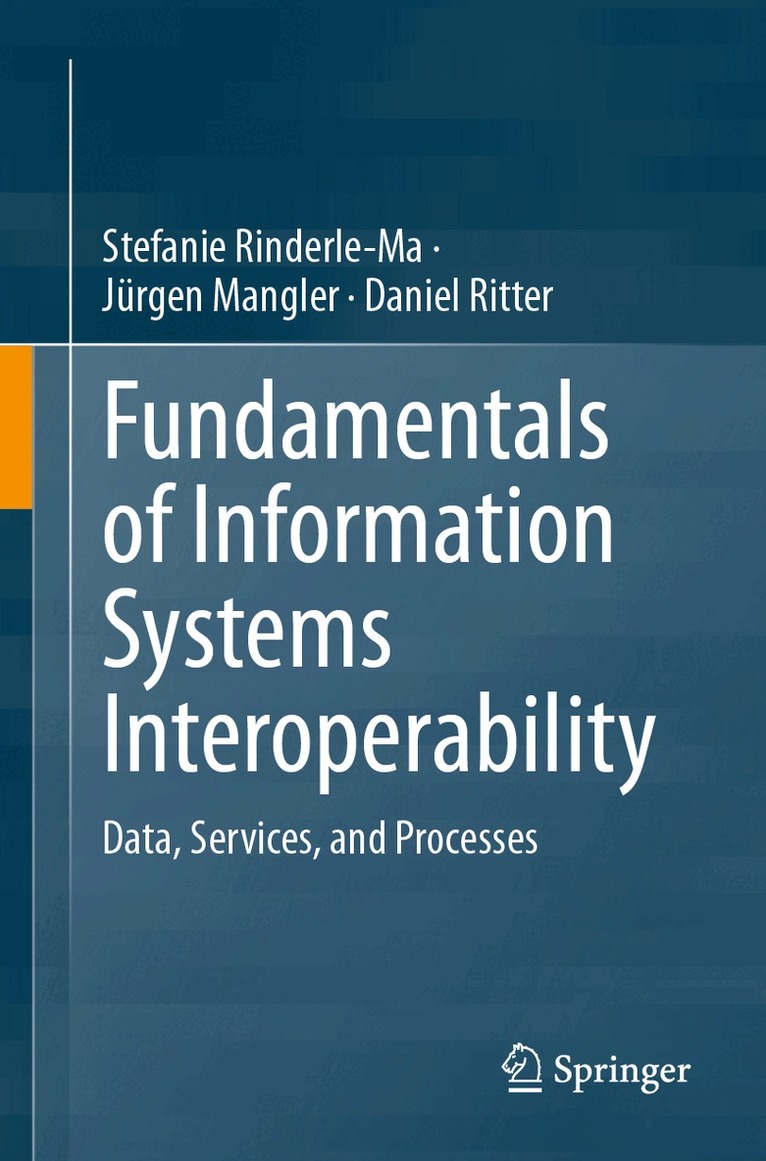
    Fundamentals of Information Systems Interoperability

    Data, Services, and Processes

    AvStefanie Rinderle-Ma,Jürgen Mangler

    Häftad, Engelska, 2024

    396 kr

    Beställningsvara. Skickas inom 10-15 vardagar. Fri frakt över 249 kr.

    Beskrivning

    This book presents fundamental concepts and technologies to tackle interoperability between information systems. It details interoperability at the data, service, and process level, and combines theoretical foundations with hands-on presentation of technologies to enable the development of sound and practical integration.Chapter 1 details general interoperability challenges and describes the structure of the book. To start with, Chapter 2 presents technologies for the exchange of data between two selected and highly relevant data formats, i.e., relational databases and XML. Next, Chapter 3 explains concepts for schema matching and mapping and data integration as well as the technological basis for implementing them based on query and transformation languages like XPath and XSLT. Chapter 4 then turns to service interoperability and explains two related technologies – REST and GraphQL – in detail. In Chapter 5, fundamentals for designing process orchestrations at the conceptual level are presented, focusing on how to model process orchestrations and how to verify their correctness and soundness, and showing BPMN as the de facto modeling standard. Chapter 6 then details the concepts and languages for the implementation of process orchestrations, including the presentation of execution languages for process orchestrations that are equipped with a formal semantics, e.g., Workflow Nets, the Refined Process Structure Tree, and CPEE Trees. Subsequently, Chapter 7 focuses on the growing number of distributed, loosely coupled, and often non-interoperable applications through the concepts of enterprise application integration and explains these by an implementation in CPN Tools and by two case studies. Eventually, Chapter 8 is lifting the orchestration and integration concepts and technologies to the choreography level by dealing with the interoperability between different process orchestrations. Chapter 9 concludes the book by featuring success factors for interoperability projects. It also provides a range of open research directions for interoperability such as compliance, sensor fusion, and blockchain technologies.The book is mainly intended as a textbook to be used for developing and teaching courses on interoperability and integration. To this end, it is accompanied by a Web site with additional teaching materials. It also spans a bridge from researchers to graduate students and practitioners by providing a deep understanding on practical interoperability challenges and solutions. The focus here is put on de facto standards and open-source systems and tools to enable interoperability solutions at low cost.

    Produktinformation

    • Utgivningsdatum:2024-04-19
    • Mått:155 x 235 x 17 mm
    • Vikt:458 g
    • Format:Häftad
    • Språk:Engelska
    • Antal sidor:281
    • Förlag:Springer International Publishing AG
    • ISBN:9783031483219

    Utforska kategorier

    • Programvaruutveckling inom Data och IT
    • Affärsförhandlingar inom Ekonomi och Ledarskap
    • Tillämpad datateknik inom Data och IT

    Mer om författaren

    Stefanie Rinderle-Ma is Full Professor at the Technical University of Munich, Germany, and head of the Chair of Information Systems and Business Process Management. Her research focuses on distributed and flexible process technology, enterprise application integration, and business intelligence. Stefanie has more than 300 publications with over 11000 citations, developed and taught a master course on interoperability at several universities, and co-authored the Springer book on Fundamentals of Business Intelligence (with W. Grossmann) which was published in 2015.  Stefanie has also led several industry projects with strong interoperability challenges, e.g., in the manufacturing and health care domain. Jürgen Mangler holds a PhD in Business Informatics from the University of Vienna and works as senior postdoc at the Technical University of Munich, Germany. He is chief developer of the open-source process execution engine CPEE. Juergen has gained deep insightsinto interoperability concepts and their realizations during several research projects such as the EU FP7 project ADVENTURE and the Austrian Center of Digital Production. The latter dealt with challenges in the vertical and horizontal integration of data, machines, systems, and humans. Juergen has taught various software engineering related topics since 2004.Daniel Ritter holds a PhD in Computer Science from the University of Vienna and works as central database architect at SAP SE for SAP HANA Cloud and OrientDB. He is a postdoctoral researcher in the SAP HANA Research Campus and from 2021 to 2022, he was a postdoctoral research fellow at the University of Potsdam, where he led the Autonomous Data Managament group at the Hasso Plattner Institute. He has 20+ years of experience in large-scale software development projects and was a central architect of SAP's Cloud Integration solution.

    Innehållsförteckning

    • Preface.- Introduction. - From Databases to Exchange Formats.-  Transformation and Integration of Exchange Formats.- Service Interoperability.- Process Orchestration: Conceptual Design.- Process Orchestration: Execution Design.- Integration Patterns and Processes.- Process Choreography.- Conclusion and Further Interoperability Aspects.- References. - Index.