Häftad, Engelska, 2025
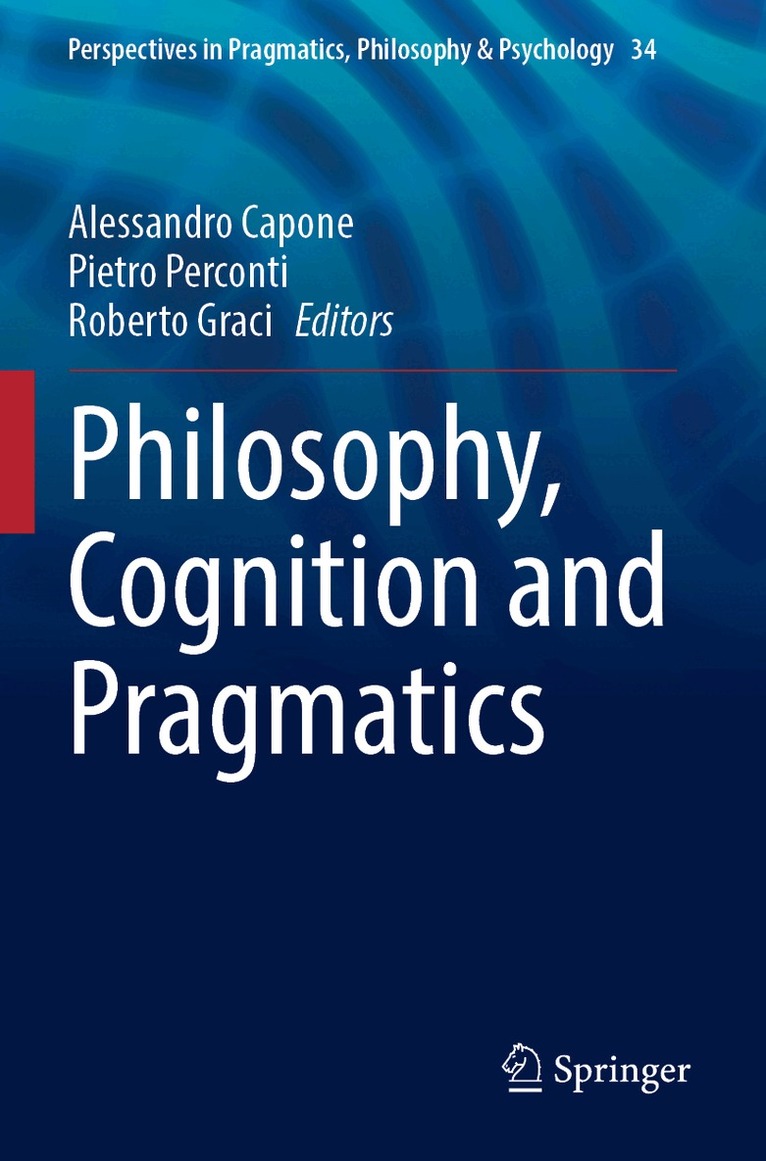
Philosophy, Cognition and Pragmatics
Av Alessandro Capone, Pietro Perconti, Roberto Graci
1639 kr
Beställningsvara. Skickas inom 10-15 vardagar. Fri frakt över 249 kr.
Beskrivning
This book contains essential contributions to enrich and broaden the application field of pragmatics. It provides an example of how the fruitful reflections and refined conceptual distinctions born in the philosophical field can find a practical application in addressing social, cognitive, clinical, and psychological problems. Its chapters address, from different points of view, the relationship between pragmatic linguistics and philosophy, and outline the possible application of pragmatic theories to different domains. Developed during the third Pragmasophia international conference, whose name is derived from the Greek terms πρᾶγμα (action, fact) and σοϕία (knowledge, science), the book aligns itself with its aim to study human actions and activities and how they take shape through language. But ‘Pragma’ and ‘Sophia’ also signal another purpose: highlighting the importance of creating links between empirical investigations on language use, and more traditional philosophical approaches. In this reading, ‘Pragma’ represents the experimental goal devoted to analysing and interpreting language facts. In contrast, the term ‘Sophia’ recalls the original vocation of past philosophers to pursue an ideal of ‘pure knowledge’, disconnected from any practical-economic interest. While maintaining the conference's original purpose of encouraging productive comparisons between different approaches, the book consists of two sections: first, on philosophical approaches, recalls more theoretical aspects (closer to the term ‘Sophia’); the second, ‘Inferential and Cognitive Pragmatics,’ addresses more practical issues affecting domains such as Greek literature, pragmatic disorders, dictionary entries, and speech analysis. The reader, whether in linguists, philosophy or psychology, obtains a complete overview of the most advanced current research lines, both theoretical and empirical, and thus contributes to broadening the scope of pragmatics.
Produktinformation
- Utgivningsdatum: 2025-03-22
- Mått: 155 x 235 x 17 mm
- Vikt: 470 g
- Format: Häftad
- Språk: Engelska
- Serie: Perspectives in Pragmatics, Philosophy & Psychology
- Antal sidor: 293
- Förlag: Springer International Publishing AG
- ISBN: 9783031501111
Utforska kategorier
Betyg & recensioner
0 recensioner
Inga recensioner tillgängliga.