• Fri frakt över 249 kr
  • •
  • Snabba leveranser
  • •
  • Billiga böcker
Kundservice

Du är på sajten för privatpersoner.

Företag, bibliotek eller offentlig verksamhet?

Du handlar på classic.bokus.com, där alla dina funktioner finns intakta.
Till classic.bokus.com
Bokus logotyp. Gå till startsidan.
  • Erbjudanden
  • Nyheter
  • Student
  • Topplistor
  • Barn & ungdom
  • Bokus Play
  • E-böcker
  • Pocketböcker
  • Spel & pussel

10% rabatt på allt med kod: NYSTART10 →

Sidfot

Mina sidor

    Hjälp

    • Kundservice
    • Vanliga frågor och svar
    • Frakt och leverans
    • Retur vid ångerrätt
    • Reklamera vara
    • Betalning
    • Köpvillkor
    • Allmänna villkor
    • Information om webbplatsens tillgänglighet

    Om Bokus

    • Om oss
    • Pressrum
    • För studenter
    • För företag
    • För bibliotek och offentlig verksamhet
    • För leverantörer
    • Hållbarhet

    Populärt

    • Aktuella erbjudanden
    • Presentkort
    • Studentlitteratur
    • Nya böcker
    • Topplistor
    • Signerade böcker
    • Engelska böcker

    Inspiration

    • Boktips
    • BookTok
    • Populära bokserier
    • Barnbokskaraktärer
    • Populära författare
    Logotyp för Bokus
    Följ oss på Facebook (extern länk)Följ oss på Instagram (extern länk)Följ oss på YouTube (extern länk)Följ oss på TikTok (extern länk)
    bokus @ CookiesAnpassa cookiesIntegritetspolicyKöpvillkor
    Till Citymail hemsida (extern länk)Till Budbee hemsida (extern länk)Till Postnord hemsida (extern länk)Till Schenker hemsida (extern länk)Till Early Bird hemsida (extern länk)Till Walleys hemsida (extern länk)
    1. Psykologi och pedagogik
    2. Psykologi
    3. Kognitiv psykologi

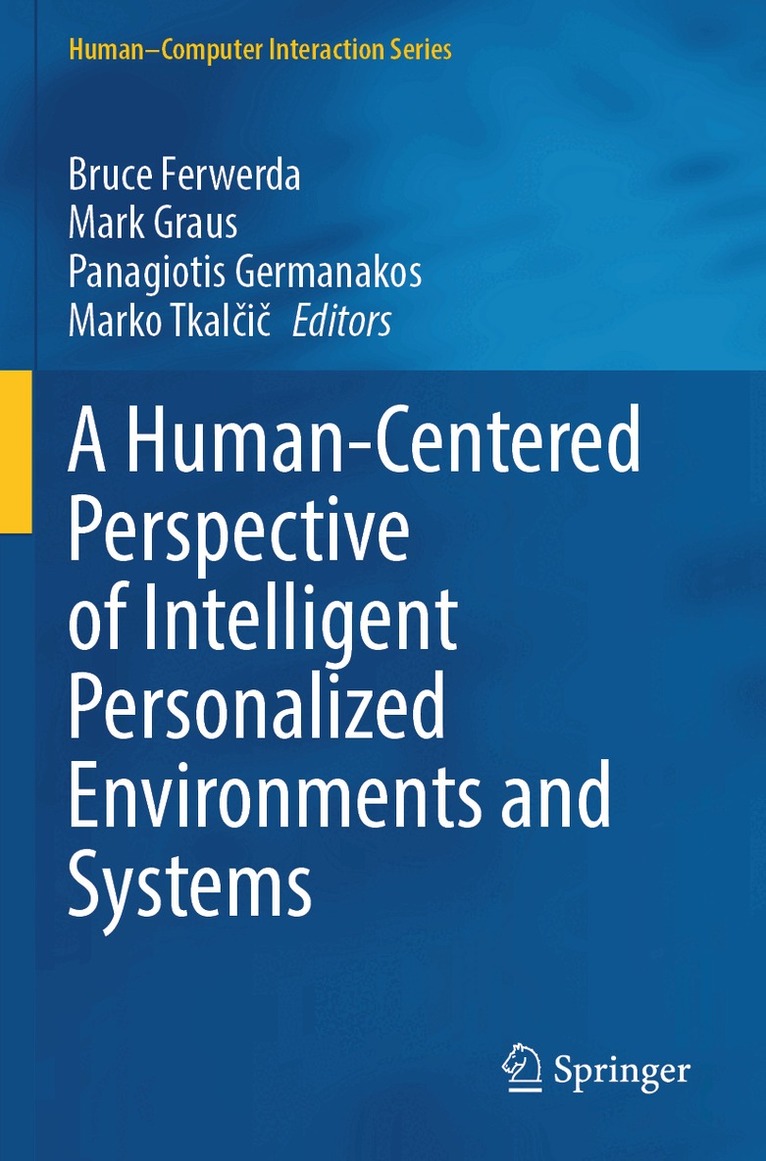
    Human-Centered Perspective of Intelligent Personalized Environments and Systems

    AvBruce Ferwerda,Mark Graus

    Häftad, Engelska, 2025

    Del i serien Human–Computer Interaction Series

    1 895 kr

    Beställningsvara. Skickas inom 10-15 vardagar. Fri frakt över 249 kr.

    Beskrivning

    This book investigates the potential of combining the more quantitative - data-driven techniques with the more qualitative - theory-driven approaches towards the design of user-centred intelligent systems. It seeks to explore the potential of incorporating factors grounded in psychological theory into adaptive/intelligent routines, mechanisms, technologies and innovations. It highlights models, methods and tools that are emerging from their convergence along with challenges and lessons learned. Special emphasis is placed on promoting original insights and paradigms with respect to latest technologies, current research trends, and innovation directions, e.g., incorporating variables derived from psychological theory and individual differences in adaptive intelligent systems so as to increase explainability, fairness, and transparency, and decrease bias during interactions while the control remains with the user.

    Produktinformation

    • Utgivningsdatum:2025-05-02
    • Mått:155 x 235 x 17 mm
    • Vikt:476 g
    • Format:Häftad
    • Språk:Engelska
    • Serie:Human–Computer Interaction Series
    • Antal sidor:292
    • Förlag:Springer International Publishing AG
    • ISBN:9783031551116

    Utforska kategorier

    • Kognitiv psykologi inom Psykologi och pedagogik
    • Artificiell intelligens inom Data och IT
    • Människa – datorinteraktion inom Data och IT

    Mer om författaren

    Dr. Bruce FerwerdaBruce is an Associate Professor in the Department of Computer Science and Informatics at Jönköping University, Sweden, and leads the Human-Computer Interaction Lab at the university. His research focuses on psychological user modeling and personalization, particularly in recommender systems. Bruce has over 70 publications, including books, journals, and conference contributions. He is an active contributor to several communities by taking part in the organizing committee or program committee. Selective organizations of previous events: Inclusion Chair at Recsys 2024, RecSys Challenge at RecSys 2021, 2022; Proceedings Chair at IUI 2020; Co-Chair of HUMANIZE 2017-2024 at ACM IUI; Co-chair HAAPIE at UMAP 2022-2023.Dr. Mark GrausMark is a freelance data scientist with a background in combining psychological theory in machine learning applications for personalization. He holds a PhD from Eindhoven University of Technology and worked as assistant professor at Maastricht University, during which he (co-)authored several conference and journal articles and book chapters and contributed to the organizing committees of conferences such as IUI and RecSys.Dr. Panagiotis GermanakosPanagiotis is User Experience Research Expert - Instructor at SAP SE, leading and supporting the user research activities of product teams for delivering usable, high quality, human-centred solutions. Embracing the role of SAP University Alliances Ambassador, he serves as a liaison between the business and academia, consulting and transferring knowledge that inspires innovations. He is also a Research Scientist, conducting basic and applied research in the fields of HCI/UX, User Modeling - bringing the ‘human-in-the-loop’, Adaptation & Personalization, and Human-centered Computing. He has an interdisciplinary background which lies in the cross-borders of Computer Science,Psychology and Business Informatics disciplines and he holds a PhD from the National & Kapodistrian University of Athens (2008). Panagiotis has over 140 publications including book, journal, and conference contributions and his work has obtained a number of awards. He has co-authored a monograph with title “Human-centred Web Adaptation and Personalization - From Theory to Practice” (released March 2016), and co-edited 7 other books. He has published 4 utility and 2 design patents and he is co-founder/ organizer of international scientific events like ACM HAAPIE and HUMANIZE series workshops. In addition, he has been participating in numerous editorial, board and program committees of top journals, conferences and workshops like ACM UMAP, IUI, INTERACT, CHI, and he is a member of various international research networks and professional bodies like ACM, AIS, Expert Network of HCI-KDD.Dr. Marko TkalčičMarko is associate professor at the Faculty of Mathematics, Natural Sciences and Information Technologies (FAMNIT) at the University of Primorska in Koper, Slovenia. He aims at improving personalized services (e.g. recommender systems) through the usage of psychological models in personalization algorithms. To achieve this, he uses diverse research methodologies, including data mining, machine learning, and user studies. Marko has over 100 publications in prestigious venues. Marko is active in the user modeling and recommender systems communities. He is editorial board member of the Springer User Modeling and User-adapted Interaction journal. He has covered organizational roles in the ACM RecSys, ACM UMAP, and ACM IUI conferences. In 2022, he was program co-chair of the ACM UMAP 2022 conference. Marko has edited two volumes with Springer, Emotions and Personality in Personalized Services in 2016 and Group Recommender Systems in 2023.

    Innehållsförteckning

    • Part I: Theory: Individual differences for intelligent personalized environments.- Human factors in user modeling for intelligent systems.- The role of human-centred ai in user modeling, adaptation, and personalization – Models, frameworks, and paradigms.- Fairness and explainability for enabling trust in AI systems.- Part II: Method: User models driven from human factors, inferred from data.- Transparent music preference modeling and recommendation with a model of human memory theory.- Personalization and individual differences in business data analytics.- Inferring Eudaimonia and Hedonia from digital traces.- Computational methods to infer human factors for adaptation and personalization using eye tracking.- Part III: Practice: The human factors in the center of applications and domains.- Coarse-grained detection for personalized online learning interventions.- Psychologically-informed design of energy recommender systems: Are nudges still effective in tailored choice environments?- Personalized persuasive technologies in health and wellness: From theory to practice.