• Fri frakt över 249 kr
  • •
  • Snabba leveranser
  • •
  • Billiga böcker
Kundservice

Du är på sajten för privatpersoner.

Företag, bibliotek eller offentlig verksamhet?

Du handlar på classic.bokus.com, där alla dina funktioner finns intakta.
Till classic.bokus.com
Bokus logotyp. Gå till startsidan.
  • Erbjudanden
  • Nyheter
  • Student
  • Topplistor
  • Barn & ungdom
  • Bokus Play
  • E-böcker
  • Pocketböcker
  • Spel & pussel

10% rabatt på allt med kod NYSTART10 →

Sidfot

Mina sidor

    Hjälp

    • Kundservice
    • Vanliga frågor och svar
    • Frakt och leverans
    • Retur vid ångerrätt
    • Reklamera vara
    • Betalning
    • Köpvillkor
    • Allmänna villkor
    • Information om webbplatsens tillgänglighet

    Om Bokus

    • Om oss
    • Pressrum
    • För studenter
    • För företag
    • För bibliotek och offentlig verksamhet
    • För leverantörer
    • Hållbarhet

    Populärt

    • Aktuella erbjudanden
    • Presentkort
    • Studentlitteratur
    • Nya böcker
    • Topplistor
    • Signerade böcker
    • Engelska böcker

    Inspiration

    • Boktips
    • BookTok
    • Populära bokserier
    • Barnbokskaraktärer
    • Populära författare
    Logotyp för Bokus
    Följ oss på Facebook (extern länk)Följ oss på Instagram (extern länk)Följ oss på YouTube (extern länk)Följ oss på TikTok (extern länk)
    bokus @ CookiesAnpassa cookiesIntegritetspolicyKöpvillkor
    Till Citymail hemsida (extern länk)Till Budbee hemsida (extern länk)Till Postnord hemsida (extern länk)Till Schenker hemsida (extern länk)Till Early Bird hemsida (extern länk)Till Walleys hemsida (extern länk)
    1. Data och IT
    2. Systemvetenskap och AI
    3. Artificiell intelligens

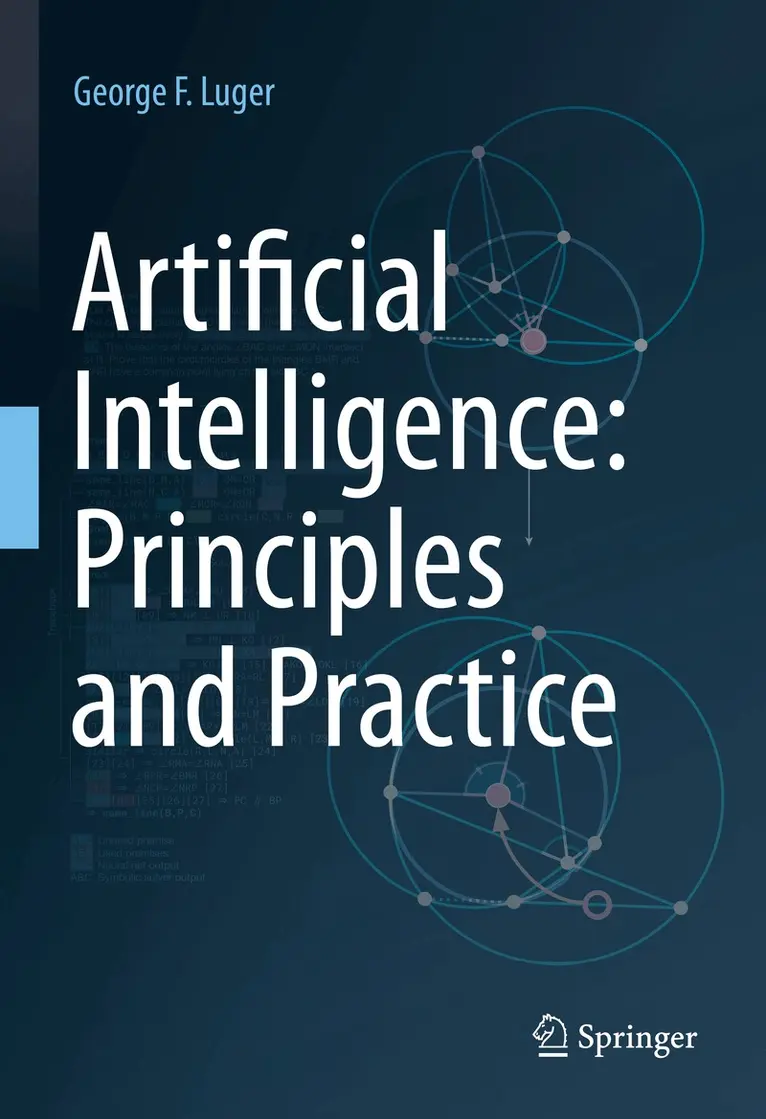
    Artificial Intelligence: Principles and Practice

    AvGeorge F. Luger

    Inbunden, Engelska, 2024

    654 kr

    Beställningsvara. Skickas inom 5-8 vardagar. Fri frakt över 249 kr.

    Fler format och utgåvor

    E-bok

    868 kr

    Häftad

    654 kr

    Beskrivning

    This book provides a complete introduction to Artificial Intelligence, covering foundational computational technologies, mathematical principles, philosophical considerations, and engineering disciplines essential for understanding AI. Artificial Intelligence: Principles and Practice emphasizes the interdisciplinary nature of AI, integrating insights from psychology, mathematics, neuroscience, and more. The book addresses limitations, ethical issues, and the future promise of AI, emphasizing the importance of ethical considerations in integrating AI into modern society. With a modular design, it offers flexibility for instructors and students to focus on specific components of AI, while also providing a holistic view of the field.Taking a comprehensive but concise perspective on the major elements of the field; from historical background to design practices, ethical issues and more, Artificial Intelligence: Principles and Practice provides the foundations needed for undergraduate or graduate-level courses.  The important design paradigms and approaches to AI are explained in a clear, easy-to-understand manner so that readers will be able to master the algorithms, processes, and methods described.The principal intellectual and ethical foundations for creating artificially intelligent artifacts are presented in Parts I and VIII. Part I offers the philosophical, mathematical, and engineering basis for our current AI practice. Part VIII presents ethical concerns for the development and use of AI. Part VIII also discusses fundamental limiting factors in the development of AI technology as well as hints at AI's promising future. We recommended that PART I be used to introduce the AI discipline and that Part VIII be discussed after the AI practice materials. Parts II through VII present the three main paradigms of current AI practice: the symbol-based, the neural network or connectionist, and the probabilistic.Generous use of examples throughout helps illustrate the concepts, and separate end-of-chapter exercises are included. Teaching resources include a solutions manual for the exercises, PowerPoint presentation, and implementations for the algorithms in the book.

    Produktinformation

    • Utgivningsdatum:2024-12-03
    • Mått:178 x 254 x 43 mm
    • Vikt:1 402 g
    • Format:Inbunden
    • Språk:Engelska
    • Antal sidor:638
    • Förlag:Springer International Publishing AG
    • ISBN:9783031574368

    Utforska kategorier

    • Artificiell intelligens inom Data och IT
    • Filosofiska discipliner inom Filosofi och religion

    Mer om författaren

    George Luger is Professor Emeritus of Computer Science at the University of New Mexico. Dr. Luger was also a Professor in the Psychology and Linguistics Departments, reflecting his interdisciplinary interests in Cognitive Science and Computational Linguistics.The National Science Foundation, NATO, the British Royal Society, NASA, the Smithsonian Institution, NIH, the Departments of Defense, Energy and Transportation, NIH, and other government agencies have supported George Luger's research. He has worked with the Los Alamos and Sandia National Laboratories and for numerous companies.  Currently, his consulting is in the design of natural language web agents and deep learning technologies that analyze information in very large collections of data. Dr. Luger is the author of Artificial Intelligence: Structures and Strategies for Complex Problem Solving (Addison-Wesley, 2009), now in its Sixth Edition, and Knowing Our World (Springer, 2021).

    Innehållsförteckning

    • The Pre-History of Artificial Intelligence.- Computing, Representations, and Definitions of Artificial Intelligence.- The State Space, Finite State Machines, and Artificial Life.- Searching the State Space.- Heuristic Search.- Heuristics: 2-Person Games and Theoretical Constraints.- Introduction to the Propositional and Predicate Calculi.- The Predicate Calculus and Unification.- Resolution: Reasoning with the Propositional and Predicate Calculi.- The Production System Representation and Search Engine.- Advanced Applications of Symbol-Based Reasoning.- Uncertain Reasoning: Symbol-Based.- Introduction to Association-Based Knowledge Representations.- Association-Based Representations: Frames, Conceptual Graphs, WordNet, and FrameNet.- An Introduction to Neural Networks.- The Delta Rule, Backpropagation, and Matrix Representations.- Deep Learning: Introduction and Representations.- Building Language Models and Transformers.- Alternative Network Architectures: Prototypes and Classifiers.- Alternative Network Architectures: Attractor Networks and Memories.- Counting, the Foundation of Probabilities.- Bayes’ Theorem.- Bayesian Belief Networks and Observable Markov Models.- Hidden Markov and Alternative Probabilistic Models.- Artificial Intelligence: User-Focused Ethical Issues.- AI Ethical Issues: From the Developers’ Perspective.- Artificial Intelligence: Current Limitations and Future Promise.