• Fri frakt över 249 kr
  • •
  • Snabba leveranser
  • •
  • Billiga böcker
Kundservice

Du är på sajten för privatpersoner.

Företag, bibliotek eller offentlig verksamhet?

Du handlar på classic.bokus.com, där alla dina funktioner finns intakta.
Till classic.bokus.com
Bokus logotyp. Gå till startsidan.
  • Erbjudanden
  • Nyheter
  • Student
  • Topplistor
  • Barn & ungdom
  • Bokus Play
  • E-böcker
  • Pocketböcker
  • Spel & pussel

10% rabatt på allt med kod NYSTART10 →

Sidfot

Mina sidor

    Hjälp

    • Kundservice
    • Vanliga frågor och svar
    • Frakt och leverans
    • Retur vid ångerrätt
    • Reklamera vara
    • Betalning
    • Köpvillkor
    • Allmänna villkor
    • Information om webbplatsens tillgänglighet

    Om Bokus

    • Om oss
    • Pressrum
    • För studenter
    • För företag
    • För bibliotek och offentlig verksamhet
    • För leverantörer
    • Hållbarhet

    Populärt

    • Aktuella erbjudanden
    • Presentkort
    • Studentlitteratur
    • Nya böcker
    • Topplistor
    • Signerade böcker
    • Engelska böcker

    Inspiration

    • Boktips
    • BookTok
    • Populära bokserier
    • Barnbokskaraktärer
    • Populära författare
    Logotyp för Bokus
    Följ oss på Facebook (extern länk)Följ oss på Instagram (extern länk)Följ oss på YouTube (extern länk)Följ oss på TikTok (extern länk)
    bokus @ CookiesAnpassa cookiesIntegritetspolicyKöpvillkor
    Till Citymail hemsida (extern länk)Till Budbee hemsida (extern länk)Till Postnord hemsida (extern länk)Till Schenker hemsida (extern länk)Till Early Bird hemsida (extern länk)Till Walleys hemsida (extern länk)
    1. Ekonomi och Ledarskap
    2. Nationalekonomi
    3. Mikroekonomi

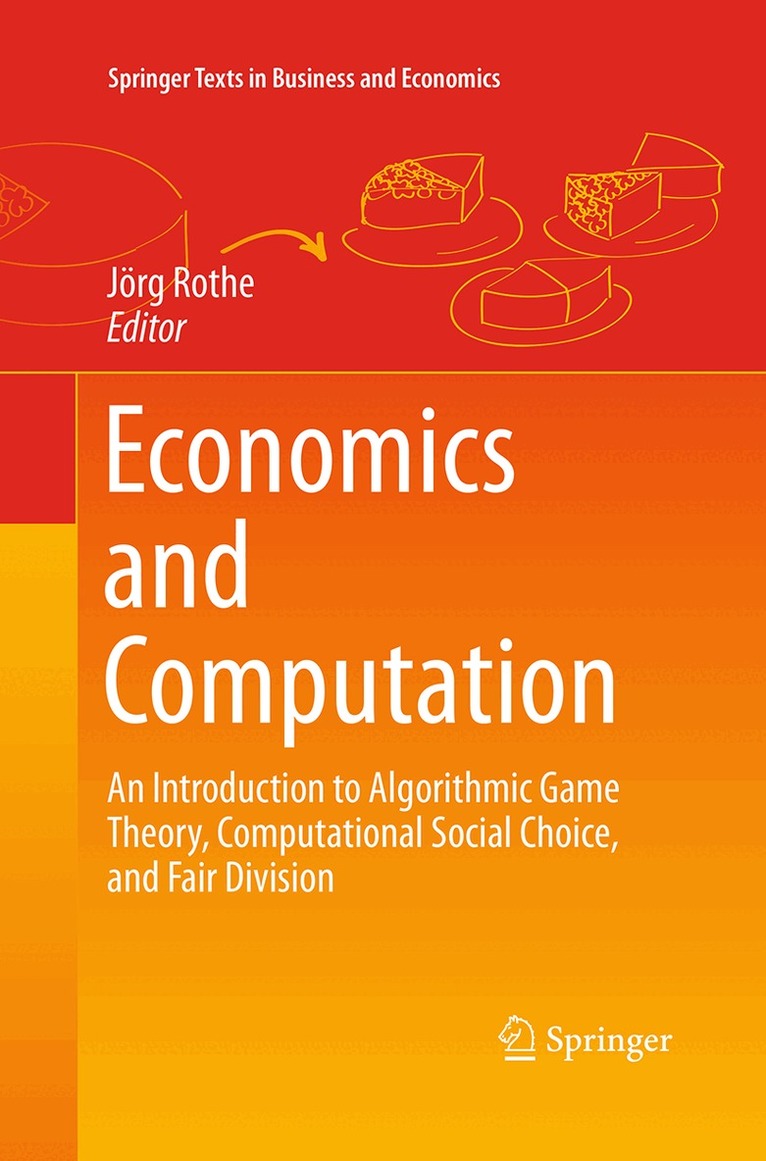
    Economics and Computation

    An Introduction to Algorithmic Game Theory, Computational Social Choice, and Fair Division

    AvJörg Rothe

    Inbunden, Engelska, 2024

    Del i serien Classroom Companion: Economics

    1 409 kr

    Beställningsvara. Skickas inom 10-15 vardagar. Fri frakt över 249 kr.

    Beskrivning

    This textbook connects three vibrant areas at the interface between economics and computer science: algorithmic game theory, computational social choice, and fair division. It thus offers an interdisciplinary treatment of collective decision making from an economic and computational perspective. Part I introduces to algorithmic game theory, focusing on both noncooperative and cooperative game theory. Part II introduces to computational social choice, focusing on both preference aggregation (voting) and judgment aggregation. Part III introduces to fair division, focusing on the division of both a single divisible resource ("cake-cutting") and multiple indivisible and unshareable resources ("multiagent resource allocation"). In all these parts, much weight is given to the algorithmic and complexity-theoretic aspects of problems arising in these areas, and the interconnections between the three parts are of central interest.

    Produktinformation

    • Utgivningsdatum:2024-06-29
    • Mått:155 x 235 x 49 mm
    • Vikt:1 338 g
    • Format:Inbunden
    • Språk:Engelska
    • Serie:Classroom Companion: Economics
    • Antal sidor:766
    • Upplaga:2
    • Förlag:Springer International Publishing AG
    • ISBN:9783031600982

    Utforska kategorier

    • Mikroekonomi inom Ekonomi och Ledarskap
    • Nationalekonomi inom Ekonomi och Ledarskap
    • Optimering inom Naturvetenskap och teknik

    Mer om författaren

    Jörg Rothe is Professor and the Vicechair of Department of Computer Science at Heinrich-Heine-Universität Düsseldorf (Germany). Previously he was a visiting Assistant Professor at the University of Rochester (USA) and a visiting Professor at Stanford University (USA). His research focuses on computational complexity, computational social choice, collective decision making, algorithmic game theory, fair division, argumentation theory, algorithmics and cryptology.

    Innehållsförteckning

    • Playing, Voting, and Dividing.- Playing Successfully: Noncooperative Game Theory.- Cooperative Game Theory.- Voting and Judging: Preference Aggregation by Voting.- The Complexity of Manipulative Actions in Single-Peaked Societies.- Multiwinner Voting.- Judgment Aggregation.- Fair Division: Cake-Cutting - Fair Division of Divisible Goods.- Fair Division of Indivisible Goods.