• Fri frakt över 249 kr
  • •
  • Snabba leveranser
  • •
  • Billiga böcker
Kundservice

Du är på sajten för privatpersoner.

Företag, bibliotek eller offentlig verksamhet?

Du handlar på classic.bokus.com, där alla dina funktioner finns intakta.
Till classic.bokus.com
Bokus logotyp. Gå till startsidan.
  • Erbjudanden
  • Nyheter
  • Student
  • Topplistor
  • Barn & ungdom
  • Bokus Play
  • E-böcker
  • Pocketböcker
  • Spel & pussel

10% rabatt på allt med kod NYSTART10 →

Sidfot

Mina sidor

    Hjälp

    • Kundservice
    • Vanliga frågor och svar
    • Frakt och leverans
    • Retur vid ångerrätt
    • Reklamera vara
    • Betalning
    • Köpvillkor
    • Allmänna villkor
    • Information om webbplatsens tillgänglighet

    Om Bokus

    • Om oss
    • Pressrum
    • För studenter
    • För företag
    • För bibliotek och offentlig verksamhet
    • För leverantörer
    • Hållbarhet

    Populärt

    • Aktuella erbjudanden
    • Presentkort
    • Studentlitteratur
    • Nya böcker
    • Topplistor
    • Signerade böcker
    • Engelska böcker

    Inspiration

    • Boktips
    • BookTok
    • Populära bokserier
    • Barnbokskaraktärer
    • Populära författare
    Logotyp för Bokus
    Följ oss på Facebook (extern länk)Följ oss på Instagram (extern länk)Följ oss på YouTube (extern länk)Följ oss på TikTok (extern länk)
    bokus @ CookiesAnpassa cookiesIntegritetspolicyKöpvillkor
    Till Citymail hemsida (extern länk)Till Budbee hemsida (extern länk)Till Postnord hemsida (extern länk)Till Schenker hemsida (extern länk)Till Early Bird hemsida (extern länk)Till Walleys hemsida (extern länk)
    1. Juridik
    2. Internationell rätt

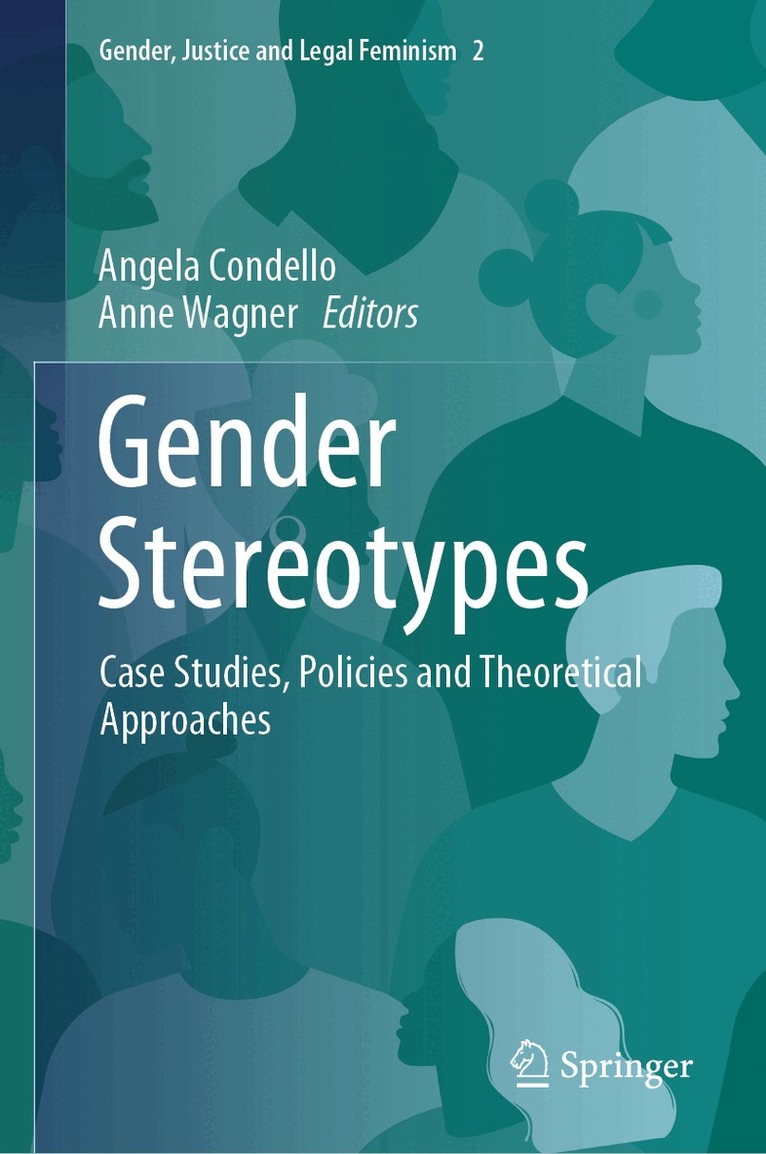
    Gender Stereotypes

    Case Studies, Policies and Theoretical Approaches

    AvAngela Condello,Anne Wagner

    Inbunden, Engelska, 2026

    Del i serien Gender, Justice and Legal Feminism

    1 989 kr

    Beställningsvara. Skickas inom 10-15 vardagar. Fri frakt över 249 kr.

    Beskrivning

    The edited volume aims at presenting the various forms of stereotyping. As a matter of fact, such logical inclination is not only perpetrated through common sense and public discourse, but also through regulation and various ethical practices. Law and politics, indeed, can have a relevant function in preventing the diffusion of bad and wrong gender stereotypes. "Stereotypes have been and remain a notion central to feminist/ gender inquiry. This edited volume brings forth original perspectives from a wide range of scholars from multiple and diverse angles. The editors, Condello and Wagner, distinguish between the frameworks of mythos, logos and nomos to show how stereotypes are entrenched in cultural narratives, normative systems and language. Authors in the volume explore how stereotypes influence policy, cultural norms and personal identity causing discrimination and exclusion. The volume aptly underscores the importance of recognizing how race, class, ethnicity, religion amongst other identities intersect with power and play out in areas like the media, education and law.  The various chapters reflect on the importance of interdisciplinary approaches to make sense of the persistence of stereotypes. The focus falls for example on gender stereotypes in the city; in textbooks, in criminal law, in the Bildungsroman and in various religious settings.The volume will be an essential read for anyone concerned about the world as it is trying to make sense of the pervasiveness and endurance of gender injustice. Judith Butler, in her latest work invokes the idea of ‘phantasm’ to illustrate how conservatives and reactionaries from various places have created fears to justify censorship, discrimination and injustice. The various takes on stereotypes in the volume highlights the role they play in putting this ‘phantasm’ to work.The chapters included here not only expose gender stereotypes and their entanglement with suffering and injustice but it also challenges us to think about and work towards alternatives. It beckons us to put our imaginaries to work, in the words of the editors, to ‘reimagine the world not as it is, but as it could be’."Karin van Marle, Research Chair Gender, Transformation, Worldmaking, University of the Western Cape

    Produktinformation

    • Utgivningsdatum:2026-02-04
    • Mått:155 x 235 x 27 mm
    • Vikt:867 g
    • Format:Inbunden
    • Språk:Engelska
    • Serie:Gender, Justice and Legal Feminism
    • Antal sidor:400
    • Förlag:Springer International Publishing AG
    • ISBN:9783031639043

    Utforska kategorier

    • Internationell rätt inom Juridik
    • Straffrätt: process och brott inom Juridik
    • Lag och samhälle inom Juridik

    Mer om författaren

    Prof. Angela Condello (JD, PhD) is Associate Professor of Legal Philosophy in the Law Department, University of Messina. She is also Adjunct Professor at the Department of Philosophy, University of Torino, where she held a Jean Monnet Module on human rights and critical legal thinking within the European legal culture (2017-2020). Her main research lies in legal theory, algorithm and legal method, legal feminism, critical theories of law, and law and humanities. She sits on the board of numerous journals and book series and is the author of six books, including Il diritto come metodo e la scienza algoritmica (ETS 2022) and Money, Social Ontology and Law (with J.R. Searle and M. Ferraris, Routledge 2019). She is the series Co-Editor of Law and Visual Jurisprudence (Springer) and of Sotto Sopra la Legge. Questioni di giusfemminismo (Mimesis).Prof. Anne Wagner (Ph.D. and Habilitation à Diriger des Recherches in Private Law) is Research Associate Professor at Lille University, ULR 4487-CRDP-Centre de Recherche Droits et Perspectives du Droit (France). Her main research lies in visual jurisprudence, Law and Semiotics, Law and Criminology, Legal Discourse Analyses, Law and the Humanities, jurilinguistics and Legal Translation. She is a recipient of the National Research Award (Rank A) for her research career and Comenda Jurista Tobias Barreto, Alta Distinção da Cultura Juridica, Instituto Brasileiro de Estudos do Direito, Recife, Brazil. She is the Editor-in-Chief of the International Journal for the Semiotics of Law (Springer), President of the International Roundtables for the Semiotics of Law, Series Co-Editor of Law, Language and Communication (Routledge), and Series Co-Editor of Law and Visual Jurisprudence; Gender, Justice and Legal Feminism; Living Signs of Law (Springer).

    Innehållsförteckning

    • Part I. Theorizing gender stereotypes.- Policy making and stereotypes: court battles in the field of criminal law.- Leibniz concepts on being born this way.- Girl Performers in Quebec, Canada: A Case Study of R v. Cloutier (2004).- Does context matter? Analyzing the association between the area of residency and intimate partner violence.- The terror of hate - Conceptualizing sexual violence against women as a gender-based hate crime?.- An intersectional approach to the protection of the Migrant woman and the migrant girl child in Migration (The case of irregular migration).- Sexual harassment in Tamil songs.- Gender inequality in Legislative Representation: A Case Study of Women in Ghana's Legislature.- The Empowerment of African Traditional Institutions of GBV prevention – An Assessment of the Camerronian Perspective.- An intersectional approach to the protection of the Migrant woman and the migrant girl child in migration.- Gender stereotypes within the normative functions of law: Splitting Equality/Equity and Identity/Difference.- dichotomies, beyond recognition and/or Tolerance.- Part II.- Equal Access to Justice for Women: Is Legal Technology the Answer? Observations and Global Trends from Asia and Europe.- Dissolving boundaries and writing to contest gender-based violence.- Preventing gender-based violence through changing social norms: the role of faith and culture leaders.- Women's Foreign Aid and Institutional Quality towards reducing Gender-based Violence in Selected African Countries.- Human Capital formation and information technology system in Southern African communities: Implication on Gender-based violence.- Easier to prove than ever? Domestic violence as gender-based discrimination before the European Court of Justice.- Bridging Legal and Institutional Gaps in the Protection of Conflict-Induced Internally Displaced Women from Sexual and Gender-based Violence.- Domestic violence against women: is there (enough) institutional solidarity in the Netherlands? How Dutch policy can reinforce the choice of a woman with a non-European migration background not to leave a violent relationship.- Lessons from South Korea: Understanding the Role of Criminal Law in Combating Technology-Facilitated Gender-Based Violence.- Labour legislation as a tool to address gender-based violence in South African public schools.- Limitations of Title IX in Rural Educational Colleges and Universities in the United States to Overcome the Shame and Stigma of Intimate Partner Violence.- Comparing Perceptions of Violence against women in different countries.