• Fri frakt över 249 kr
  • •
  • Snabba leveranser
  • •
  • Billiga böcker
Kundservice

Du är på sajten för privatpersoner.

Företag, bibliotek eller offentlig verksamhet?

Du handlar på classic.bokus.com, där alla dina funktioner finns intakta.
Till classic.bokus.com
Bokus logotyp. Gå till startsidan.
  • Erbjudanden
  • Nyheter
  • Student
  • Topplistor
  • Barn & ungdom
  • Bokus Play
  • E-böcker
  • Pocketböcker
  • Spel & pussel

10% studentrabatt med kod TERM26

Sidfot

Mina sidor

    Hjälp

    • Kundservice
    • Vanliga frågor och svar
    • Frakt och leverans
    • Retur vid ångerrätt
    • Reklamera vara
    • Betalning
    • Köpvillkor
    • Allmänna villkor
    • Information om webbplatsens tillgänglighet

    Om Bokus

    • Om oss
    • Pressrum
    • För studenter
    • För företag
    • För bibliotek och offentlig verksamhet
    • För leverantörer
    • Hållbarhet

    Populärt

    • Aktuella erbjudanden
    • Presentkort
    • Studentlitteratur
    • Nya böcker
    • Topplistor
    • Signerade böcker
    • Engelska böcker

    Inspiration

    • Boktips
    • BookTok
    • Populära bokserier
    • Barnbokskaraktärer
    • Populära författare
    Logotyp för Bokus
    Följ oss på Facebook (extern länk)Följ oss på Instagram (extern länk)Följ oss på YouTube (extern länk)Följ oss på TikTok (extern länk)
    bokus @ CookiesAnpassa cookiesIntegritetspolicyKöpvillkor
    Till Citymail hemsida (extern länk)Till Budbee hemsida (extern länk)Till Postnord hemsida (extern länk)Till Schenker hemsida (extern länk)Till Early Bird hemsida (extern länk)Till Walleys hemsida (extern länk)
    1. Historia och arkeologi
    2. Historia
    3. Historia: särskilda händelser och ämnen

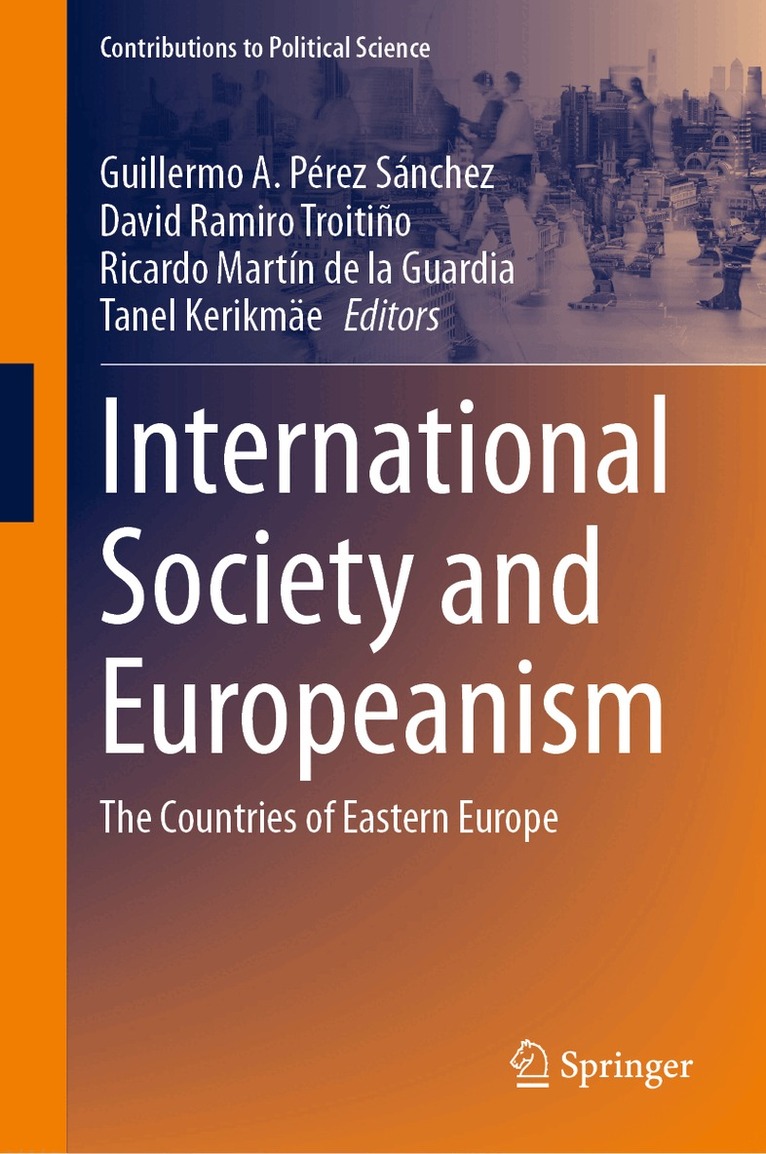
    International Society and Europeanism

    The Countries of Eastern Europe

    AvGuillermo A. Pérez Sánchez,David Ramiro Troitiño

    Inbunden, Engelska, 2025

    Del i serien Contributions to Political Science

    1 460 kr

    Beställningsvara. Skickas inom 10-15 vardagar. Fri frakt över 249 kr.

    Beskrivning

    This pioneering volume examines Europeanism in the new international society that emerged after the First World War through the League of Nations, with a focus on the countries of Central and Eastern Europe (CEE), the Baltic countries, and the Balkans. The book analyzes how Europeanism was consolidated as an argument for the future, especially after the Second World War, when the three strong ideas of Europeanism came to fruition: peace among Europeans, good democratic government, and the socioeconomic welfare of peoples. By doing so, this book offers a comprehensive overview of the evolution of Europeanism and its positive influence in the countries of Eastern Europe, from the interwar period to the present day.The book will appeal to researchers, students, and scholars of political science, international relations, European studies, and history, as well as policy-makers interested in a better understanding of Europeanism and the European integration process of the CEE, Baltic, and Balkan countries.

    Produktinformation

    • Utgivningsdatum:2025-03-02
    • Mått:155 x 235 x 20 mm
    • Vikt:545 g
    • Format:Inbunden
    • Språk:Engelska
    • Serie:Contributions to Political Science
    • Antal sidor:246
    • Förlag:Springer International Publishing AG
    • ISBN:9783031660764

    Utforska kategorier

    • Historia: särskilda händelser och ämnen inom Historia och arkeologi
    • Statsvetenskap och politisk teori inom Samhälle och politik
    • Internationella relationer inom Samhälle och politik

    Mer om författaren

    Guillermo A. Pérez Sánchez is a Professor of Contemporary History at the Department of Modern, Contemporary, American History, Journalism and Audiovisual Communication and Advertising at the University of Valladolid (Spain), and Director of the Institute for European Studies (Jean Monnet Center of Excellence). Previously, he has been a "Salvador de Madariaga Fellow" at the European University Institute of Florence (Italy), where he worked on issues related to European integration. Pérez Sánchez's research focuses on the European ideal, the recent history of the Eastern countries and the former Soviet Union, as well as on relations between the global North and South. He has published various books, book chapters, and journal articles on these topics, including the Springer volumes "The EU in the 21st Century" (2020) and "The European Union and its Political Leaders" (2022) as a co-editor.David Ramiro Troitiño is a Professor at the Tallinn University of Technology (Estonia) and Jean Monnet Chair on Digital Europe and Future Integration. He coordinates a Jean Monnet Network with a multidisciplinary view of the digital integration process in the European Union. He is the author of more than 200 publications, including five Springer books related to European Union topics as an editor and author of several chapters in the books: "Brexit: History, Reasoning and Perspectives" (2018), "The EU in the 21st Century: Challenges and Opportunities for the European Integration Process" (2020), and "The European Union and its Political Leaders" (2022). His research focuses on the European Union from a broad perspective, approaching it as a process. Ricardo Martín de la Guardia is a Professor of Contemporary History at the University of Valladolid (Spain) and a Jean Monnet Professor for the History of the European Union since January 2020. Previously, he was the Director of the Institute of European Studies at the Jean Monnet Center of Excellence, University of Valladolid, between 2009 and  2013. His research focuses on international relations and European integration. Martín de la Guardia is the author, co-author, or editor of various books, journal articles, and book chapters, including the Springer volumes "The EU in the 21st Century" (2020) and "The European Union and its Political Leaders" (2022) as a co-editor.Tanel Kerikmäe is Full Tenured Professor of European Legal policy and Law & Technology at the Tallinn University of Technology. Professor Kerikmäe is a well-known international lawyer and EU scholar who received his academic degrees in law and political science & governance from Tartu, Tallinn, Helsinki and educated himself also in Oxford, EUI, Turku, Cambridge, Strasbourg and Edinburgh. He serves also as a director of TalTech Law School and senior strategist of TalTech Legal Lab, an entrepreneurial hub that consults public and private sector all over the world.

    Innehållsförteckning

    • Chapter 1. Building Europe in a Time of Deconstruction and Destruction.- Chapter 2. The Baltic States and Europeanism in the Interwar Period. The Implementation of a European Model Antagonist to Soviet Structure.- Chapter 3. Exile and Europeanism. Eastern European Exiles During the Years of Real Socialism and Their Influence on the Fall of the Soviet System When the Liberation Revolutions of 1989-1991 Took Place in the Area.- Chapter 4. Central Europe and Europeanism: Divided Germany After World War II, East German Dissidence and Europeanism.- Chapter 5. At the Boundaries of Europe, From the Interwar Period to Post-second World War: Turkey and Europeanism.- Chapter 6. Europe, From the Interwar Period to the Decolonization Process: Anticolonialism and Europeanism?.- Chapter 7. Central Europe and Europeanism: the Case of Czechoslovakia, From the Interwar Period to Its Aspiration for Integration Into the European Community.- Chapter 8. Balkan Europe and Europeanism: the Case of Croatia, From the Interwar Period to Its Aspiration to Join to Community of Europe.- Chapter 9. On the Eastern Border of Europe: the Case of Ukrainian Nationalism, From the Inter-war Period to the Years the Second World War: Towards an Independent Ukraine?.- Chapter 10. The Petite Entente Des Femmes in the Interwar Period and Their Integration Ideas.- Chapter 11. Central Europe and Europeanism: the Case of Hungary, From the Interwar Period to Its Aspiration for Integration Into the European Community.- Chapter 12. Europe’s Importance to Poland During the Communist Period.- Chapter 13. From Europeanism to Europeanisation: Electoral Behaviour in the Baltic States and the Visegrad Group (2004-2024).- Chapter 14. Women in Interwar Period and Europeanism in Central Europe.