• Fri frakt över 249 kr
  • •
  • Snabba leveranser
  • •
  • Billiga böcker
Kundservice

Du är på sajten för privatpersoner.

Företag, bibliotek eller offentlig verksamhet?

Du handlar på classic.bokus.com, där alla dina funktioner finns intakta.
Till classic.bokus.com
Bokus logotyp. Gå till startsidan.
  • Erbjudanden
  • Student
  • Topplistor
  • Barn & ungdom
  • Bokus Play
  • E-böcker
  • Ljudböcker
  • Pocketböcker
  • Spel och pussel

5% studentrabatt – använd koden KURSBOK27 →

Sidfot

Mina sidor

    Hjälp

    • Kundservice
    • Vanliga frågor och svar
    • Frakt och leverans
    • Retur vid ångerrätt
    • Reklamera vara
    • Betalning
    • Köpvillkor
    • Allmänna villkor
    • Information om webbplatsens tillgänglighet

    Om Bokus

    • Om oss
    • Pressrum
    • För studenter
    • För företag
    • För bibliotek och offentlig verksamhet
    • För leverantörer
    • Hållbarhet

    Populärt

    • Aktuella erbjudanden
    • Presentkort
    • Studentlitteratur
    • Nya böcker
    • Topplistor
    • Signerade böcker
    • Engelska böcker

    Inspiration

    • Boktips
    • BookTok
    • Barnbokskaraktärer
    • Populära författare
    Logotyp för Bokus
    Följ oss på Facebook (extern länk)Följ oss på Instagram (extern länk)Följ oss på YouTube (extern länk)Följ oss på TikTok (extern länk)
    bokus @ CookiesAnpassa cookiesIntegritetspolicyKöpvillkor
    Till Citymail hemsida (extern länk)Till Budbee hemsida (extern länk)Till Postnord hemsida (extern länk)Till Schenker hemsida (extern länk)Till Early Bird hemsida (extern länk)Till Walleys hemsida (extern länk)
    1. Data och IT
    2. Systemvetenskap och AI

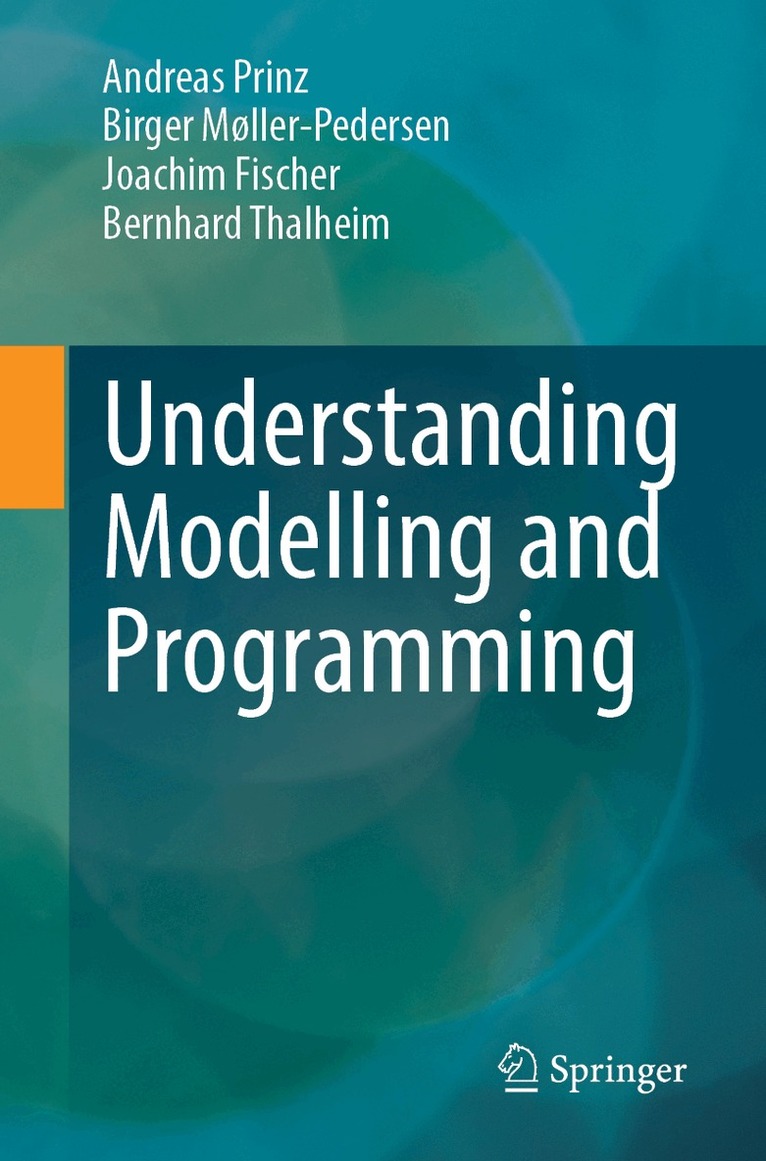
    Understanding Modelling and Programming

    AvAndreas Prinz,Birger Møller-Pedersen

    Häftad, Engelska, 2024

    614 kr

    Beställningsvara. Skickas inom 10-15 vardagar. Fri frakt över 249 kr.

    Beskrivning

    This book provides a concise overview of modelling and programming by presenting their essential concepts. It enables the reader to better understand the relationships between modelling and programming by describing abstract properties, desired behaviours, intended structures, needed interactions, and other specific viewpoints on the overall system under development.After an introduction to the importance of modelling and programming in the scope of system engineering in chapter 1, the book provides four main chapters covering systems, models, specifications, and programs, each of them with a set of reflection exercises. Chapter 2 explores how systems relate to reality, exploring different perspectives related to the purpose of the system. Chapter 3 explains what it takes to be a model and how models and systems are related and concludes with discussing model semantics, meaning, and correctness. In Chapter 4, specifications are debated which are precise descriptions of models and systems. It presents the language constructs needed to describe systems and shows how the constructs can be expressed in concrete languages, considering both the structure and the behaviour of models. Chapter 5 considers the creation, simulation, and correct execution of specifications (model descriptions or programs). Eventually, Chapter 6 presents a collection of real-world modelling cases. Apart from describing the case, the concepts of the book are applied to the case, thus giving a better understanding of the concepts.The book is carefully designed to explain modelling and programming concepts, their relationships, and their use. Written for computer science students and lecturers, it covers systems, modelling, programming, simulation, and semantics.

    Produktinformation

    • Utgivningsdatum:2024-12-30
    • Mått:155 x 235 x 8 mm
    • Vikt:213 g
    • Format:Häftad
    • Språk:Engelska
    • Antal sidor:111
    • Förlag:Springer International Publishing AG
    • ISBN:9783031712791

    Utforska kategorier

    • Systemvetenskap och AI inom Data och IT
    • Programvaruutveckling inom Data och IT
    • Tillämpad datateknik inom Data och IT

    Mer om författaren

    Andreas Prinz is Full Professor at University of Agder, Faculty of Engineering and Science, Department of Information and Communication Technology. He was responsible for the formal semantics of the object-oriented ITU modelling language SDL (specification and description language). Prinz works on system development in various areas like eHealth, eTeaching, and eSports. Specifically, his research revolves around the creation and use of domain-specific languages for modelling, system specification, and system analysis.Birger Møller-Pedersen is a computer scientist and Professor Emeritus at the University of Oslo, Department of Informatics. He published numerous works on object-oriented modelling and programming and worked in many academic and industrial projects. He has contributed to the creation of the BETA programming language (a descendant of Simula), was key in extending the ITU specification and description language SDL to become object-oriented and was involved in the making of UML 2 on behalf of Ericsson and other telecom companies.Joachim Fischer is Professor Emeritus at Humboldt-University Berlin, Department of Computer Science, Chair of Systems Analysis. His focus is on modelling and computer simulation of discrete, continuous and hybrid systems using formal object-oriented languages. He has contributed to various research projects in this area and was very active in standardization committees for object-oriented modelling and programming languages and platforms.Bernhard Thalheim is a computer scientist and Professor Emeritus of information system engineering at the University of Kiel. He is widely known for his work on conceptual modelling and its theoretical foundational contributions. Thalheim has received the Peter P. Chen Award of Elsevier for Entity-relationship model research. His current interest is advancing the state of the art in the use of models for system engineering, moving from programming to modelling.

    Innehållsförteckning

    • 1. Introduction.- 2. Systems and Reality.- 3. Modelling.- 4. Specifications.- 5. Programming.- 6. More Cases.- 7. Summary.