• Fri frakt över 249 kr
  • •
  • Snabba leveranser
  • •
  • Billiga böcker
Kundservice

Du är på sajten för privatpersoner.

Företag, bibliotek eller offentlig verksamhet?

Du handlar på classic.bokus.com, där alla dina funktioner finns intakta.
Till classic.bokus.com
Bokus logotyp. Gå till startsidan.
  • Erbjudanden
  • Student
  • Topplistor
  • Barn & ungdom
  • Bokus Play
  • E-böcker
  • Ljudböcker
  • Pocketböcker
  • Spel och pussel

Pocketfynda! Hundratals böcker för 49 kr/st →

Sidfot

Mina sidor

    Hjälp

    • Kundservice
    • Vanliga frågor och svar
    • Frakt och leverans
    • Retur vid ångerrätt
    • Reklamera vara
    • Betalning
    • Köpvillkor
    • Allmänna villkor
    • Information om webbplatsens tillgänglighet

    Om Bokus

    • Om oss
    • Pressrum
    • För studenter
    • För företag
    • För bibliotek och offentlig verksamhet
    • För leverantörer
    • Hållbarhet

    Populärt

    • Aktuella erbjudanden
    • Presentkort
    • Studentlitteratur
    • Nya böcker
    • Topplistor
    • Signerade böcker
    • Engelska böcker

    Inspiration

    • Boktips
    • BookTok
    • Barnbokskaraktärer
    • Populära författare
    Logotyp för Bokus
    Följ oss på Facebook (extern länk)Följ oss på Instagram (extern länk)Följ oss på YouTube (extern länk)Följ oss på TikTok (extern länk)
    bokus @ CookiesAnpassa cookiesIntegritetspolicyKöpvillkor
    Till Citymail hemsida (extern länk)Till Budbee hemsida (extern länk)Till Postnord hemsida (extern länk)Till Schenker hemsida (extern länk)Till Early Bird hemsida (extern länk)Till Walleys hemsida (extern länk)
    1. Psykologi och pedagogik
    2. Pedagogik
    3. Utbildningsstrategier och utbildningspolitik

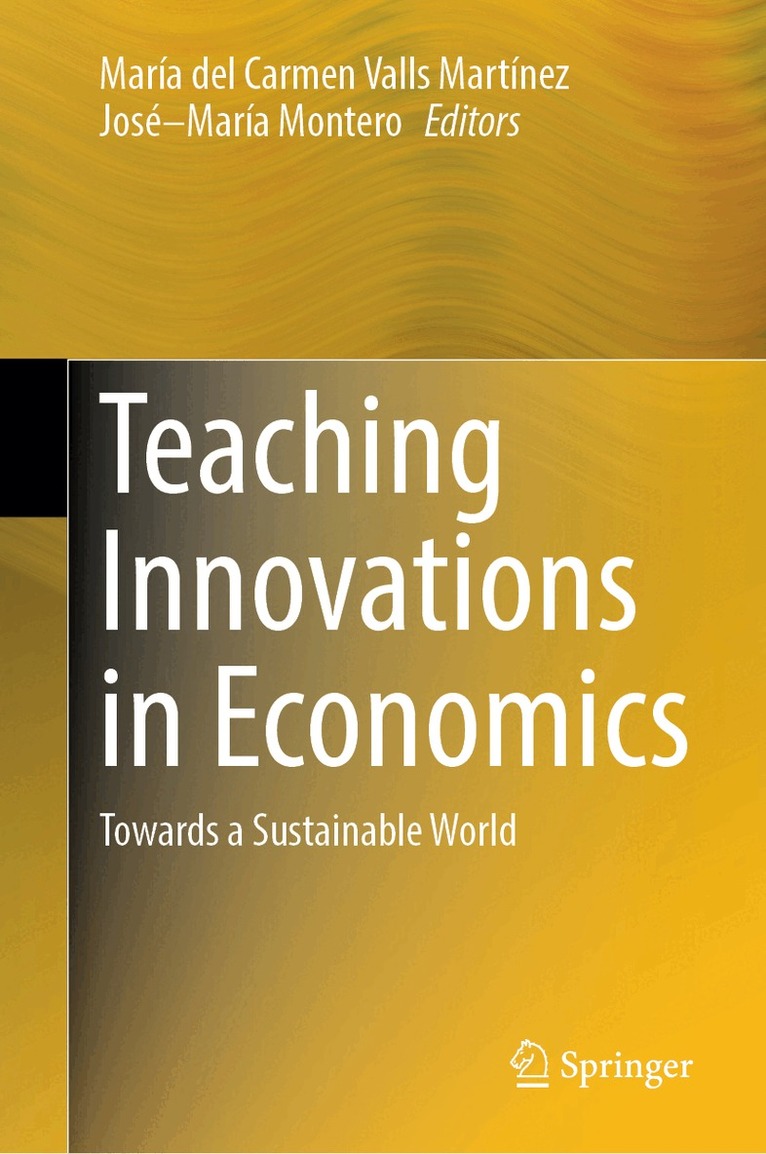
    Teaching Innovations in Economics

    Towards a Sustainable World

    AvMaría del Carmen Valls Martínez,José–María Montero

    Inbunden, Engelska, 2024

    3 221 kr

    Beställningsvara. Skickas inom 10-15 vardagar. Fri frakt över 249 kr.

    Beskrivning

    This book highlights the latest technological innovations in economics education. Economics, as a discipline, not only studies the relationship between ends and scarce means, which can be used alternatively, but also serves as a social science that uses historical data to predict future events—a task complicated by the influence of human behavior. In economics, a solid theoretical foundation alone is insufficient; practical application requires a deep understanding of statistics. With the vast amount of information available today, data processing is now performed using specialized software.Consequently, teaching economics demands a wide range of complex skills that have significantly evolved in recent years, driven by the growing interest in educational innovation among professors and scientists, further accelerated by advancements in new technologies. Moreover, economics education is increasingly aligned with the global concern for sustainability, as emphasized in the United Nations' Agenda 2030. Professors are now integrating sustainability into syllabi and teaching methodologies.This book covers key topics such as:Technological and innovative advancements in economics education.New teaching-learning theories and models in economics education.The impact of digital transformation on economics education.The role of artificial intelligence in economics education.Addressing special educational needs in economics education.Evaluation of the teaching-learning process in economics.Assessment of student learning in economics.Development of materials and tools for economics education.Final projects (Undergraduate and Master's) in economics.Authored by leading professors and researchers in the field, this book presents a collection of chapters that rigorously explore teaching innovations in economics.

    Produktinformation

    • Utgivningsdatum:2024-11-01
    • Mått:155 x 235 x 36 mm
    • Vikt:1 166 g
    • Format:Inbunden
    • Språk:Engelska
    • Antal sidor:580
    • Förlag:Springer International Publishing AG
    • ISBN:9783031725487

    Utforska kategorier

    • Utbildningsstrategier och utbildningspolitik inom Psykologi och pedagogik
    • Nationalekonomi inom Ekonomi och Ledarskap
    • Affärsutveckling inom Ekonomi och Ledarskap

    Innehållsförteckning

    • Introduction.- Part I-New Teaching-Learning Models in Economic Education.- Chapter 1. Pedagogical Framework Targeting the Enhancement of Instruction in Quantitative Economic and Business disciplines.- Chapter 2. Enhancing Teaching Innovations in Business Administration and Management Through Interdisciplinary Coordination in Quantitative Subjects.- Chapter 3. Enhancing Visual Literacy and Data Analysis Skills in Macroeconomics Education: A Beveridge Curve Analysis Using FRED® Data.- Chapter 4. Methodology for Analyzing Educational Forums with NLP: Searching for Economic Terms.- Chapter 5. Adaptive Self-Assessment through the Virtual Campus: A Tool to Improve the Teaching-Learning Process.- Part II-Sustainable Development Goals. Sustainability in Economics Teaching.- Chapter 6. Uncovering the Impact of Developing a Sustainability Mindset on Business and Economics Students’ Motivation to Learn about the Sustainable Development Goals.- Chapter 7. Sustainability Reports in the Classroom.- Chapter 8. Education on Sustainability and Sustainable Development Goals in University Teaching through Community Service Delivery.- Chapter 9. 2030 Agenda and Sustainable Learning: Access to Justice as an Instrument of Guarantee in the Face of the Social Inequalities of Globalisation.- Chapter 10. Climate Change and Emissions Rights: Teaching Experience Using Artificial Intelligence Tools.- Part III-Technology and Innovation in Economics Education.- Chapter 11. Generative Artificial Intelligence in Education: Risks and Opportunities.- Chapter 12. Acceptance of Technological Innovations in Economic Education: Key Factors for Implementation.- Chapter 13. SADMER: A System to Aid the Teaching of Econometric Modeling Using the R Language.- Chapter 14. Scientometrics, Data Science and Teaching Innovations in Economics. Reality or Utopia?.- Part IV-Methodologies and Tools for Active Learning.- Chapter 15. Enhancing Learning in Family Business Management through Art: Integrating Creative Methodologies in Higher Education.- Chapter 16. Peer-to-Peer Training in UAM Economics Faculty to Increase Scores and Motivation, Lower Defection Rates and Boost Employability in the Economy-Business Field.- Chapter 17. Improving Active Learning: Innovation in Statistics Education.- Chapter 18. Exploring the Impact of Problem-Based Learning on the Emotions of Business Administration and Management Students.- Chapter 19. Autonomous Collaborative Learning: Topic Development and Oral Presentation.- Part V-Gamification as a Teaching Methodology.- Chapter 20. The Implication of Expected Grades in the Evaluation of Traditional Pedagogical Materials and Gamification.- Chapter 21. Gamification, Learning and Satisfaction: An Empirical Approach.- Chapter 22. Strengthening Higher Education for Sustainable Development: Gamification and SDG 16.- Chapter 23. Development of Practical Skills in Probability: A Teaching Innovation Project to Make Applied Economics More Fun with Games of Chance.- Chapter 24. Applying a Gamification Technique for Learning Sustainable Finance.- Part VI-Curriculum Design.- Chapter 25. Field Work: Designing a Professionalising Master's Degree in Honduras.- Chapter 26. Attitudes towards Statistics in Business and Economic Studies: Implications for Teaching Innovation in Undergraduate Education.- Chapter 27. Strategies for Innovative Teaching of Entrepreneurship Skills: Developing Business Plans for Undergraduate Final Year Projects.- Chapter 28. The Project for Innovation and Improvement of External Internships in the Faculty of Social Sciences of the University of Castilla-La Mancha at Cuenca.