• Fri frakt över 249 kr
  • •
  • Snabba leveranser
  • •
  • Billiga böcker
Kundservice

Du är på sajten för privatpersoner.

Företag, bibliotek eller offentlig verksamhet?

Du handlar på classic.bokus.com, där alla dina funktioner finns intakta.
Till classic.bokus.com
Bokus logotyp. Gå till startsidan.
  • Erbjudanden
  • Student
  • Topplistor
  • Barn & ungdom
  • Bokus Play
  • E-böcker
  • Ljudböcker
  • Pocketböcker
  • Spel och pussel

Pocketfynda! Hundratals böcker för 49 kr/st →

Sidfot

Mina sidor

    Hjälp

    • Kundservice
    • Vanliga frågor och svar
    • Frakt och leverans
    • Retur vid ångerrätt
    • Reklamera vara
    • Betalning
    • Köpvillkor
    • Allmänna villkor
    • Information om webbplatsens tillgänglighet

    Om Bokus

    • Om oss
    • Pressrum
    • För studenter
    • För företag
    • För bibliotek och offentlig verksamhet
    • För leverantörer
    • Hållbarhet

    Populärt

    • Aktuella erbjudanden
    • Presentkort
    • Studentlitteratur
    • Nya böcker
    • Topplistor
    • Signerade böcker
    • Engelska böcker

    Inspiration

    • Boktips
    • BookTok
    • Barnbokskaraktärer
    • Populära författare
    Logotyp för Bokus
    Följ oss på Facebook (extern länk)Följ oss på Instagram (extern länk)Följ oss på YouTube (extern länk)Följ oss på TikTok (extern länk)
    bokus @ CookiesAnpassa cookiesIntegritetspolicyKöpvillkor
    Till Citymail hemsida (extern länk)Till Budbee hemsida (extern länk)Till Postnord hemsida (extern länk)Till Schenker hemsida (extern länk)Till Early Bird hemsida (extern länk)Till Walleys hemsida (extern länk)
    1. Naturvetenskap och teknik
    2. Geovetenskap
    3. Geovetenskap

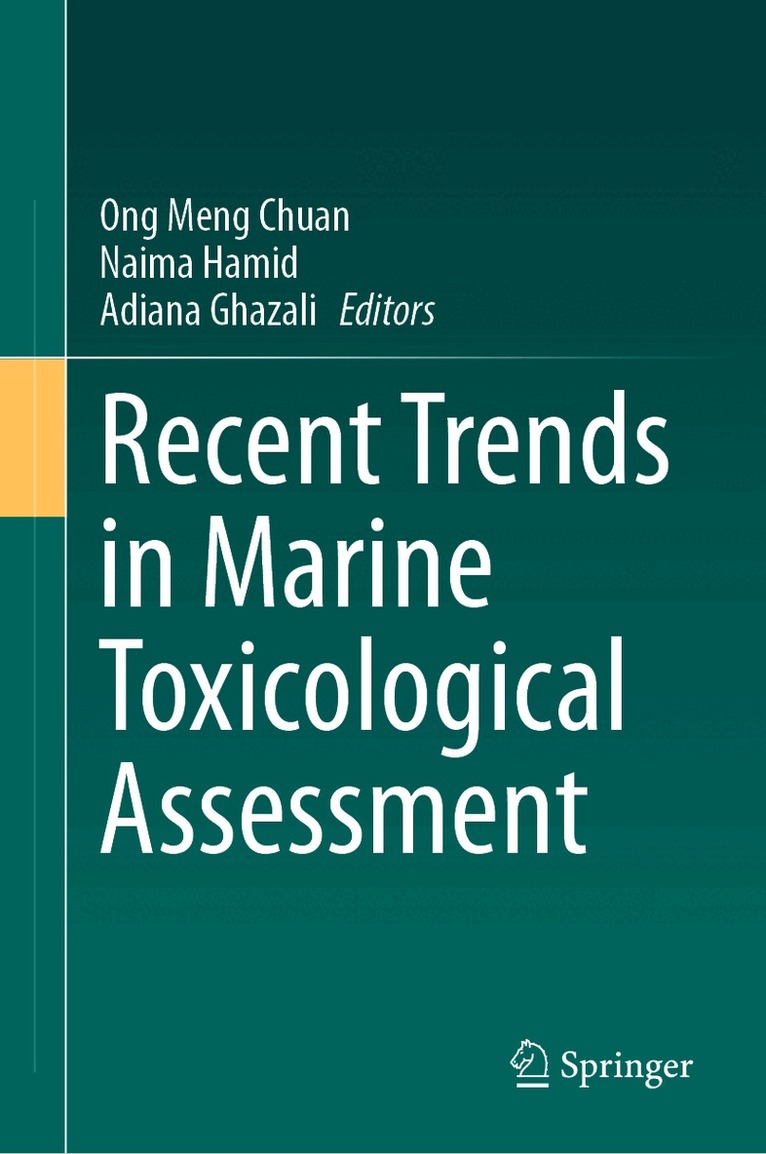
    Recent Trends in Marine Toxicological Assessment

    AvOng Meng Chuan,Naima Hamid

    Inbunden, Engelska, 2025

    2 213 kr

    Beställningsvara. Skickas inom 10-15 vardagar. Fri frakt över 249 kr.

    Beskrivning

    Marine pollution is an escalating global concern, with growing awareness of its severe impact on the world’s oceans. Rapid industrialization and intensified human activities have significantly elevated pollution levels, posing a serious threat to marine ecosystems and biodiversity. This book addresses these critical environmental issues by focusing on advanced methodologies for detecting and assessing marine pollutants. It provides a comprehensive overview of the current state of marine toxicology, emphasizing the importance of innovative approaches to protect ocean health and ensure sustainable marine environments.Combining expert contributions worldwide, this book explores the latest developments in marine toxicological assessment. It begins with discussing the sampling methodologies used for analysing legacy and emerging pollutants in aquatic environments, highlighting the distribution and concentration of these pollutants and their impacts on marine life. The book also introduces the adverse outcome pathway (AOP) framework for microscale toxicity testing, which evaluates the effects of pollutants at various biological levels. In addition, it examines in silico techniques and the Toxicology in the 21st Century (Tox21) concept, which employs a comprehensive approach beyond traditional quantitative structure-activity relationship (QSAR) methods. These advanced techniques are essential for predicting ecotoxicological impacts and ensuring chemical safety in marine ecosystems."Recent Trends in Marine Toxicological Assessment" is designed for a diverse audience, including students, research scholars, and policymakers in environmental science, marine chemistry, marine biology, and biotechnology. It is an invaluable resource for those seeking to enhance their understanding of marine pollution, toxicological assessment, and the latest methods for monitoring and mitigating the impact of pollutants. This book will assist policymakers and environmental managers develop effective strategies to combat marine pollution and protect ocean health. By integrating advanced scientific techniques with practical applications, this book aims to support ongoing efforts to preserve marine ecosystems and promote sustainable practices.

    Produktinformation

    • Utgivningsdatum:2025-03-02
    • Mått:155 x 235 x 31 mm
    • Vikt:992 g
    • Format:Inbunden
    • Språk:Engelska
    • Antal sidor:465
    • Förlag:Springer International Publishing AG
    • ISBN:9783031757129

    Utforska kategorier

    • Geovetenskap inom Naturvetenskap och teknik
    • Miljövetenskap och miljöpolitik inom Naturvetenskap och teknik
    • Farmakologi inom Medicin

    Mer om författaren

    Dr. Ong Meng Chuan is an Associate Professor in the Marine Science Program at the Faculty of Science and Marine Environment, Universiti Malaysia Terengganu (UMT). He holds a doctoral degree in Marine Pollution, specifically metals pollution, from the University of South Brittany, France. He is actively involved in teaching, research, and knowledge transfer programs for communities and school children. He is actively engaged in research and formed a Research Interest Group, Ocean Pollution, and Ecotoxicology (OPEC) Research Group, among UMT researchers and other institutions in Malaysia. He is currently mentoring 5 postgraduates pursuing their Ph.D. and M.Sc. degrees by research. He has successfully guided 9 postgraduate students (3 PhD and 8 M.Sc.) as principal and co-supervisor until project completion and graduation. Besides, he has also supervised 62 undergraduate final-year research projects as the main and co-supervisor. He has published over 80 research outputs in scientific journals, book chapters, and conference papers. He was also appointed an Associate Fellow at the Institute of Oceanography and Environment, UMT. He was also appointed as an evaluator for the Ministry of Higher Education (MOHE) research grant in 2019. In September 2022, he was appointed Head of the Marine Science Program under the Faculty of Science and Marine Environment. Dr. Naima Hamid is a lecturer in the Marine Science Program at the University Malaysia Terengganu (UMT), Malaysia. Previously, she was an Assistant Professor in the Department of Environmental Sciences at Lahore College for Women University, Pakistan. Her research interests primarily focus on ecotoxicology and risk assessment of hazardous chemicals in environmental matrices. She holds the position of the editorial board member of the Science of the Total Environment and Journal of Hazardous Materials. She is involved in teaching, knowledge transfer programs, and activity-based community learning. Dr. Hamid received her doctoral degree from the University of Chinese Academy of Sciences (UCAS), China, with the Chinese Academy of Sciences-The World Academy of Sciences (CAS-TWAS) presidential scholarship for three years (2017-2020). Dr. Hamid has authored and co-authored two books published by Springer Nature Publishers and Bentham Science Publishers. She is an active member of the Ocean Pollution, and Ecotoxicology (OPEC) Research Group, in Malaysia. She has contributed significantly to her field with 44 research articles and book chapters published in indexed and high-impact factor journals.Dr. Adiana Ghazali is a lecturer in the Marine Science Program at the Faculty of Science and awarded the prestigious UMT’s Tuanku Canselor scholarship throughout her doctoral degree and was appointed as a chartered chemist under the Malaysian Institute of Chemistry. Currently, she is actively engaged in community and school-based learning, research, knowledge transfer programs, mentoring undergraduate and postgraduate students, and is a part of the Research Interest Group, Ocean Pollution and Ecotoxicology (OPEC) Research Group, UMT. She has published over 40 research papers in indexed and high-impact journals. Her research interests are focused on understanding metals and rare earth elements with the application of spectrometric and chemometrics techniques in correlation to the geochemistry aspects and water quality in the aquatic ecosystem.

    Innehållsförteckning

    • Part I. Introduction.- Chapter 1. An Introduction to Marine Ecosystem: Environmental and Economic Impacts.- Part II. Sampling Methodology of Pollution Assessment in the Marine Ecosystem.- Chapter 2. Monitoring of the Environmental Indicators in the Marine Ecosystem.- Chapter 3. The Study Methods of the Marine Benthic Community Structures.- Chapter 4. Sampling Procedures for Primary Producers in Marine Ecosystems.- Chapter 5. Approaches to Marine Invertebrate Sampling for Environmental Health Monitoring and Scientific Research: From Methodologies to Applications.- Chapter 6. Sampling Methods of Fish in the Marine Ecosystem.- Chapter 7. Migration and Chemical Transformation of Pollutants in the Marine Ecosystem.- Part III. Microscale Toxicity Testing of Pollutants at Various Biological Levels.- Chapter 8. Tracing the Impact of Heavy Metals on Marine Ecosystems: A Scientometric Analysis of Biological, Metabolic, and Genetic Responses.- Chapter 9. Pharmaceutically Active Compounds (PhACs) in Biota of Asian Countries: Occurrence, Distribution and Health Risk Assessment.- Chapter 10. Molecular Pathways of Emerging Pollutants in the Marine Ecosystem.- Chapter 11. Molecular Pathways of Microplastics in the Marine Ecosystem.- Chapter 12. A Review Notes on Role, Behavior, Risk Assessment Tools and Adverse Outcomes of Metal and Microplastic Pollution in Benthic Sea Food Ecosystem.- Chapter 13. Factors Affecting Bioavailability and Toxicity of Lead, Mercury, Organochlorides, Antibiotics, and Micro- and Nanoplastics in Marine and Oceanic Sediments.- Chapter 14. Nitrate and Coral Reefs in South East Asia.- Part IV. Marine Toxicological Assessment via Qsar-Based Tools.- Chapter 15. Toxicity in the 21st Century (Tox-21): A Multidisciplinary Approach for Toxicity Prediction for Marine Organic Pollutants.- Chapter 16. Predictive Tox-21 Methods for Assessing Emerging Pollutants in the Marine Environment.- Chapter 17. Risk Analysis for the Sungai Buloh River and Estuary.- Chapter 18. Concluding Remarks.