• Fri frakt över 249 kr
  • •
  • Snabba leveranser
  • •
  • Billiga böcker
Kundservice

Du är på sajten för privatpersoner.

Företag, bibliotek eller offentlig verksamhet?

Du handlar på classic.bokus.com, där alla dina funktioner finns intakta.
Till classic.bokus.com
Bokus logotyp. Gå till startsidan.
  • Erbjudanden
  • Nyheter
  • Student
  • Topplistor
  • Barn & ungdom
  • Bokus Play
  • E-böcker
  • Pocketböcker
  • Spel & pussel

10% rabatt på allt med kod NYSTART10 →

Sidfot

Mina sidor

    Hjälp

    • Kundservice
    • Vanliga frågor och svar
    • Frakt och leverans
    • Retur vid ångerrätt
    • Reklamera vara
    • Betalning
    • Köpvillkor
    • Allmänna villkor
    • Information om webbplatsens tillgänglighet

    Om Bokus

    • Om oss
    • Pressrum
    • För studenter
    • För företag
    • För bibliotek och offentlig verksamhet
    • För leverantörer
    • Hållbarhet

    Populärt

    • Aktuella erbjudanden
    • Presentkort
    • Studentlitteratur
    • Nya böcker
    • Topplistor
    • Signerade böcker
    • Engelska böcker

    Inspiration

    • Boktips
    • BookTok
    • Populära bokserier
    • Barnbokskaraktärer
    • Populära författare
    Logotyp för Bokus
    Följ oss på Facebook (extern länk)Följ oss på Instagram (extern länk)Följ oss på YouTube (extern länk)Följ oss på TikTok (extern länk)
    bokus @ CookiesAnpassa cookiesIntegritetspolicyKöpvillkor
    Till Citymail hemsida (extern länk)Till Budbee hemsida (extern länk)Till Postnord hemsida (extern länk)Till Schenker hemsida (extern länk)Till Early Bird hemsida (extern länk)Till Walleys hemsida (extern länk)
    1. Samhälle och politik
    2. Samhälle och kultur

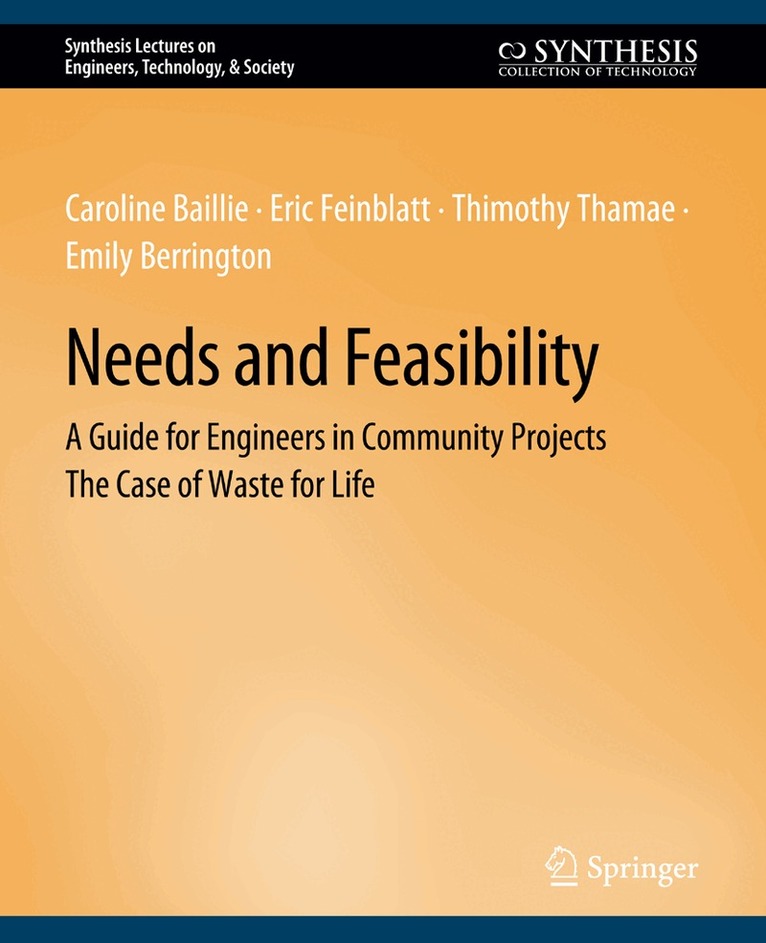
    Needs and Feasibility

    A Guide for Engineers in Community Projects

    AvCaroline Baillie,Eric Feinblatt

    Häftad, Engelska, 2010

    Del i serien Synthesis Lectures on Engineers, Technology, & Society

    309 kr

    Beställningsvara. Skickas inom 10-15 vardagar. Fri frakt över 249 kr.

    Beskrivning

    Needs and Feasibility: A Guide for Engineers in Community Projects -- The Case of Waste for Life is the story of Waste for Life (WFL). WFL is a not-for-profit organization that works to promote poverty-reducing solutions to environmental problems, and its educational branch is an international consortium of universities in six countries, involving students in support of community development projects. WFL currently works in Lesotho and Argentina. We present the story of the development of WFL in each country as a case-based guide to engineers, professors and students interested in community development work, particularly in contexts very different from their own. We focus mainly on the set-up stages, framing the projects to ensure that community needs are adequately articulated and acted upon. We begin with needs assessment, what is it that needs to be done -- for whom and why? How feasible is this, technically, economically, and can we guarantee sustainability? Before we can decide any of this, we need to understand and map the territory -- who are the key players, who have the most influence, and who will be most impacted by what we are doing? What is the role of the local government? If the groups are working as cooperatives, what does this mean, and what are these groups looking for? What is the technical solution going to look like? If it is a product, how will it be marketed? What other social, environmental, and economic impacts will it have and on whom? Once these have all been negotiated, and it is clear that all parties are working towards a mutually acceptable goal, how do we move forward so that any dependence on external partners is removed? When do we bring students into the work? What role can they play? Should they stay at home and support the project from there or is it better to do work in the field? This guide will be useful for the student engineer or the experienced engineer or professor who is interested in moving towards socially just engineering development work but has no idea where to begin. The real difficulties and on the ground issues encountered by the Waste for Life team are presented honestly and with the knowledge that we must learn from our mistakes. Only then can we hope to gain a better understanding of our potential role in supporting community development and move towards a better future. Table of Contents: An Introduction / Assessing the Need in Lesotho / Feasibility of WFL Lesotho / Mapping the Territory in Buenos Aires / Stakeholder Focus: The Local Government / Stakeholder Focus: Cooperatives / Sustainability: Economic, Environmental, and Social / Student Involvement / Summary Thoughts

    Produktinformation

    • Utgivningsdatum:2010-02-18
    • Mått:191 x 235 x 8 mm
    • Vikt:269 g
    • Format:Häftad
    • Språk:Engelska
    • Serie:Synthesis Lectures on Engineers, Technology, & Society
    • Antal sidor:121
    • Förlag:Springer International Publishing AG
    • ISBN:9783031799570
    • Originaltitel:Needs and Feasibility

    Utforska kategorier

    • Samhälle och kultur inom Samhälle och politik
    • Teknik: allmänt inom Naturvetenskap och teknik
    • Pedagogik inom Psykologi och pedagogik

    Mer om författaren

    Caroline Baillie is Professor of Praxis in Engineering and Social justice at the University of San Diego, and co-founding director of the not-for-profit “Waste for Life” (wasteforlife.org) which supports vulnerable communities in the development of upcycled waste-based businesses. Baillie’s research considers socio-technical processes and systems, which enhance social and environmental justice, and educational systems that promote these. She brings lessons learned from these studies and practices into the classroom of all ages, to facilitate the transformation to a more equitable and just future. Professor Baillie has published 27 scholarly books, over 200 book chapters, peer reviewed journal and conference papers, and is Editor of this book series Engineers, Technology, and Society. George D. Catalano is a Professor of Mechanical Engineering at the State University of New York at Binghamton. He holds joint appointments in the Departments of Mechanical Engineering and Bioengineering. In addition, he serves as the director of the university wide honors program at Binghamton. Dr. Catalano earned a Doctor of Philosophy and Master of Science degrees in aerospace engineering at the University of Virginia and a Bachelor of Science degree also in aerospace engineering at Louisiana State University. Prior to his present position, he has served on the faculty at the Air Force Institute of Technology, Wright State University, Louisiana State University, and the United States Military Academy at West Point. He also served as a visiting scholar at the Politechnic in Torino, Italy and at the Technical Institute in Erlangen, Germany. Dr. Catalanos research interests include turbulent fluid flows, low and high speed aerodynamics and experimental methods in physics, modeling ecosystems as well as learning strategies and paradigms, engineering ethics, engineering design and environmental ethics. He is listed in the Philosopher's Index for his published work in animal rights and environmental ethics. Dr. Catalano has over 150 technical and educational publications and has twice been selected as a Fulbright Scholar in recognition of his work in turbulent fluid mechanics.

    Innehållsförteckning

    • An Introduction.- Assessing the Need in Lesotho.- Feasibility of WFL Lesotho.- Mapping the Territory in Buenos Aires.- Stakeholder Focus: The Local Government.- Stakeholder Focus: Cooperatives.- Sustainability: Economic, Environmental, and Social.- Student Involvement.- Summary Thoughts.