E-bok, Engelska, 2025
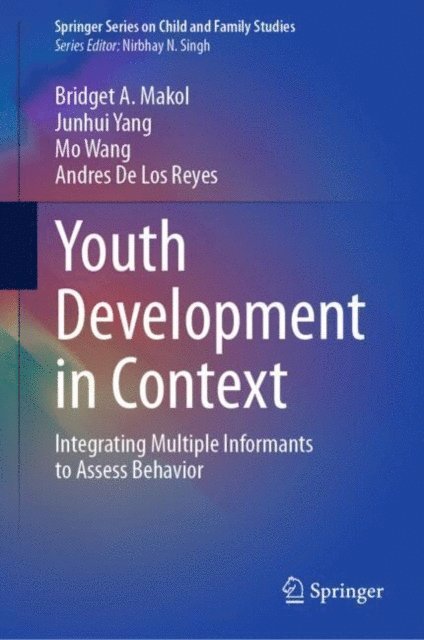
Youth Development in Context
Av Andres De Los Reyes, Mo Wang, Junhui Yang, Bridget A. Makol
2006 kr
Läs direkt i Bokus Reader – eller ladda ned till din enhet
Beskrivning
This book investigates the most common approach to assessing behavior in youth development. It explores use of multiple informants who each observe youth in the social contexts that typify their everyday lives, including parents, teachers, peers, and youth themselves. The volume characterizes the most common outcome from taking this assessment approach — the discrepant results or estimates about behavior that informants’ reports often produce. Grounded in the Operations Triad Model — the foundational framework for contemporary scholarship about discrepant results — this book focuses on strategies that discrepant results compel scholars to implement, namely strategies for integrating these results. The book highlights that the integrative strategies scholars have historically used prevent them from capitalizing on the valid data that discrepant results often contain. This authoritative, thoroughly resourced, and methodologically rigorous book provides readers with integrative strategies that align with scholarship in youth development. In doing so, the book provides readers with a paradigm for testing competing data integration strategies, using a sophisticated suite of Monte Carlo Simulation and measurement validation tools that are applicable to a host of assessment scenarios in scholarship on youth development.
Key areas of coverage include:
- Use of multiple informants to assess behavior in youth development.
- The frequent observation of discrepant results when assessing behavior in youth development.
- Theoretical models for explaining discrepant results in behavior assessments and how they inform strategies for integrating assessment data.
- Key distinctions in the assumptions that underlie the use of competing integrative strategies.
- Application of Monte Carlo Simulation strategies for testing competing integrative strategies.
- Implementation of measurement validation strategies that put competing integrative strategies to the test, within data conditions that typify research in youth development.
Youth Development in Context is an essential resource for researchers, professors, graduate students as well as clinicians, therapists, and other professionals in developmental psychology, social work, public health, pediatrics, family studies, child and adolescent psychiatry, school and educational psychology, and all interrelated disciplines.
This book investigates the most common approach to assessing behavior in youth development. It explores use of multiple informants who each observe youth in the social contexts that typify their everyday lives, including parents, teachers, peers, and youth themselves. The volume characterizes the most common outcome from taking this assessment approach — the discrepant results or estimates about behavior that informants’ reports often produce. Grounded in the Operations Triad Model — the foundational framework for contemporary scholarship about discrepant results — this book focuses on strategies that discrepant results compel scholars to implement, namely strategies for integrating these results. The book highlights that the integrative strategies scholars have historically used prevent them from capitalizing on the valid data that discrepant results often contain. This authoritative, thoroughly resourced, and methodologically rigorous book provides readers with integrative strategies that align with scholarship in youth development. In doing so, the book provides readers with a paradigm for testing competing data integration strategies, using a sophisticated suite of Monte Carlo Simulation and measurement validation tools that are applicable to a host of assessment scenarios in scholarship on youth development.
Key areas of coverage include:
- Use of multiple informants to assess behavior in youth development.
- The frequent observation of discrepant results when assessing behavior in youth development.
- Theoretical models for explaining discrepant results in behavior assessments and how they inform strategies for integrating assessment data.
- Key distinctions in the assumptions that underlie the use of competing integrative strategies.
- Application of Monte Carlo Simulation strategies for testing competing integrative strategies.
- Implementation of measurement validation strategies that put competing integrative strategies to the test, within data conditions that typify research in youth development.
Youth Development in Context is an essential resource for researchers, professors, graduate students as well as clinicians, therapists, and other professionals in developmental psychology, social work, public health, pediatrics, family studies, child and adolescent psychiatry, school and educational psychology, and all interrelated disciplines.
Produktinformation
- Utgivningsdatum: 2025-02-24
- Språk: Engelska
- Filformat: EPUB
- Kopieringsskydd: LCP
- ISBN: 9783031805493
- Förlag: Springer Nature Switzerland
Utforska kategorier
Betyg & recensioner
0 recensioner
Inga recensioner tillgängliga.