• Fri frakt över 249 kr
  • •
  • Snabba leveranser
  • •
  • Billiga böcker
Kundservice

Du är på sajten för privatpersoner.

Företag, bibliotek eller offentlig verksamhet?

Du handlar på classic.bokus.com, där alla dina funktioner finns intakta.
Till classic.bokus.com
Bokus logotyp. Gå till startsidan.
  • Erbjudanden
  • Student
  • Topplistor
  • Barn & ungdom
  • Bokus Play
  • E-böcker
  • Ljudböcker
  • Pocketböcker
  • Spel och pussel

Pocketfynda! Hundratals böcker för 49 kr/st →

Sidfot

Mina sidor

    Hjälp

    • Kundservice
    • Vanliga frågor och svar
    • Frakt och leverans
    • Retur vid ångerrätt
    • Reklamera vara
    • Betalning
    • Köpvillkor
    • Allmänna villkor
    • Information om webbplatsens tillgänglighet

    Om Bokus

    • Om oss
    • Pressrum
    • För studenter
    • För företag
    • För bibliotek och offentlig verksamhet
    • För leverantörer
    • Hållbarhet

    Populärt

    • Aktuella erbjudanden
    • Presentkort
    • Studentlitteratur
    • Nya böcker
    • Topplistor
    • Signerade böcker
    • Engelska böcker

    Inspiration

    • Boktips
    • BookTok
    • Barnbokskaraktärer
    • Populära författare
    Logotyp för Bokus
    Följ oss på Facebook (extern länk)Följ oss på Instagram (extern länk)Följ oss på YouTube (extern länk)Följ oss på TikTok (extern länk)
    bokus @ CookiesAnpassa cookiesIntegritetspolicyKöpvillkor
    Till Citymail hemsida (extern länk)Till Budbee hemsida (extern länk)Till Postnord hemsida (extern länk)Till Schenker hemsida (extern länk)Till Early Bird hemsida (extern länk)Till Walleys hemsida (extern länk)
    1. Data och IT
    2. Systemvetenskap och AI

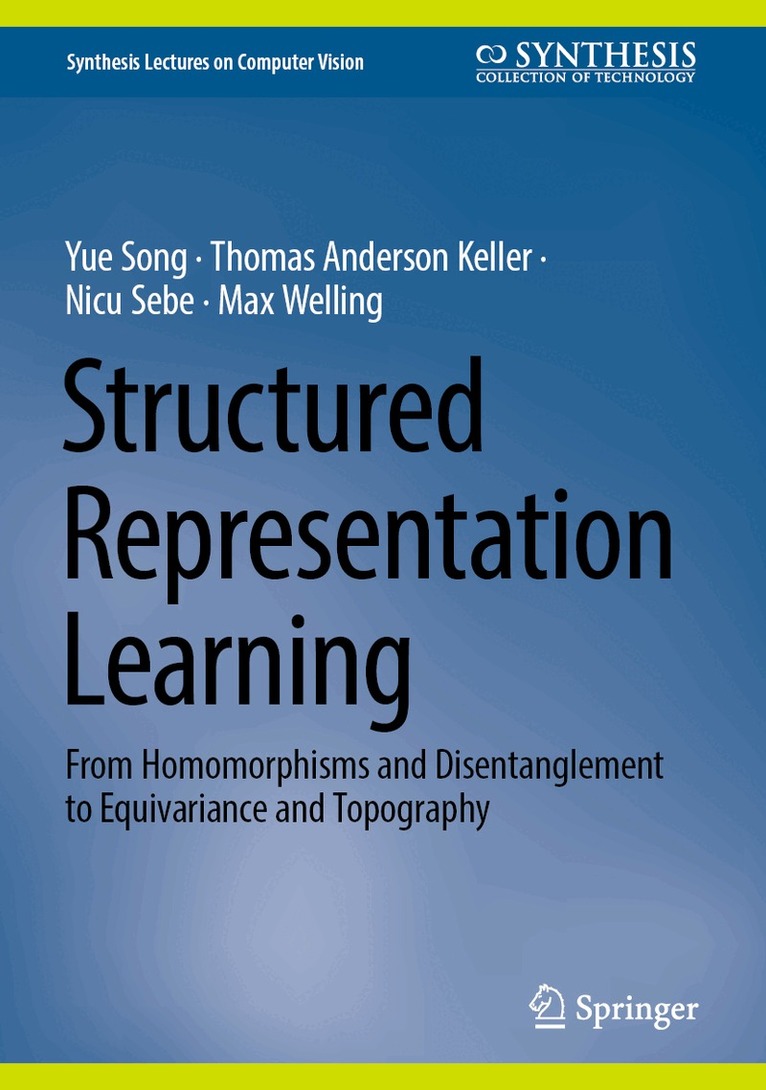
    Structured Representation Learning

    From Homomorphisms and Disentanglement to Equivariance and Topography

    AvYue Song,Thomas Anderson Keller

    Inbunden, Engelska, 2025

    Del i serien Synthesis Lectures on Computer Vision

    489 kr

    Beställningsvara. Skickas inom 10-15 vardagar. Fri frakt över 249 kr.

    Fler format och utgåvor

    Häftad

    504 kr

    Beskrivning

    This book introduces approaches to generalize the benefits of equivariant deep learning to a broader set of learned structures through learned homomorphisms.  In the field of machine learning, the idea of incorporating knowledge of data symmetries into artificial neural networks is known as equivariant deep learning and has led to the development of cutting edge architectures for image and physical data processing. The power of these models originates from data-specific structures ingrained in them through careful engineering.  To-date however, the ability for practitioners to build such a structure into models is limited to situations where the data must exactly obey specific mathematical symmetries.  The authors discuss naturally inspired inductive biases, specifically those which may provide types of efficiency and generalization benefits through what are known as homomorphic representations, a new general type of structured representation inspired from techniques in physics and neuroscience.  A review of some of the first attempts at building models with learned homomorphic representations are introduced.  The authors demonstrate that these inductive biases improve the ability of models to represent natural transformations and ultimately pave the way to the future of efficient and effective artificial neural networks.

    Produktinformation

    • Utgivningsdatum:2025-05-19
    • Mått:168 x 240 x 14 mm
    • Vikt:450 g
    • Format:Inbunden
    • Språk:Engelska
    • Serie:Synthesis Lectures on Computer Vision
    • Antal sidor:140
    • Förlag:Springer International Publishing AG
    • ISBN:9783031881107

    Utforska kategorier

    • Systemvetenskap och AI inom Data och IT
    • Tillämpad matematik inom Naturvetenskap och teknik

    Mer om författaren

    Yue Song, Ph.D. is a Computing and Mathematical Sciences postdoctoral research fellow at Caltech.  He pursued doctoral studies under the European Laboratory for Learning and Intelligent Systems (ELLIS), where he was affiliated with the Multimedia and Human Understanding Group (MHUG) at the University of Trento, Italy, and the Amsterdam Machine Learning Lab (AMLab) at the University of Amsterdam, the Netherlands. He researches structured representation learning, specifically leveraging beneficial inductive biases from scientific disciplines such as math, physics, and neuroscience to improve and explain existing machine learning models.Thomas Anderson Keller, Ph.D., is a postdoctoral research fellow at the Kempner Institute at Harvard University. He completed his doctorate under the supervision of Max Welling at the University of Amsterdam in the Amsterdam Machine Learning Lab (AMLab). His current research focuses on structured representation learning, probabilistic generative modeling, and biologically plausible learning. His research explores ways to develop deep probabilistic generative models that are meaningfully structured with respect to observed, real-world transformations. In the long term, the goal of Dr. Keller’s research is to understand the abstract mechanisms underlying the apparent sample efficiency and generalizability of natural intelligence, and ultimately integrate these into artificially intelligent systems.Nicu Sebe, Ph.D., is a Professor at the University of Trento, Italy, where he is leading the research in the areas of multimedia analysis and human behavior understanding. He was the general co-chair of the IEEE FG 2008 and ACM Multimedia 2013. He was a program chair of ACM Multimedia 2011 and 2007, ECCV 2016, ICCV 2017, and ICPR 2020, and a general chair of ACM Multimedia 2022. He serves as the Co-Editor in Chief of the Computer Vision and Image Understanding journal. He is a fellow of IAPR and of .the European Lab for Learning and Intelligent Systems (ELLIS).Max Welling, Ph.D., is a Research Chair in Machine Learning at the University of Amsterdam and a Distinguished Scientist at MSR. He is a Fellow at the Canadian Institute for Advanced Research (CIFAR) and the European Lab for Learning and Intelligent Systems (ELLIS) where he also serves on the founding board. His previous appointments include VP at Qualcomm Technologies, professor at UC Irvine, postdoc at U. Toronto and UCL under the supervision of Prof. Geoffrey Hinton, and postdoc at Caltech under the supervision of Prof. Pietro Perona. He finished his Ph.D. in theoretical high energy physics under the supervision of Nobel laureate Prof. Gerard ‘t Hooft.

    Innehållsförteckning

    • Introduction.- Background.- Topographical Variational AutoEncoders.- Neural Wave Machines.- Latent Traversal as Potential Flows.- Flow Factorized Representation Learning.- Unsupervised Factorzied Representation Learning through SparseTransformation Analysis.- Conclusion.