• Fri frakt över 249 kr
  • •
  • Snabba leveranser
  • •
  • Billiga böcker
Kundservice

Du är på sajten för privatpersoner.

Företag, bibliotek eller offentlig verksamhet?

Du handlar på classic.bokus.com, där alla dina funktioner finns intakta.
Till classic.bokus.com
Bokus logotyp. Gå till startsidan.
  • Erbjudanden
  • Nyheter
  • Student
  • Topplistor
  • Barn & ungdom
  • Bokus Play
  • E-böcker
  • Pocketböcker
  • Spel & pussel

10% rabatt på allt med kod: NYSTART10 →

Sidfot

Mina sidor

    Hjälp

    • Kundservice
    • Vanliga frågor och svar
    • Frakt och leverans
    • Retur vid ångerrätt
    • Reklamera vara
    • Betalning
    • Köpvillkor
    • Allmänna villkor
    • Information om webbplatsens tillgänglighet

    Om Bokus

    • Om oss
    • Pressrum
    • För studenter
    • För företag
    • För bibliotek och offentlig verksamhet
    • För leverantörer
    • Hållbarhet

    Populärt

    • Aktuella erbjudanden
    • Presentkort
    • Studentlitteratur
    • Nya böcker
    • Topplistor
    • Signerade böcker
    • Engelska böcker

    Inspiration

    • Boktips
    • BookTok
    • Populära bokserier
    • Barnbokskaraktärer
    • Populära författare
    Logotyp för Bokus
    Följ oss på Facebook (extern länk)Följ oss på Instagram (extern länk)Följ oss på YouTube (extern länk)Följ oss på TikTok (extern länk)
    bokus @ CookiesAnpassa cookiesIntegritetspolicyKöpvillkor
    Till Citymail hemsida (extern länk)Till Budbee hemsida (extern länk)Till Postnord hemsida (extern länk)Till Schenker hemsida (extern länk)Till Early Bird hemsida (extern länk)Till Walleys hemsida (extern länk)
    1. Naturvetenskap och teknik
    2. Teknik och industri
    3. Energiteknik

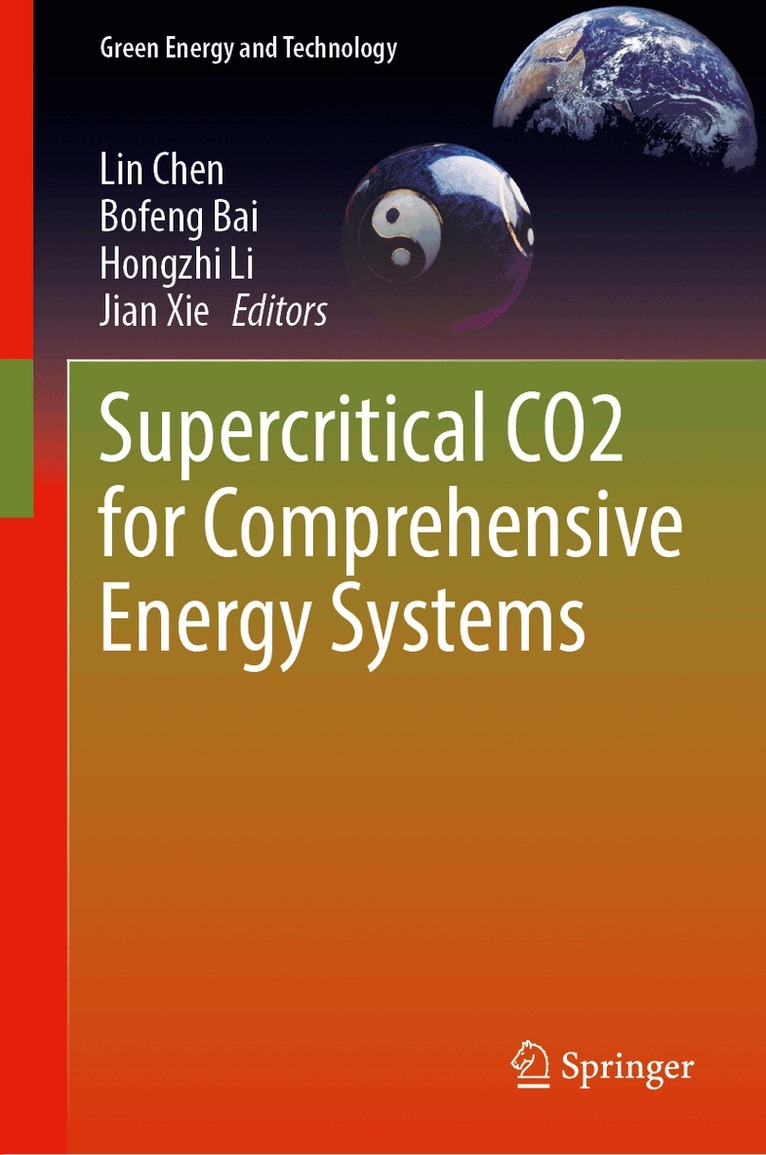
    Supercritical CO2 Power Cycles and Related Energy Systems

    AvLin Chen,Jinliang Xu

    Inbunden, Engelska, 2026

    Del i serien Green Energy and Technology

    2 165 kr

    Beställningsvara. Skickas inom 10-15 vardagar. Fri frakt över 249 kr.

    Beskrivning

    This book is a comprehensive introduction to supercritical carbon dioxide (sCO2) concepts, including its singular flow and heat transfer characteristics, the basic principles of sCO2 power systems, and related challenges and solutions. It also explores how to expand to multi-energy complementary systems based on CO2’s unique properties and introduces the latest research progress. The relevant energy technologies mentioned in this book use CO2 as a medium to reduce carbon emissions in the energy sector, which can help in achieving carbon neutrality worldwide. Supercritical CO2 Power Cycles and Related Energy Systems is an important power and energy engineering reference for students, engineers, and scientists in energy, environmental, and chemical fields. It is also an excellent primer for those in other fields who need a basic understanding of sCO2 power systems.Presents the unique properties of supercritical CO2;Covers novel supercritical CO2 power systems and implementation methods;Explains reducing carbon emissions with carbon dioxide.

    Produktinformation

    • Utgivningsdatum:2026-01-03
    • Mått:155 x 235 x 26 mm
    • Vikt:727 g
    • Format:Inbunden
    • Språk:Engelska
    • Serie:Green Energy and Technology
    • Antal sidor:353
    • Förlag:Springer International Publishing AG
    • ISBN:9783031894664

    Utforska kategorier

    • Energiteknik inom Naturvetenskap och teknik
    • Miljövetenskap och miljöpolitik inom Naturvetenskap och teknik
    • Maskinteknik och material inom Naturvetenskap och teknik

    Mer om författaren

    ​​Lin Chen, Ph.D., is a full professor and Director of the Heat and Mass Transfer Research Center at the Institute of Engineering Thermophysics, Chinese Academy of Sciences, and jointly at the University of Chinese Academy of Sciences, China. He is a board member of the Experts Commission of China Energy Society. Dr. Chen obtained his B.E and Ph.D. from Peking University. He was previously an Assistant Professor at Tohoku University, Japan. His current research topics include new energy and power engineering, CCUS (geological flow), energy resources (gas hydrate, hydrogen), and supercritical fluids. He is currently leading a multi-disciplinary team focusing on CO2 based energy-power system. He has authored over 300 journal papers and/or conference presentations, 20 patents, and five professional books, including Handbook of Research on Advancements in Supercritical Fluids Applications for Sustainable Energy Systems (IGI Global, 2021). He has served 10 times as a Chair/major organizer and 40 times as a plenary/invited speaker at international conferences and symposiums. He won the Young Scholar Award of the Asian Union of Thermal Science and Engineering in 2018, the Research Paper Award of the Visualization Society of Japan in 2022, and the Chenxuejun Paper Award of the Chinese Society of Engineering Thermophysics in 2024. He is currently an Associate Editor of the ASME Journal of Nuclear Engineering and Radiation Science and an Editorial Board member of the Journal of Supercritical Fluids (Elsevier). Jinliang Xu, Ph.D., is a professor in the School of Energy Power and Mechanical Engineering at North China Electric Power University and has been the Director of the Key Laboratory of Power Station Energy Transfer Conversion and System, China. He has over thirty years of experience in multiphase flow and heat transfer. Dr. Xu has obtained visiting positions in Hong Kong, the United States, Singapore, and the United Kingdom. He led the National Key R&D Program of China and the National Basic Research Program of China for ten years. Dr. Xu is active in the field of multiphase flow. He is the editor of the journals Thermal Science and Engineering Progress, Frontiers in Heat Pipe, Water, and Energies. Dr. Xu has been a guest editor for special issues of the journals Energy and Applied Thermal Engineering. He has presented 40 plenary/keynote speeches at international conferences and has been a reviewer for more than 40 journals. He published more than 300 scientific papers and co-authored two books as a corresponding author. Dr. Xu received the Natural Science Award from the Ministry of Education, China, and the Distinguished Contribution Award from the Chinese Society for Electrical Engineering (2021). Jian Xie, Ph.D., is an associate professor at North China Electric Power University, where he is the team leader for advanced power generation system innovation. His research interests include heat transfer of multiphase flow and supercritical fluid, advanced power cycle and low-grade energy utilization, and thermal storage in solar or coal-fired power plants. He published over 40 papers in international journals and obtained over 20 granted patents. Dr. Xie won the IAAM Scientist Award from the International Association of Advanced Materials, the Chen Xuejun Outstanding Paper Award for Young Scholars, and the Young Elite Scientists sponsorship program. He has also delivered 12 plenary/keynote lectures at international academic conferences and was named an Excellent Editorial Board Member of the Journal of Thermal Science in 2022.Jiangfeng Guo, Ph.D., is a Researcher at the Institute of Engineering Thermophysics, Chinese Academy of Sciences. He was a Fellow at Imperial College London and obtained his Bachelor’s degree from North China Electric Power University and his Doctoral degree from Shandong University. His current research interests include the application of fundamental principles of thermodynamics, fluid mechanics, heat, and mass transfer to innovative high-performance heat exchange components, technologies and systems for energy (heat, power, cooling) recovery, utilization, and conversion with an emphasis on the efficient and cost-effective utilization of renewable and waste heat, and solar energy. He has authored over 100 international journal papers and conference presentations. He was awarded the Marie Skłodowska-Curie Fellowship from the European Union. He is an Associate Editor of Frontier in Energy Research and an editorial board member of Frontiers in Heat and Mass Transfer.

    Innehållsförteckning

    • Part 1: Fundamentals of sCO2 fluid nature.- Chapter 1: Analysis of Fluctuations of Supercritical Region CO2 by SANS.- Chapter 2: Preliminary Analysis and Verifications of Supercritical CO2 Complex Phase Behaviors.- Chapter 3: Experimental Study on Critical Flow of High-Temperature and High-Pressure Supercritical Carbon Dioxide at Transient State.- Chapter 4: Experimental Study on Supercritical Heat Transfer Characteristics of CO2/R134a Mixtures.- Part 2: Heat transfer and flow behaviors of  sCO2.- Chapter 5: Experimental and Simulation Investigation on Heat Transfer Deterioration of sCO2.- Chapter 6: Characterization of Flow Dynamic Behaviors of Critical Size Nozzle Flow of Supercritical CO2 for Power Systems.- Chapter 7: Dynamic Mode Decomposition Study of Transient Heat Transfer Behavior of Turbulent Boundary Layer in sCO2 Channel.- Chapter 8: Study on the Flow and Heat Transfer Characteristics in Manifold Microchannels with Column-Row Structures.- Chapter 9: Numerical Investigation of Jet Impingement on Concave Cooling of sCO2 under Different Heat Flux.- Part 3: Equipment design and analysis of sCO2 power cycles.- Chapter 10: Investigations of Longitudinal Conduction Effect on Heat Transfer Performance.- Chapter 11: Simulation Analysis of Thermal-hydraulic Performance and Heat Transfer Enhancement Structure.- Chapter 12: Heat Transfer Characteristics and Calculation Method of Supercritical CO2 Boiler.- Chapter 13: Study on Performance Prediction of Supercritical CO2 Compressor.- Chapter 14: Thermal Elasto-Hydrodynamic Lubrication Characteristics Analysis.- Chapter 15: Numerical Investigation of a Novel Gravity-driven Moving Bed Reactor.- Part 4: Performance assessment and multi-energy applications.- Chapter 16: System Simulation on Semi-closed Supercritical CO2-mixture.- Chapter 17: The Economics of Wind Photovoltaic Storage System.- Chapter 18: Off-design Characteristics of Equipment on Optimization.- Chapter 19: Investigation of Trans/supercritical CO2-based Mixed Working Fluids Cycle Performance.- Chapter 20: Dynamic Performance Analysis and Control Strategy of Supercritical CO2 Waste Heat Recovery System.- Chapter 21: Thermodynamic Optimization of Supercritical CO2 Brayton Cycles.